Discipline makes Daring possible.

Give it up.

Give it up.

You start your own business to take back control.   To be at nobody’s beck and call.   To do what you think is right by your clients.

Once you get good at that, you outsource key functions, take people on to help you deliver, and suddenly, you’ve lost it.   The control has gone.   You’re at the beck and call of clients, or team members, or suppliers, and it seems impossible to get people to do things the way you would.

A natural reaction is to tighten your hands on the reins, supervise more, intervene more, even to redo the work.

Micromanagement doesn’t work.   You only end up working harder, being a nag, and training your people to give up trying.

Instead, give control away as soon as you can.

Not by abdicating, not even by handing it over to superstar colleagues, but by installing your DNA into the way the business works, so that it works the way you want it to when you’re not in the room.

Strangely, creating this kind of control is liberating:

  • For your people, because they know the outcomes they are aiming for, and what needs to happen to achieve them, plus they have the freedom to do that with flair and personality.
  • For you, because you can relax your vigilance, and concentrate on growing and evolving your business.
  • For your business, because its no longer dependent on the individuals who happen to be there at any one time.

We call this writing your Score.  Because once you’ve written it, the music you and your orchestra are creating now can last forever, no matter who plays it, or how.

If you want to take back control, start by giving it all away.

“What would happen if we removed all Managers?”

“What would happen if we removed all Managers?”

Lisa Haggar started a lively discussion on this topic on LinkedIn today:

https://www.linkedin.com/posts/lisa-haggar-540a68117_whatnomanager-selfmanagement-timesarechanging-activity-6687251785352024065-esUl

Of course I had to join in.

Why not join in too?   I’d love to know what you think.

Thinking about flywheels, again.

Thinking about flywheels, again.

I’ve been thinking about flywheels again.

Here’s one I drew to illustrate what I can do for a business:

A business freedom flywheel

Does that make sense to you?

Do let me know.

Mintzberg revisited

Mintzberg revisited

A while ago,  I wrote about Mintzberg’s continuum of management, which looks something like this:

I’ve been thinking, and I think it should look like this:


What do you think?

Wilful Blindness

Wilful Blindness

I’ve just finished reading this book, the first of 3 I ordered after hearing Margaret Heffernan on the radio last week.

It’s a worrying and challenging read, exploring and explaining just how naturally easy it is for we humans not to see what’s in right in front of our eyes.

The reasons are varied, from feelings of affinity or love, wanting to fit in or please people in authority, too rigid systems, distance and disconnection, the bystander effect, a narrow focus on money or sheer cognitive overload and exhaustion.   Sometimes, in the worst scenarios, such as Grenfell Tower or Texas City, several reasons combine and exacerbate each other.

The answer is to make ourselves see better. Systematically, intentionally, but never mechanically.

We do that by encouraging diversity of thinking and argument, by thanking whistleblowers, complainers and critics instead of sidelining them.

We do it by constantly reminding ourselves of what we are in business to do – to make and keep promises to human beings, our customers, and by eliminating the hierarchies, silos and long chains of command that get in the way of that.

We do it by creating transparent ways of working that keep our promise visible and support people to hold each other accountable as human beings for seeing what’s really there, and acting on it.

And of course the irony is that if we do these things well, we will create more value and do better financially.  Because its not only bad things we make ourselves wilfully blind to, its also opportunities.

Amnesia

Amnesia

We’ve all suffered from it.  Corporate amnesia.   You call a company you’ve done business with for years, and give them your name, address, and inside leg measurement 3 of 4 times before you get to the point of the call.

A more insidious form of corporate amnesia forces a team member to recall the process before they perform a task, instead of having the system remember it for them.

This kind of amnesia results in variation over time and between team members.    Sometimes the variations will be improvements, but most often they are an ever-worsening copy of a long-forgotten original, void of life or meaning.    Any improvements are forgotten, because the organisation has no way to capture them or remember them.

This isn’t just amnesia, its also akrasia – doing one thing when you should be doing another.

Because if you’re too busy remembering what’s supposed to happen, you aren’t making it happen.

Akrasia – doing one thing when you should be doing another

Akrasia – doing one thing when you should be doing another

I learned a lovely new word yesterday.   ‘Akrasia’.   It means doing one thing when you should be doing something else.

I’m guilty of that all the time, sometimes as a form of procrastination (I know I should eat my frog, but I’ll just have ice-cream first), occasionally as a form of hiding (doing the easy thing, because the hard thing is scary).

But whole companies are guilty of akrasia too.   They spend time, money and attention instructing down and reporting up the management hierarchy, when they should be making and keeping promises to the people they serve instead.

The solution is simple.

Structure your business around doing, not monitoring.

Flywheels

Flywheels

If you’ve ever started up a spin bike, you know about flywheels.

They take a lot of effort to get going, but once they’re off, the energy you put in is released, making it much easier to keep momentum going for longer.

That’s a pretty good metaphor for building a system for making and keeping promises.   It takes effort to get up and running, but once it is, it can keep going almost forever.

Long after you’ve jumped off the bike.

This isn’t my utopia

This isn’t my utopia

The thing I love about reading, is that I’m always finding new ways of saying things, from people who can say them much better than me.

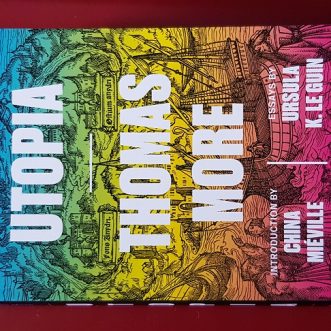
This midsummer weekend, I finally got round to reading the Verso edition of Utopia, by Thomas More.  It was not More’s words that struck me, but Ursula K. Le Guin’s – in fact not always her words, but words she assembled, interpreted and discussed in the first of her essays included with this book: “A non-Euclidean View of California as a Cold place to be”.

“The activities of a machine are determined by its structure, but the relationship is reversed in organisms – organic structure is determined by it’s processes”*

“The societies which have best protected their distinctive character appear to be those concerned above all with persevering in their existence.”**

“Persevering in one’s existence is the particular quality of the organism; it is not a progress towards achievement, followed by stasis, which is the machine’s mode, but an interactive, rhythmic, and unstable process, which constitutes an end in itself.”

“Since the day of the Roman empire and the Christian church, we hardly think of a social activity except as it is coherently Organized into a definite unit definitely subdivided.   But, it must be recognized that such a tendency is not an inherent and inescapable one of all civilization.”***

I (like Le Guin) found Thomas More’s Utopia unsatisfactory.   It is founded on force and maintained through slavery.   It’s activities are determined by its structure.   It is like most utopias,“the product of ‘the euclidean mind’ (a phrase Dostoyevsky often used), which is obsessed by the idea of regulating all life by reason and bringing happiness to man whatever the cost.”****

Here’s a stab at pulling this all together into something relevant for me as Gibbs & Partners:

  • Most human beings, including business owners, are simply trying to persevere in their existence.
  • Most corporates, built as machines, where structure determines process, are inimical to this.   Which is why people, when they get the chance, retire, or leave and set up their own small businesses, often with no idea of growth, simply as a means of persevering in their existence.
  • What I’m making explicit and to an extent formalising, is an alternative, organic view of a business where process (the making and keeping of promises) determines structure.   An alternative Le Guin might call yin.
  • By formalising this structure,  I’m trying to create a blueprint for documenting the ‘laws’ of a business that enables it to be both a place where people can  persevere in their own existence and a generator of the growth, innovation and profit that will create more spaces for more people to persevere in theirs.  A place where it’s possible to enjoy both freedom and happiness.
  • I’m by no means the only person I know of trying to do something like this.  I’m part of a trend, that recognises the need for humanity to make “a successful adaptation to their environment and learn to live without destroying each other.”****

As Derek Sivers puts it:

“When you make a business, you get to make a little universe where you control all the laws.  This is your utopia”.

Welcome to mine.


*Fritjof Capra, The Turning Point (New York: Simon & Schuster, 1982). Excerpted in Science Digest (April 1982), p. 30.

**Claude Levi-Strauss, The Scope of Anthropology (London: Jonathan Cape, 1968), pp. 46-47. Also included in Structural Anthropology II (New York: Basic Books, 1976), pp. 28-30. The version here is Le Guin’s own amalgam of the two translations.

***Alfred L. Kroeber, Handbook of the Indians of California, Smithsonian Institution, Bureau of American Ethnology Bulletin no. 78 (Washington, D.C., 1925), p. 344.

****Robert C. Elliott, The Shape of Utopia (Chicago: University of Chicago Press, 1970)