Discipline makes Daring possible.

Reminders

Reminders

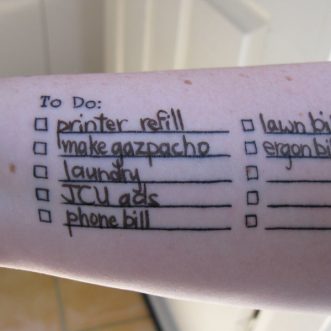
We like to remind ourselves of what we have ‘to do’.   But we all too easily forget the why behind them.   It’s easy to get derailed by happenstance and other people’s agendas.    This isn’t helped by systems that focus on tasks rather than outcomes.

True productivity (adding value) is driven by focusing on the why.   What if you built a system that constantly reminds people of that?

Given the why, they can probably work out the best thing to do next.

Watching other people work

Watching other people work

I must confess to having a bit of a thing about phone answering services.   Not because I dislike them, but because I think they are one of those things that can really enhance the customer experience when done well.

You can always tell when someone is using an answering service, because you get asked more questions that you often would, and you can tell there’s a process going on.  That’s a good thing, something more businesses that answer their own phones should learn to do.   It would save a lot of miscommunication.

When someone providing this service does it really well, I have a genuine conversation.   I am allowed to ramble a little about why I’m calling (the person I want to speak to knows I’m due to call and why), but they still get from me (not necessarily by asking me) the information they need to pass on the message – my name (including how to spell it), my business name, why I’m calling and who I want to speak to, and finally how they can get hold of me.

I can even have a separate conversation about the fact that they provide the service, which is how I found out who they were.

Its a pleasure to participate in someone doing their job with commitment intelligence and humanity.   Its an enjoyable experience for me as customer, prospect or supplier as well as for the person doing it.

That’s why your Customer Experience ScoreTM needs to cover everything.


PS the company was Take My Calls.   When my current credit runs out, I’ll be switching to them.

Playing A Role

Playing A Role

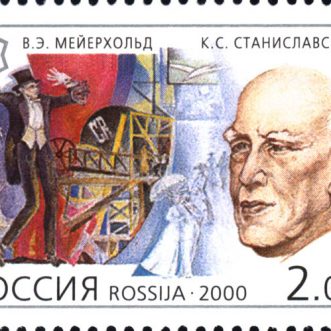
I’d heard of ‘The Method’ – a way of acting designed to help actors deliver more ‘authentic’ performances by mining their own emotions – “to plumb past trauma, joy, grief, euphoria, and relive those feeling states each night on the stage.”

Until yesterday, when I read this article  by William Justice Bruehl, I hadn’t heard of the person who originally came up with it – Constantin Stanislavski – and certainly hadn’t heard that he revised his ideas in later life.

His new idea was much less emotionally draining for actors.   Simply put, the idea is to “study the text and articulate what their character struggles to achieve – the character’s ‘objective’ – throughout the whole play, in every scene, and then to simply note what the character should feel along the way.”  In other words, to put yourself in the character’s shoes, and follow the logic of the story they are telling themselves.  Different interpretations of the character’s underlying objective will lead to different interpretations in performance – even though the words stay the same.

This seems to me to be a useful and doable approach for non-actors playing a customer-facing role too.   A combination of discipline (the text) and freedom (to divine the ‘objective’ of the person in front of me right now), that makes for a more fulfilling experience for both sides.

You need a text though, otherwise nobody makes sense.

PS I recommend Psyche as a source of interesting things to read.

Related

Related

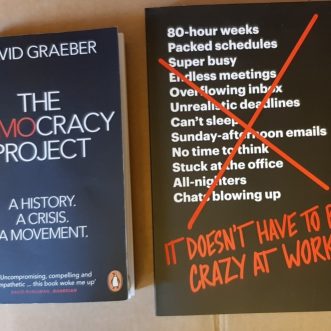
This was last weekend’s reading.

Strangely enough, they are related.  I recommend reading them together.

One percent

One percent

The very best question I know for improving your process for making and keeping promises is this one:

“How can we make this 1% better today?”

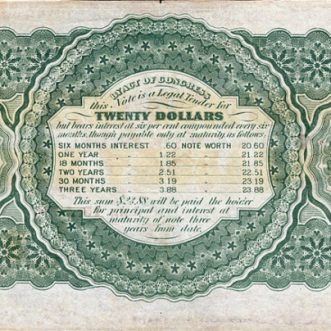
1% seems like a pathetic target for improvement until you realise it compounds.

Compounding works in any direction of course, so it helps to frame the question in the direction you want without tying down the ‘how’.   This takes some thinking about, but is well the effort.

Hiut Denim (who gave me the idea) has this one, for example:

“How can we reduce the environmental impact of our jeans today?”

Tiny, daily, incremental improvement are easy to start, easy to keep going as a habit, and add up sooner than you think to a ‘better’ that’s far bigger than you could ever have dreamt of.

What would your question be?

Which, What and How

Which, What and How

You’d think that Keeping your Promise is easy to do.   That’s true when everything is going to plan, but when times are hard, or the unexpected happens, it may not be so easy.  It may even be impossible.

It’s at these times that questions can help you hold yourself to account for what you do and the way you do it:

  • Which parts of my Promise of Value are sacrosanct?

If you have more than one set of stakeholders (and it seems to me you’ll always have at least 5 – customers, employees, shareholders, suppliers, your community), then you can also ask:

  • What’s the unbreakable promise you make to these people?  (In this podcast, Brian Chesky talks to Eric Ries about making 2 or 3 unbreakable promises to each set of stakeholders)

When you know the answers to these questions, you can ask further, practically useful ones:

  • Which part(s) of my Promise does this activity demonstrate and uphold?
  • Which part(s) of my Promise does this activity contradict or undermine?    If it does, how can I bring it into line?  Could I do something different?   Could I do it differently?

If everyone in your business is in the habit of asking these questions in the good times, you’ll be well able to do the right things, the right way, when things are bad.

Where, Who, When and What.

Where, Who, When and What.

We’ve already seen that motivation isn’t enough to lead to action.   It needs to be combined with ability.  But motivation plus ability alone is still not enough.  We also need prompts, says B J Fogg, behaviour designer and author of ‘Tiny Habits‘ .

We need to be triggered into doing things we are motivated and able to do.

That means that Sharing your Promise is all about finding the motivated and able, and prompting them to take action.

So, some questions that might help here are:

  • Where do the motivated and able people you seek to serve hang out?
  • Who do they hang out with?
  • Where do they go for help and advice?
  • Who do they trust?
  • Who do they look up to?
  • When are they most receptive to a prompt?
  • What makes an effective prompt?

Prompting someone to do what they already want to do feels much better than ‘selling’ doesn’t it?   Especially if you’ve already worked out how to make it easier for them too.

Making maps

Making maps

“There are known knowns; there are things we know we know.  We also know there are known unknowns; that is to say we know there are some things we do not know.  But there are also unknown unknowns—the ones we don’t know we don’t know. .. it is the latter category that tend to be the difficult ones.”  Donald Rumsfeld

Part of any consultant’s job is to formalise the known knowns and the known unknowns.   To map out the worldview a business owner is working within so that they can share it with their teams, giving them routes to follow.

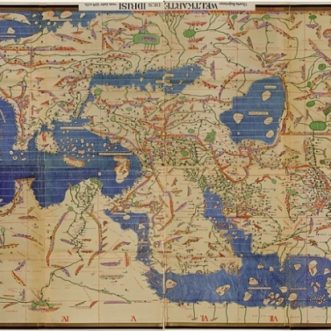
In doing that, we achieve something even more important – we surface the unknown unknowns – the areas of the map that have up to now been blank, or worse, have become the abode of monsters signalling ‘Don’t go there‘.  And by turning the ‘unknown unknown’ into a ‘known unknown’, we break through to new territories for the business to explore and expand into.

For me, the brilliant thing is that all it takes to achieve all this is questions.  So this week I’m going to share some of the best mapmaker questions I know, organised around my map of a business:

I hope you’ll join me on the journey.

I’d lose control

I’d lose control

The only way to scale a business that is built around you is to embed the ‘you’ into the way the business works, so that everything about it reminds your prospects and clients of you, even when you are not in the room.

That means enabling and empowering other people to do what you do, as well as or better than you do it.  That isn’t losing control, it’s just putting the control in a different place – into the fabric of the business, instead of one or more people’s heads.

Perhaps what’s really behind the worry of ‘losing control’ is the fear of becoming less important to the business.  After all, if it can get on perfectly well without you, where does that leave you, the founder, the originator of the vision?  The irony is of course, that the more you dig your actual self into the business, the less able it will be to survive without you.   All too often, an amazing little business fizzles out with the life of its founder.   To my mind, it’s almost criminal to let that happen.

Done well, composing your Customer Experience Score puts you right where you belong – embedded into the heart and soul of the business, without actually having to be present day to day.   It’s not just your prospects and clients that will be reminded of you every time they interact with your business, your people will be reminded too.  Even those who haven’t joined yet.

Dale Carnegie has been dead a long while, but the business he founded carries on as world-wide empire, with his vision and philosophy firmly ensconced at its heart.

Isn’t that something worth giving up hands-on control for?
No one else is doing it

No one else is doing it

Of course ‘Nobody else is doing it‘, is really an observation about risk, not isolation.   Most of us don’t like to go first, for fear of looking stupid.   Unlike my beloved, who, faced with a marquee-full of Cornish pasties and cream teas at the grand opening of the Eden Project, boldly stepped forwards with the words “My mum would expect it of me” – and broke the ice for everyone else, hesitating hungrily on the periphery.

So the real answer to ‘Nobody else is doing it‘ is ‘What’s the worst that can happen?‘.   The best that can happen is that you get results that the waiting others couldn’t dream of, and you get them first.

If you do what everyone else does, you’ll get what everyone else gets, maybe less.   Provided the downside isn’t too damaging, it’s worth taking the leap.   Then the very best that can happen is that you break the ice for the others, and everyone benefits from your lead.