Discipline makes Daring possible.

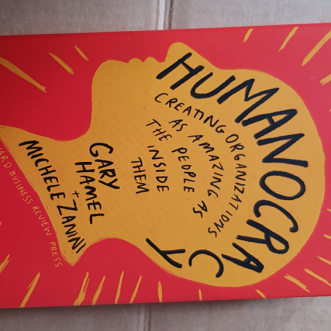
Humanocracy

Humanocracy

This arrived yesterday evening (see why I need an extension?).

The promise is to “show you how to create an unstoppable movement to create an organization that’s fit for the future and fit for human beings.”

I’m looking forward to reading it, although I suspect it won’t go far enough for me.

I’ll keep you posted.

There’s nothing new under the sun

There’s nothing new under the sun

A coal mine isn’t the kind of place that springs immediately to mind when you think of innovative, even revolutionary forms of management, but as the Corporate Rebels shared today, that’s exactly what Eric Trist found at Haighmoor Colliery, way back in the 1940s.

The article is well worth a read, but what really resonated for me were these highlights:

  • “Miners were recognised for ‘cycle completion’: meaning being jointly responsible for the whole extraction process.”
  • “The miners not only ran the mining job. They also took care of selling the coal they mined. They were responsible for the product they produced.”
  • “a reward policy based on a basic wage and a bonus linked to productivity of the group throughout the extraction cycle, rather than a single shift.”
  • “Each miner at Haighmoor could handle a half-dozen jobs. That meant each could take on multiple team roles.”
  • “All teams were multidisciplinary.”
  • because the miners could influence their own work, they continuously innovated.”

Observing these work practices, Eric Trist and his former coal miner colleague, Ken Bamforth, called the whole thing practising “responsible autonomy”.

Sound familiar?

Which begs the question:

If we already know that responsible autonomy works, why aren’t we practising it more often?

Mash-ups

Mash-ups

Humans love mash-ups.   Collisions of disparate ideas to form a new, even more interesting idea.    Given the chance, we mash-up all the time – most obviously to make each other laugh.

Surprisingly often, a mash-up leads to a breakthrough, and even more often, these breakthrough mash-ups come from an outsider asking a ‘stupid question’ – “Why can’t I see the picture now Daddy?”, “Why can’t I cast iron the way I used to cast brass?“.

If you’re running a business, you want mash-ups to occur, but not at the expense of delivering on your promises.   So how can you achieve a balance?

  • Keep your Promise of Value tight.
  • Keep your Customer Experience Score loose.
  • Recruit from as diverse a pool of experience, mindset, interests and backgrounds as you can.
  • Admit only those who buy into the Promise.
  • Leave room for randomness.
  • Create a process for capturing, testing, building and rewarding mash-ups that help you fulfil your Promise better.
  • If someone comes up with a great mash-up that doesn’t fit your Promise, help them to turn it into a new business.

Sparked by ‘Rebel Ideas’ by Matthew Syed, recommended and kindly given to me by Nigel Whittaker.

Recipes do not a restaurant make.

Recipes do not a restaurant make.

I enjoy cooking, and do it every day.

When I make lunch, sometimes I follow a procedure (a recipe), but mostly I use techniques and rules of thumb I’ve learned over the years to create a simple, one-course meal out of whatever I happen to have at the time.

This kind of cooking is fine for my lunch.   My ‘Promise of Value’ to my husband is a tasty, filling and nutritious lunch.   He doesn’t really care how I get there.

For Sunday dinner though, I need more than a procedure and a set of techniques.   I’ll use several procedures (roast chicken, yorkshire pudding, accompanying vegetables, pudding), and loads of techniques (roasting, making a batter, boiling, steaming, baking).

But the thing that really makes Sunday dinner work is that I co-ordinate all the main course procedures so they finish at the same time, while pudding arrives at just the right interval later.   That’s what I call a process.

Now imagine I want to open a restaurant.

Even with a limited menu, I’ll have different tables working at different timescales, with different options.   Not only do I have to get meals cooked on time, I’ll need to make sure there are enough clean tables, dishes and cutlery.   I’ll need to greet guests, take orders, offer drinks, and serve dinners.    Several of them, all at once.

In other words one overall process (Lunch) is actually the co-ordination of multiple instances of several processes, which are in turn the co-ordination of several procedures – all designed to deliver the same Promise of Value (“Sunday Dinners like your Mother used to make”).

If I don’t work out what those processes should be, so I can deliver my Promise effectively for less than I charge, I won’t have a restaurant for long.  If I design them to over-deliver for less than I charge, I’ve got the start of a restaurant chain.

‘Process’ is a word that’s bandied about quite a bit.   Like all jargon it can be misused or misunderstood, but it’s definitely bigger than a recipe.
The artist’s hand

The artist’s hand

“They say that truth is naked. I cannot admit this for any but abstract truths; in the arts, all truths are produced by methods which show the hand of the artist.” Delacroix, ‘Journal’.

Your business is your art, your Promise of Value is your truth.    Let your people be your fellow artists, and show their hands in the work.


HT to Project Gutenberg for tweeting this.  They happen to be a brilliant open source for free e-books.

As-is, Should-be

As-is, Should-be

Mozart didn’t write down his music ‘as-is’ before writing it again as ‘should-be’.

Of course not.

Like all composers, Mozart started with what he wanted the audience to hear, the ‘should-be’, translating as closely as he could what he had in his head into musical notes on paper.

I doubt if his first result was the only one.

Once you’ve got your Customer Experience Score written down, it doesn’t matter that it started as ‘should be’.   The job now is to make it your ‘as-is’, then to continually evolve it in line with the best ‘should-be’ you and your people can imagine.

Idiot-proof

Idiot-proof

“I try to invest in businesses that are so wonderful that an idiot can run them. Because sooner or later, one will.”  Warren Buffet.

There are 2 ways to make a business idiot-proof.

One is to build a business that generates and shares real value, making and keeping promises to customers and continually improving how it does that.   All protected from a potential ‘idiot’ at the top, because there is no top.   The people who do the business run the business, the way an orchestra plays a symphony, without needing a composer to be present.

The other way is to build and protect a racket, a monopoly (Buffett calls this ‘putting a moat around the business‘), that can’t help but make extraordinary profits, no matter who’s in charge.

The first way takes investment, but for most of us, it’s the affordable option (as well as being the right one).

Form follows Function

Form follows Function

“Some people think design means how it looks. But of course, if you dig deeper, it’s really how it works.” Steve Jobs.

That’s true of all human artefacts, including a business.

Form follows function.

Our default business form follows its historical economic function – the concentration of capital and consequently power, to the apex of a pyramid.

If we want business to do something else, we need to give it a different shape.

One option:

A business is a system for making and keeping promises

Wiring

Wiring

One of my favourite feeds, Corporate Rebels, shared a really interesting post today  “Removing Bureaucracy and Hard-Wiring Trust”

It’s a really great read, about instilling responsible autonomy into your team, clarifying the ‘compass’ that will guide individuals, and setting a few big rules for ‘How we do things round here’ ( based around “Act In the Best Interests of the Company”)

But.

Where’s the customer?

And where’s the continuity?   What happens when these particular individuals move on?   How do new people learn quickly?

It’s brilliant and essential to empower your people and your teams.  But it’s more sustainable to include some infrastructure too.

Some actual wiring.  Built around the people you serve.

Manifesto for a Disappearing Boss

Manifesto for a Disappearing Boss

I’ve decided to embrace my inner revolutionary and write a Manifesto.

I’d love to know what you think of it.

Whatever you think of it.

  • Does it work?
  • What do you like?
  • What don’t you like?
  • What do  you want to do after reading it?
  • Does it help you do that?

Thank you for reading it.