Discipline makes Daring possible.

Devolution

Devolution

Often, when we think about delegation, we’re thinking about merely handing over execution to someone else.  We’ve already worked out what needs to be done, all they have to do is reproduce that.   This somewhat mechanical form of delegation works well for really simple and generic tasks such as answering the phone, booking meetings, or filling in forms, or even for generic functions such as preparing annual accounts, fulfilment, distribution, even marketing.

But for what really weighs down a business owner, delegating execution doesn’t help much.

I remember my mum telling me, when as a child I offered to go shopping for her “The shopping is the least of my worries – I still have to think about what we’re going to eat, plan the meals, and write out the list.  That’s the hard bit.” 

What we really want to be delegating is the thinking, the decision making – in other words, the management.  And that’s hard, because it means giving up power, entrusting business outcomes to other people. It means devolution.

But devolution is what really pays off.  If my siblings and I had all taken turns to ‘manage’ the household, or taken responsibility for different parts of it, I’m sure that our family horizons and opportunities would have been broadened. 9 heads – even childish ones – are always better than 1.

The good news is that as business owners we have an advantage over mum, in that we’re dealing with adults we’ve selected for shared values, principles and beliefs.  Who will welcome the ability to step up and lead.

Especially if given a score to follow while they (and you) get used to the idea.
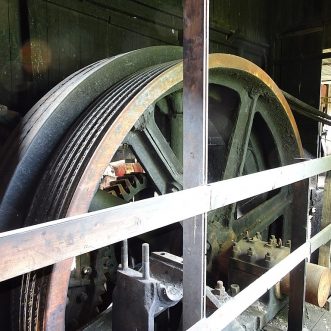
A virtuous flywheel

A virtuous flywheel

I love it when somebody else finds ways to say things better than I can.   Here’s a great post from Corporate Rebels exploring how 2 very different companies found similar ways to turnaround and then grow:

3 Principles To Run A Company Sensibly

“both were motivated to adopt their unique methodologies to rescue the struggling companies they were leading. They wanted to save the jobs of people in their organizations.  They thought this could be achieved by giving all an understanding of how the businesses were run—and then involve them in improving them.  Their way of saving jobs became a new way to create jobs.  These new jobs created new wealth. This wealth, was then shared with those who created it in the first place: all those in the company.”

In other words, they created a virtuous flywheel that didn’t depend on the bosses.

Sounds sensible to me.   Flywheels get going faster when everyone pushes in the same direction.

How to capture a business process: Step 1

How to capture a business process: Step 1

The first step in defining a business process is to work out where you want to be at the end of it.   More precisely, where do you want the person you are serving to be at the end of it.

This involves stepping up a level or two from your usual narrative – from the minutiae of how it gets done to what it is you are really trying to achieve.   This helps you identify ‘what’ has to happen, which in turn can open you up to different ‘hows’ for making it happen.

Write down (or better still get someone else to write down) the process you want to think about as a narrative.   Then ask yourself these questions:

  • What things should be true after this process is completed?
  • Which of those things is truly meaningful to the person you are serving (your prospect, client or customer)?
    • What is it that matters to them?
    • What difference will they notice?
    • What is it that they are paying you for?
  • How could you best sum that up in a two-word phrase, composed of a verb followed by a noun?   This phrase should be binary, it’s either true or it’s not.  You’ve either done it or you haven’t.

Now you’ve found the point of your process.  It’s probably much bigger than you thought.

The joy of sameness.

The joy of sameness.

Patterns are a shortcut to previous experience.   They enable us to see similarities beyond a mass of detailed differences.  We enjoy repetition and sameness – as long as there are enough differences to stimulate us, and keep our eye moving.

The same goes for processes.    Sameness is good.  A pattern is easy to grasp and easy to remember.   That gives us freedom to fill in the details differently when needed.

The trouble is, when we try to communicate a process to other people, we tend to focus on the detail, not the pattern.   We feel we have to capture every exception, every flourish and curlicue, every nuance.   The result is a mess, that takes too long to untangle and so languishes unused and ignored.  Or an unwieldy encyclopedia of micro-patterns – forms, checklists, procedures that makes it impossible to see the patterns that matter.

So if you’re trying to capture process in your business, try looking for the pattern first.   Imagine you’re up a level from the process you’re trying to describe, above it, rather than in it, seeing the path through the woods rather than the immediate undergrowth.

Here’s a brilliant example of someone doing that in a completely different context, to free people from the tyranny of recipes or ready-prepared meals.

The Discipline of pattern is what makes Daring possible in execution.


Thanks to The Intuitive Cook for the inspiration.


Order without control

Order without control

“Improvisation is what life does.  Nothing living, from a bacterium to a blue whale, has a script for their life.  This includes you.  Somehow or other every living being copes with untold complexity without a plan, and always has.” Robert Poynton ‘DO/IMPROVISE’

‘The counter argument to that’, my husband replies, ‘is that these are the result of millions of generations of evolution and dead-ends.   You and I don’t have that much time, which is why we plan and design’.

I agree, and to be fair, Poynton isn’t recommending that we improvise our way through life and business (although it would be interesting to explore how far we could go with that, like lilies of the field). And living things aren’t improvising randomly.   That ‘somehow or other’ is underpinned by a set of simple rules for responding to things you can’t control.  The driver is a process that leads to a single outcome, reproduction.   The result is ‘order without control’, a self-organising system for delivering an outcome.

But without the capacity to improvise, all you have is a machine.  Inflexible, slow to change and ultimately fragile.

You don’t need to build a business as a machine, with every thing designed precisely down to the nth degree.  Get the driver right, then let improvisation keep it relevant.   Create a process for delivering the right customer experience, driven by your unique Promise of Value.  Use the process as a framework for action, that empowers your people to see the offer in the unexpected or exceptional and act accordingly.

The discipline that makes daring possible leads to order without control and a business that truly lives.

Forever if you want it to.

Streamlining

Streamlining

‘Streamlining’ was very fashionable back in the 1930s and 40s.  Originally pure engineering, the purpose was to reduce drag over fast moving vehicles such as trains, planes and automobiles.

However, the look quickly got taken up as a badge of modernity, often accentuated with totally unnecessary, usually shiny protuberances, that looked the part, but actually increased friction.  Eventually, ‘streamlining’ got applied to all sorts of things that were never going to move, never mind create drag – record players, light fittings, buildings.

The point is to remember who it’s for.   That’s where Good Services principle no. 8 comes in: “A good service requires as few steps as possible to complete.”  For the user.   If you deliver through other people, they are effectively the user.

What does “as few steps as possible” really mean?   For me, this:

  • Each step is a meaningful move in the right direction from the perspective of the client.  This often means that steps are bigger than you’re used to thinking of.   If I want to hire a car, filling a form in isn’t meaningful to me, but choosing a car from those you have available is.
  • Each step is completely self-contained.  There is no possibility of ‘limbo’ (or purgatory).  A step is complete or its not.  That way, everyone knows exactly where you are in the overall process.
  • You couldn’t add another step to the process without muddying it.
  • You couldn’t remove any step from the process without breaking it.

Streamlining a process into as few steps as possible isn’t necessarily about speed either.  The process itself may take a long time.   Individual steps may take a long time, or there may be long gaps between them:

The service, or process, should be as simple as possible, but no simpler, and possible to deliver with minimal interaction from you, or anyone else in your business.

Of course, achieving this might mean re-organising your business.   But it will be worth it.

Spontaneity

Spontaneity

My friend Harry Morrison is an actor.  He’s recently started writing short, packed posts on what it’s really like to work in theatre, and guess what?  It’s hard work.

I particularly liked this from today’s post:

“Even the best stand-ups have notebooks packed with all their best ‘spontaneous’ off-the-cuff quips.   Their skill is in waiting for the perfect time to use them.”

There are 2 things here that a relevant for designing effective business processes:

  • If you haven’t rehearsed the likely scenarios, you’ll never spot that ‘perfect time’.
  • The biggest impact comes from realising that the unlikely scenario you’re currently in is actually ‘the perfect time’.

Process, preparation, and practice (aka ‘doing the work’, aka discipline) is what makes spontaneous creativity possible.

What’s on the inside doesn’t matter

What’s on the inside doesn’t matter

Good Services principle no. 7: “A good service is agnostic to organisational structures”.

In other words, the way you organise your company’s resources to deliver on your Promise of Value should essentially, be invisible and irrelevant to your customers and clients.

What if you took it further, so that your team and your clients saw the same service, one from the inside, one from the outside?  What if you then made those services the basis for your organisational structure?

That would make life easier for everyone, wouldn’t it?

Assume no prior knowledge

Assume no prior knowledge

Here’s another simple solution to the confusion I experienced the other day – don’t assume I know what all you suppliers know, and include the unit of measurement with the price.

Nicely leading in to principle no. 6: “A good service requires no prior knowledge to use”.

In this mini-series of blogs, I’m working through the principles outlined in this brilliant book by Lou Downe “Good Services” as a way of exploring how Service Design principles might apply to services that are delivered through people, rather than through online systems.

My thinking is that if you think of your people as users, you can design your operational processes as services that enable your users to deliver the business promise on your behalf. And if you follow the design principles for good services, you’ll build a scalable and resilient operation.

Back then, to principle no. 6.   As Lou puts it: “There is no service that will be used just by people who have used it before.”

When someone new joins your business they don’t know what you know.  They don’t know how you work, even if they have years of experience in the same field.  That means that they will automatically follow their own assumptions about how things work, and default to doing things the way they know.   If you have deliberately made yourself exactly the same as every one of your competitors, this is fine, but I happen to think that’s unlikely.

So the question is, how do you address this?  Here are some ideas:

  • Make as much as possible as self-explanatory as possible – like having a flat plate on the ‘push’ side of a door.
  • Give people a map, that shows the destinations and the different routes for getting there, and a compass for in case they get lost.  Or, if you prefer a different analogy, a score to follow.
  • Train people in your way of doing things.   Base your training on a familiar model, like learning to drive, or to fly a plane, and let them master the basics in a simulator first.  Teach all the likely scenarios, not just what happens to occur during their first week with you.
  • Build resources that will help newbies to learn (and oldies to remember) for themselves – explainer videos, detailed instructions, useful techniques, tricks and tips.  Make sure your map or score includes pointers to these, but isn’t cluttered up with them.
  • Include meta-services “What to do if you don’t know what to do“, “Where to look for answers.” that give people a way in.
  • Follow all the principles of good Product and Service Design.

In other words, “Design your company, or it will be designed for you.”

Familiarity

Familiarity

The trick to building a business that can scale profitably and last longer than you, is to stop managing people and empower them to manage themselves.

You can support the transition from supervision to responsible autonomy with a framework that works like handrails – supportive, available when you need them, but not overly constricting.    I call this framework your ‘Customer Experience Score’.

Another way to think of it, that might be useful for you, is as a set of services that your team use to deliver on what the business does.   In this mini-series of blogs, I’m working through the principles outlined in this brilliant book by Lou Downe “Good Services” as a way of exploring this idea.

Principle number 5 makes a lot of sense: “a good service works in a way that’s familiar.”

But.

What exactly does ‘familiar’ mean?    The way we’ve always done it?   The way everyone else does it?  The way a 70-year-old expects it to happen?  The way an 8-year-old expects it to happen?

I think in the end, the answer is that however you deliver it, (and there may well be more than one way) it should always feel like it is being delivered by your business. even if – especially if- it also reminds them of something else.  Buying from a physical shop is a familiar experience, but Apple has it’s own way of delivering that.   Buying online is familiar, but as you’d expect Apple very much has it’s own way of doing that too.

Every service your users run for the people you serve should be recognisably similar to the way your business does everything.  In other words it should be congruent with your business’s unique Promise of Value.  That doesn’t just reinforce the Promise for customers and clients, it reinforces it for your team too.   They’ll be able to tell you when something jars before your customers do.

By all means make your services rhyme with what’s already out there.  But the real trick is to build familiarity with your unique way of doing things, so your business becomes an old friend people turn to instinctively.

The right kind of familiarity breeds connection.