Discipline makes Daring possible.

Octopuses

Octopuses

Humans keep most of their brain cells in their heads.

Which means that our bodies, sensing the world around us, have to send messages ‘up the line’ and wait for instructions before they can act.  That’s an exaggeration of course, we have automatic reflexes.  But on the whole, if I want to move my legs, my brain has to tell them to do it first.

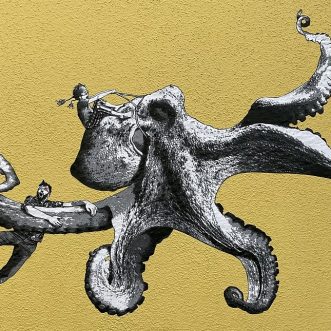
Octopuses have a different model of intelligence.  Most of their brain cells are in their tentacles.  Which means that each tentacle has its own ‘brain’.  Tentacles are autonomous, able to operate independently of the head-brain, and of each other, yet also connected.  Tentacles can even have different ‘personalities’ – some are ‘shy’, some are ‘bold’, and so will react differently to the world around them- enriching the information collected and minimising risk to the organism as a whole.

You can probably see where I’m going with this.  Over their 155 million years of evolution, octopuses have mastered the art of effective delegation. For them ‘The Boss’ has all but disappeared.  9 brains are better than one.

We could learn something from them.
Chains

Chains

Here’s Peter Drucker talking about management chains, way back in 1954:

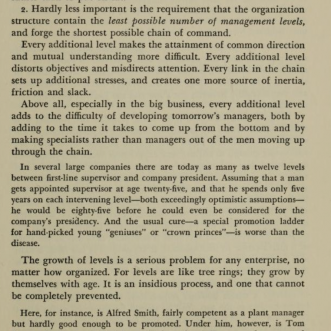
“Every additional level makes the attainment of common direction and mutual understanding more difficult.  Every additional level distorts objectives and misdirects attention.  Every link in the chain sets up additional stresses and creates one more source of inertia, friction and slack.    Above all, especially in the big business, every additional level adds to the difficulty of developing tomorrow’s managers, both by adding to the time it takes to come up from the bottom and by making specialists rather than managers out of the men moving up the chain.”

There’s a good chance that these observations reflect your reasons for setting up on your own – so you could focus on the customer rather than your boss(es), and so you could have complete autonomy over how you serve those customers.

But as you grow your own business from just you to more than a few, how do you stop yourself replicating the structures you found so constricting?

Simple.

Make everyone a manager – not of other people, but of the process every business runs – making and keeping promises to the people it serves:

disappearing boss course card


When everyone’s a boss, there’s no need for chains of any kind.

Thanks to Michele Zanini for the prompt.

Take back control

Take back control

One of the things that puts business owners off growing, is the fear of losing control.   They’ve handcrafted a customer experience that works well.  They have built up a clientele that loves what they do and the way that they do it.  They are concerned about diluting that.

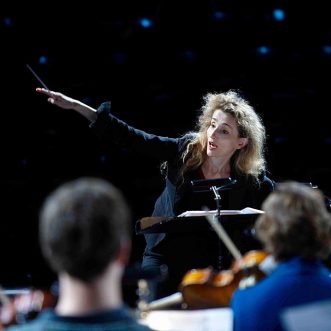
The answer, as every composer knows, is to take the music that is in your head, and write it down, so that others can play it.  Put the control into a score, not a person.

That way, your customer experience lives on through others, not in spite of them.

At first, you will have to conduct this music yourself.  But after a while, your people won’t even need that.  With a good score, they can conduct themselves.

And that removes the real limit to growth – you.

Unfreedom

Unfreedom

If you need to have a job in order to live (and most of us do), then work all too easily becomes a series of power plays, tests of will between worker and supervisor, supervisor and manager, manager and director.  Between subordinate and superior.

Power plays that can get nasty, because there is no way out, no safe word you can say to signal ‘Stop, I’ve had enough‘.

When everyone but the person at the top feels too afraid to disobey, and is unable to walk away in protest, what cascades down is unfreedom.  Or as we might have called it in earlier times, slavery.

How much worse then, if it turns out that what you are in thrall to isn’t even human, but AI.    Statistics generating targets that take no account of actual conditions on the ground – a pandemic, a storm, a tornado – with no possibility of being overidden by an intelligent human.

As a result 6 people died in this Amazon warehouse, picking stuff people don’t need, made using resources that could be better used elsewhere (or not used at all) to make money Bezos doesn’t know what to do with.

Work should not be this way, need not be this way.

Stop.  I’ve had enough.

And I know where and how to change it.

It’s me they want

It’s me they want

It’s a trap many founders of service businesses fall into.  You start off as the technician, doing everything, and at first you love it.

Then you grow your client base, and with it a team to help you serve them.   Yet it seems, no matter how much you reassure them that your team is capable, no matter how much extra you charge them for the privilege, clients insist that you are the one that looks after them.  Or, they insist that it’s a particular member of your team that looks after them.    You get overloaded, and your team lose out on the chance to grow.

The answer is to make sure a new client or a new project starts with one of your team, not you.  Perhaps random, perhaps thoughtfully matched to each others’ working styles.   That means making sure everyone knows how to make and keep your business promise as well as or better than you, from start to finish.  And that means articulating what that experience looks like.

There’s nothing wrong with being relationship-based – I’m all for connection between people –  but the deepest relationship you want to forge is one between the client and your business, where the client’s experience will be consistently outstanding, no matter who delivers it.  Not identical, consistent.

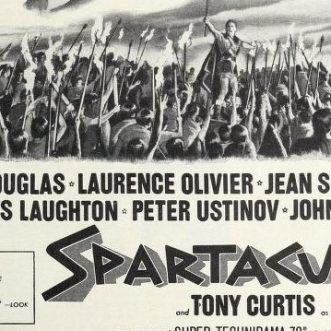
The more you enable your team to stand up and say “I am Spartacus!“, the more clients you’ll be able to delight, without killing yourself or your team in the process.

Reconciliation

Reconciliation

You run a business with a partner.  One of you hates not knowing what’s going to happen, the other loves that.   One favours planning, the other seeing what happens.  This is a source of much tension.

How could you reconcile these opposites to get the best of both worlds?

Simple.

Give yourself a safety net.  A floor below which things cannot go.  Or as Mr Nassim Taleb would have it, protect yourself against the downside.

Design repeatable processes that ensure ‘the least that should happen’.  The planner will be much more comfortable with possibility when you’ve ruled out the worst.  You can both be open to the upside.

When you find it, move the net up, and repeat.

This doesn’t only work for partners, it can help everyone who works with you to reconcile their individual appetites for risk.

Indispensable

Indispensable

It feels nice to be wanted.  To be the fount of all knowledge .  To be the one everyone turns to when they have a question.  To be deferred to in all day-to-day decision-making.  To be the person every client or prospect enquiry is referred to.

But beware.  Making yourself indispensable is the passive form of being a control freak.   An indispensable boss may not actively seek to control what others do, and how they do it, but somehow nothing much happens without being run past them first.  The approach is different, but the result is the same.

It isn’t productive.  It isn’t very liberating for the people with day-to-day decisions to make.  It can easily become a trap for you.  And it soon becomes a constraint on the growth of your business.

The solution is to enable people to answer their own questions, make their own decisions.  Not from scratch, but with all the benefit of what you already know.  As a Customer Experience Composer, not the boss.

Write them a score.  Let them rehearse their part before they have to perform in front of a live audience.  Get everyone together for regular practice at playing together.  Review the score.  Adjust if necessary.


Free your team to bring more of themselves to the job, free yourself up to deal with everything that isn’t day-to-day, free your business up to fly.

The music in your head is the start, not the end.  Get it out there.

Three Freedoms

Three Freedoms

What is freedom, really?

Here’s a possible definition, not mine*.  Three freedoms, each building on the one before.

  1. The freedom to walk away, knowing that you will be taken in elsewhere by other people who see you as one of them.
  2. The freedom to disobey, knowing that you can ‘vote with your feet’.
  3. The freedom to create new and different forms of social reality.

The third can’t happen without the first two.  Not without becoming tyranny, anyway.

These are big ideas, but since our businesses can be anything we want, we can practise them small.


*In the sense that I didn’t think of them.  They come from “The Dawn of Everything” by David Wengrow and David Graeber.

Pinning things down

Pinning things down

When we want to examine something closely, it helps to take a snapshot of it, to capture it at a point in time, to pin it down and look at it as a specimen.   This makes it easier for us to analyse its composition and construction.

This is a useful way to gather some information, as long as we remember that for all systems, including our businesses, the natural state is to be moving, changing and renewing.

For most things worth investigating, static means dead.

Creating bandwidth

Creating bandwidth

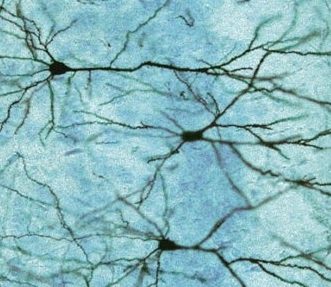
Apparently human neurons are strikingly different from those of other mammals.   Neurons are the building blocks of our nervous system – our internal communiactions system by which we percieve and react to the world.

All neurons communicate with each other and with other cells through electrical impulses, produced by ‘ion channels’.   In general, the larger the neuron, the more ion channels it has.   Until we get to humans.

Our neurons have far fewer ion channels than expected.   We still need ion channels, but somehow we are able to get by perfectly well with less of them.

The hypothesis is that by evolving a ‘lean’ neuron model, human brains became more efficient, able to spend less energy on the basics, freeing some up to spend on more interesting things that other mammals don’t do, such as imagining.

That makes sense.  The less communication you have to do to support the usual, the more bandwidth you leave to deal with the unusual.   Or to imagine a new usual.

Our businesses could learn something from our neurons.