Discipline makes Daring possible.

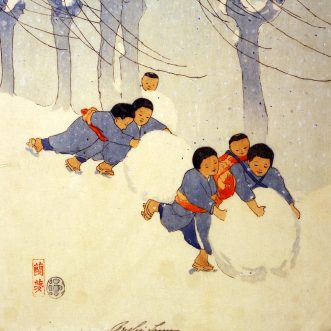
Snowballing

Snowballing

It’s every new business owner’s dream.   Your first customers love what you do so much that they tell their friends, who become customers.  They love what you do, and tell their friends, who become customers and tell their friends, and so on…

Until suddenly it overwhelms you.   You can’t keep up with demand.  You can’t recruit fast enough, you can’t train people fast enough, you can’t supervise any more jobs yourself.

Soon, the referral rate has slowed.   Worse, as customers become disillusioned, they warn off their friends, who warn off their friends, and so on…

Suddenly you don’t have a business any more.

What you’re experiencing is a reinforcing feedback loop (a flow of customer referrals) that hits a limit (your capacity to deliver), and slows down or even goes into reverse.

The good news is that a loop that’s gone into reverse will also eventually hit a limit, as the flow of customer referrals gets back into balance with your capacity to deliver.

The best news is that you don’t have to wait for that.

One short-term fix is to slow-down the referral rate, to give you more time to implement a longer-term fix of increasing capacity:

  • put your prices up – this will reduce the number of referrees who turn into customers, and give you more money to invest in increasing capacity.
  • create a queue – increasing waiting times gives you more time to invest in increasing capacity.

Similarly, there are short-term fixes for the capacity side too:

  • put wages up – this will increase the flow of potential team members who can deliver for you.
  • pay overtime or bonuses to your existing team – this will increase the flow of work from your existing resources.  (This is probably only true for emergencies though)
  • use freelancers – this may increase the flow of already capable capacity into your team.

The best thing you can do for the long-term is to monitor your referral rate, because this will help you plan ahead.

The time it takes for an exponentially growing stock (such as customers) to double in size is roughly 70 divided by it’s growth rate as a percentage.

So if 5% of your customers refer each month, your pool of customers will double in 14 months.  If 50% of your customers refer, you’ll have double the number of customers to deal with in just 1.4 months.

For a sustainable business, what you really want is to keep customers and capacity in balance, as you grow both.  What’s counterintuitive, is that it’s monitoring flows, and the rates of flow that will help you achieve this at the speed you want.

Snowballs are only fun for a little while.

Discipline makes Daring possible.
Introducing systems thinking

Introducing systems thinking

We spend much of our time in business measuring quantities or stocks, when often what we should be looking at are flows – the processes that affect those quantities, for good or ill.

In fact, we’d learn more from looking at how those flows are changing – are they speeding up or slowing down?  – and by asking why, create ourselves more options and opportunities to improve things.

We also tend to focus too much on stocks that are concrete (profit, inventory, capacity) and ignore the abstract (delight, autonomy, morale).   Partly because the abstract is harder to measure, partly because we think they don’t matter.

As we all know, what gets measured, gets managed.    The trouble is that managing the wrong things distorts the system.  Until it no longer serves the purpose we originally envisaged. Or until it breaks.

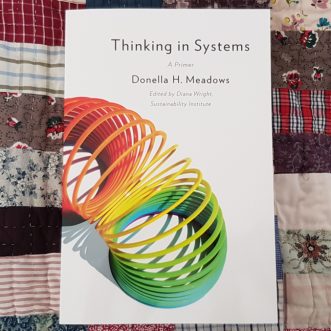
If you’re looking for a different way of explaining – and re-designing – your world, this book is an excellent introduction to systems thinking.

This week I’ll be sharing some ideas from the book, as they apply to the systems we are all trying to create – our businesses.

You’ll recognise them.

TIAAA

TIAAA

How often have you been told ‘It must be this way’, ‘This is just how it works’, ‘Things have always been like this’, ‘There is no alternative’?

There is always an alternative.  More importantly, there are always alternatives.   Always have been throughout human history.  Always will be throughout whatever future we have left.  Alternatives we’ve designed for ourselves as a counter to what’s on offer.

It’s just that history is told by the victors, and alternatives – especially those that work – are hidden or misrepresented by the people who benefit from the status quo.

So maybe part of our job as owners of purposeful, sustainable and humane businesses is not just to find those alternatives and explore them.   It’s also to share them.  To show them.  To enable people to make up their own minds on which they’d rather choose.

Our models of the world are stories we tell ourselves.

Let’s not get ourselves trapped in just one.

And what about everyone else?

And what about everyone else?

It’s not often I think that Seth Godin is being ungenerous.  But I think he is in this post.

Of course Seth is writing for his tribe, those with what Shelle Rose Charvet would call  an ‘Options’ preference.  Who love uncertainty, exploration, overshooting boundaries and blank sheets of paper.

But not everyone works like that.   A few like to slavishly follow a process step-by-step.  Most of us like to have a map.  Or a score we can interpret in our own way.

That doesn’t make us want to be a cog in a machine without responsibility or accountability.  It just means we like to see where we are, where the destination is and what the possible routes are.   We are perfectly willing to take responsibility, be on the hook, initiate action.  It’s just that like children, we play more freely when we can see the boundaries.

Industrial control was never the answer to human flourishing, but neither is a void.

A little bit of discipline makes a lot of daring possible.

Approaching equilibrium

Approaching equilibrium

Systems of all kinds can persist for long periods, staying more or less the same.   Not static, but always hovering around some equilibrium value, even as they grow.

This happens because of feedback.  A change in the equilibrium value triggers a change in the flow of something that affects that value.   Like your central heating thermostat, which uses feedback on the actual room temperature to regulate the flow of hot water to your radiators in order to maintain a temperature that feels comfortable to you.

A business is a system too.  We’re usually looking to grow it, exponentially if we can.  We don’t often think of it as something we want to keep in equilibrium.

But perhaps we should.

A business is a system for making and keeping promises.  That means that whatever else we might like to see, the important equilibrium value is how many promises we keep – or perhaps even how many we exceed.

If we all made that our thermostat there’s a good chance that a better kind of exponential growth would take care of itself.

Remember that you have a voice

Remember that you have a voice

I love this reminder from The Phone Lady about the leaving a message when you phone and don’t get through.

OK, voicemail may be a bit old-fashioned now, but Whatsapp, Facebook, Telegram, Twitter all have voice options.  If you’re feeling brave, and have more time, most social media channels have live video options too.

The main point though is that your voice is human.  It creates connection and builds trust.

Show you’re human, show you care, use your voice.

Being an ancestor

Being an ancestor

As I get older, I am more conscious that I am not immortal.  It’s quite hard to imagine my life 20 or 30 years from now.

But then, I never did think that far ahead – not even when I could reasonably expect to have another 30, 40 or even 70 years ahead of me.

Would I have made different decisions if I had?

It is of course impossible to foresee the future, so the question would have to be about impact and ripple effects rather than concrete, specific results, but ancestor questions are well worth asking, of one’s self and one’s business:

“What impact do I want to make on my generation?”

“What impact do I want to make on the next generation?”

“What impact do I want to make on the generation after that?;

“And the one after that?”

“And the one after that?”

“And the one after that?”

“And the one after that?”

We can’t know how they’ll live.

We can know whether we have made living harder or easier for them.

And it’s not too late to change what we do.  Especially if we change together.

Do you believe in the lifeworld?

Do you believe in the lifeworld?

I’ve been trying to get my head around the work of Jurgen Habermas lately.    It’s interesting.

Simply put, his theories state that we humans operate in and across 2 spheres of existence:

One: the ‘lifeworld’ – where we operate in our capacity as human beings, members of communities at different levels – family, friends. communities and society; and two: the ‘system’  (or systems) where we operate as economic agents or as citizens of a state.

Freetrader, Public domain, via Wikimedia Commons

So far so good.

The lifeworld is something we create ourselves, through what Habermas calls communicative action, a constant adjustment of norms, preferences, values and desires between ourselves and others.  Adjustments we choose to make ourselves in discourse with others.   We are never alone in the lifeworld.  You can’t be human without other humans.

In contrast the system is created by others.  We don’t get much of a say in how the economy or the state works.  We don’t get to choose how we act as consumers or employees, or as clients or citizens.

We could live just in the lifeworld.  As humans we did so for millenia, coming up with all sorts of creative adjustments to enable human flourishing.

The problem is that as humans we are also good at creating systems that crush that flourishing.  Not necessarily intentionally.  Systems that make us less than human, that sometimes run away with us.

We can’t live just in systems.   So maybe, part of our job as business owners is to keep the balance weighed in favour of the lifeworld, not the system.

Luckily I think that comes naturally to most of us.

Beyond urgency

Beyond urgency

For a long time, paid-for journalism has been in trouble.

It has relied on a model of change that it no longer monopolises.  That model is based in acting as a fire alarm: find smoke, shout ‘Fire!‘ and let the outrage build until those in power do something to put the fire out.

The trouble is, anyone can shout ‘Fire‘ on social media.  Plus those in power often start fires of their own, as a distraction from the big fire everyone’s worried about.   The result is that there’s a lot of outrage out there, and very few fire extinguishers.

There is an alternative.  Some call it Solutions Journalism, others Constructive Journalism.

This journalism says it’s no longer valuable enough to simply shout ‘Fire!‘ and expect the problem to be solved, this journalism seeks out people and places who have solved the problem already, finds out how they did it and shares that knowledge with their audience.

This journalism uses knowledge transfer to move the audience “from urgency to agency“.

Why am I telling you this?

One, because The Carbon Almanac is an excellent example of this kind of journalism.  Sign up for a Daily Difference newsletter.

Two, because I think this is an excellent model of change for small, purposeful businesses to adopt too.

If you’re struggling to change, instead of shouting ‘Fire!‘ and waiting for the consultancy fire engines to arrive with the usual solution, why not seek out people and places who’ve already done what you seek to achieve, and share that learning with your team?

Even better, why not encourage your team to be the journalists and do the seeking out?  Once everyone knows something is possible, it’s easier to see how you can make it happen in line with your own Promise of Value.

This post is mostly a paraphrase of this excellent speech by Professor Jay Rosen.  I recommend a read of it.

Meanwhile, here are some questions I’ve extracted for you to assign to your investigative journalists:

  • What’s working where? (It’s a simple starting point. But so different from, “what’s broken here?”)
  • Who does it better than we do? (Who in North Rhine-Westphalia, who in Germany, in Europe, or around the world.)
  • Who has bucked the trend? (Meaning: faced the same problem, got a different result. Also called “positive outliers.”)
  • How did they find their way to a better outcome? (Bornstein calls this the “detective story.”)
  • What’s missing from our community that these other communities seem to have?

Go beyond urgency.  Construct agency.

A Promise of Value

A Promise of Value

I’m liking this new website from 37Signals, who’ve just renamed themselves back from Basecamp.

It’s one of the clearest, simplest and most comprehensive expressions of a Promise of Value I’ve seen.

What would yours look like if you wrote it out this way?