Discipline makes Daring possible.

Going with the grain

Going with the grain

We’re often told that left in a ‘state of nature’, humans would end up fighting a ‘war of all against all’, leaving life ‘nasty, brutish and short’.

I don’t know about you, but I’ve never seen any evidence of that, not even in the dodgiest part of Manchester in the high-unemployment, welfare-cut-ridden 1980s.

This story is used (has been used for millenia) to justify hierarchy.   ‘Someone needs to be in charge, because otherwise everying will go to pot.‘  And with hierarchy comes inequality. ‘I’m at the top, so I deserve more‘.

As I’m working through Sarah Blaffer Hrdy’s ‘Mothers and Others‘, it’s becoming clear that flexibility, empathy, mutual care and co-operation aren’t just useful human traits, they are literally the traits that made us human.  These behaviours evolved before our bigger brains, before language.   They made our bigger brains possible.  Without these behaviours, we would still be great apes, or extinct.

So a flexible, co-operative mindset based on empathy and care for others, including those currently ‘unproductive’ comes naturally to us.  Anything else goes against the grain.

Suppressing our nature isn’t just bad for people’s mental health, it’s bad for business, and right now it’s sending us down the road to extinction.

We’ll need to mobilise all our natual proclivities for teamwork, ingenuity and mutual aid to prevent this.

And we’re out of practice.

That’s where small businesses come in.

Where better to get practicing empathy, co-operation and mutual support than a business that already feels more like a family than a corporation?

Who better to kick off this transition in the UK than the 1.2 million ‘bosses’ of family-sized businesses?

When better to start than now, when it’s not too late?

And why not, when you can grow your business with the grain instead of against it?  Giving your business an evolutionary advantage, enabling scale without adding overhead or stress or losing what makes it unique?

Discipline really does make Daring possible.

A category of 1

A category of 1

Here’s a good question from Alan Wick:

What do you want your business to be known for?

It’s a hard one to answer, because there’s a second unspoken part to it:

That nobody else is known for?

To put you in a category of 1.

Which side are you on?

Which side are you on?

If you’ve read Geoffrey Moore’s “Crossing the chasm” (and I recommend it), you’ll be familiar with this diagram:

But what does it practically mean for you?

If you are a business offering something new and different from what has gone before, something that could potentially disrupt the status quo, you need to understand this curve.

As an example, here’s what it means for me.

In the UK, there are around 1,018,220 businesses that employ between 3 and 10 people, including the owner.  These are my overall ‘market’, the people I want to serve.

I offer a service that’s new and potentially disruptive to the status quo, so however I niche down into that market, by industry say, or geography, or business life stage, this curve comes into play.   It adds another dimension to the psychographic of the people I can help most, that I have to consider when designing, marketing and delivering my service.

Here’s how it splits:

25,455 of them are Innovators.  They love trying new things, what matters to them is that things are new and better than the current best option.  They’ll want to know how it works (and they’ll take it apart to find out).   They’re not worried about support, or infrastructure, they’re just happy to have the latest cool thing to play with.    These are great people to test really new ideas on.  Until they get bored and move on to the next cool new thing.

137,460 of them are Visionaries.  They are interested in getting ahead, and if they can see how a thing will get them ahead of their competitors faster, they’ll go for it.  They don’t mind if it’s not all there, or if there is no support. They will happily support themselves.  They will ask for your thing to be redesigned to suit them though, so be prepared to maintain several versions of your thing.

346,195 of them are Pragmatists, and much more demanding.   They want to know whether a thing solves their problem better than the current market leader, for less than the cost of the problem.  They want to know that you are a safe company to work with; that there is support, and maintenance and spare parts.  As long as these things are in place they don’t care who does it, which means you can still be a small business, collaborating with other small businesses to provide a complete service.   Pragmatists will only use a new thing if they believe that there are enough people like them already using it.  They don’t trust Visionaries (‘flying by the seat of their pants’) and they trust Innovators even less.  That gap between Pragmatists and Visionaries is The Chasm.

The same number of businesses (346,195 of them) are Conservatives.    I think of these people as the ones who say ‘nobody ever got fired for hiring IBM‘.   For them what matter is whether a thing solves their problem better than the current market leader, for less money.    They want everyone else to be using your thing before they do.   They want you to be not just safe, but respected in the marketplace.  They also expect you to provide everything yourself – support, maintenance, spare parts.  In other words, you have to be a big company like them.  Or at least look like it.

Finally, there the 152,733 who are Skeptics.  As you might imagine from their position on the distribution curve, they are the last to adopt new things, sticking stubbornly to whatever has served them well up to now, even if the new thing would serve them better.

I’m an Innovator looking to serve Visionaries.

What side of the Chasm are you on?  More importantly, where are the people you seek to serve?

Catching on

Catching on

“The ultimate, hidden truth of the world is that it is something that we make and could just as easily make differently.” David Graeber.

For many of us, this is exactly why we start a business.  To build our own little utopia, where we make the rules, and get to decide how our world within a world should work.

But if we want to make a bigger impact, our model of how the world should work has to catch on.  With clients, with team members, with suppliers, investors, our families and friends, our competitors.

That can only happen once the model is outside of our heads.

The good news is that getting it out of your head makes it easier for it to catch on.

Dictatorship

Dictatorship

“This is not a democracy, it’s a benevolent dictatorship.” 

As kids we occasionally questioned the benevolence.  My mother must have questioned the dictatorship.  Often.

Because more often than we sullenly submitted to some arbitrary (to us) command, we found ways to do exactly what we wanted.  Mostly by simply doing them out of sight.

Looking back, its clear that much of this dictatorship came from inability, not unwillingness.  We simply couldn’t afford stuff.  But talking about this would have meant explaining why we couldn’t afford it, which in a nutshell was because there were too many of us for the income.  And my parents never wanted any of us to feel unwanted or unloved.

Still, a bit of participatory democracy might have made things easier.   We could have come up with ideas for saving money and priorities for spending it that we all agreed on.

It’s often said that small businesses are like families.  And as ‘The Boss’, it seems easiest to run things as a ‘benevolent dictatorship’.  But how much is going on out of your sight?  How many good ideas are you losing?  How much help are you missing out on?

Dictatorships, no matter how benevolent, aren’t just unfair.   They’re inefficient and fragile.  And in the long run, unsustainable.

Participation makes daring scalable.

The latest batch

The latest batch

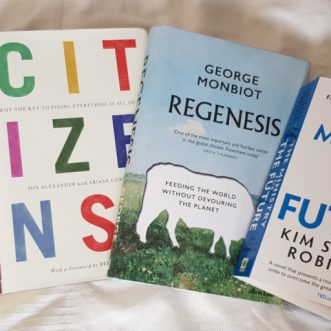
The latest batch of learning arrived over the weekend, courtesy of the real amazons.

There’s fiction here as well as fact.    I find both illuminating.

Fiction allows us to imagine new possibilities, new solutions, to think the unthinkable.

Fact often shows us we’ve done all of those things before, actually, with success.

We just hid them, so we could forget, and stay on the hamster wheel.

One day we really will have to get off, whether we want it or not.

It’s better to be able to welcome it.

Radical minimalism

Radical minimalism

At this morning’s Like-hearted Leaders, listening to Gareth Dauncey’s story of how he thought up, designed and developed his Mood app, I was struck by two things.

First how radically simple he’s managed to keep it.  “2 clicks to log your mood is OK, 3 is too many” 

Second, how ruthlessly focused it is on helping the customer, and nobody but the customer.   “100% private – you log your mood for you and nobody else.”

Radical minimalism.

Something we can all aspire to.


I found it on Google playstore by searching for ‘moodapp’, then scrolling down to see #mood

Writing it down

Writing it down

Sometimes, it seems we business owners have a problem with writing things down.

On the one hand we think we have to pin down every last detail; dot every i; cross every t and cover every eventuality, so that absolutely nothing can go wrong.   On the other hand, we fear that writing down anything at all will somehow stop our people thinking for themselves.

The answer is to sketch.  Make a picture, not a document.

We humans are very good at working out what’s going on from sketches, outlines and broad strokes.  We can follow the basics, and use our imaginations to fill in the rest.

If your ‘business imaginations’  are bounded by a clear and comprehensive Promise of Value, a sketch of what has to happen to make and keep that Promise is usually enough to be helpful without stifling imagination.  You can always elaborate further where needed.

A sketch is much better than an excruciatingly detailed tome that we’d never have time to read.

And way better than a blank sheet of paper.

It’s discipline that makes daring possible.

Handshake overhead

Handshake overhead

“Handshake overhead is the result of the simple law of more people. n*(n – 1)/2. Two people need one handshake to be introduced. On the other hand, 9 people need 36 handshakes. More people involve more meetings, more approvals, more coordination.”   Seth Godin, from this post.

Only if you’ve designed your business so that everyone needs someone else’s approval to get things done.

The great thing about designing your business to be more like an orchestra than a pin-factory, is that if you want to make more noise you simply add more players.

Give each new player a copy of the Customer Experience Score to follow, a bit of time to practise, then simply let them get on with it.

If everyone in your business knows how to make and keep your Promise from beginning to end, there’s no need for them to get anyone’s approval first.

Least of all yours.

Archaeology

Archaeology

I’ve been reading a book on ‘Women in Prehistory’, in which the author quite rightly expresses caution about inferring social structures from archeological finds.

That reminded me an episode of ‘The Goodies‘, in which Bill Oddie attempts to reconstruct a prehistoric creature from a fragment of fossilised bone.  The resulting creature is preposterous, because Bill’s assumptions about what the bone was and where it came from in the original animal are completely wrong.

It isn’t only ancient history that can be misinterpreted in this way.

If an archaeologist discovered your abandoned business tomorrow, what could they infer about how it works from the artefacts left behind?

What do today’s new joiners and new customers have to infer from the systems, people and processes they encounter when they arrive?

The advantage of writing down your Customer Experience Score is that nobody has to guess, or reconstruct the symphony from a single note.

There’s room for different interpretations of course, but they are very unlikely to be preposterous.