Discipline makes Daring possible.

The best protection is permeable

The best protection is permeable

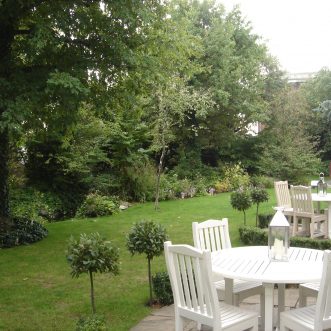
As every Chelsea gardener knows, the best way to protect your garden from wind is not a solid wall or fence, but a permeable barrier like a hedge.

This filters the wind, slowing it down, letting in fresh air to circulate among your precious plants and shrubs without damaging them.

A solid barrier on the other hand lets air crash over it like a wave – and then falls at the first gale.

Comfort

Comfort

“Most of us like things to stay the same, we seek order and predictability.” Except that’s not really true is … Read More “Comfort”

Not freedom or order, but freedom and order.

Not freedom or order, but freedom and order.

This is the second post inspired by an extract from ‘Leadership and The New Science’ by Margaret Wheatley, entitled “Change, Stability, and Renewal: The Paradoxes of Self-Organising Systems

To recap: if a business has a strong frame of reference in place – its Promise of Value and its ‘way we do things round here’ – then it can be confident that any changes that occur will be consistent with that frame of reference.

This means that not only a business can afford to be open to small variations (what Holacracy calls ‘tensions’), it needs to be – especially to small, persistent variations that are driven by the people it serves – its customers.

This in turn means that it makes sense to give people full autonomy to respond to variation, because you know they will do so in line with the Promise of Value at the core of the business, so no harm will be done, and because what starts as a small variation may well turn into a new opportunity, a new product or service, a new way of doing things, that makes the business stronger and more stable over time.

Most of us like things to stay the same, we seek order and predictability.   We fear that loosening control will lead to too much fluctuation and eventually chaos, so we tend to keep systems rigid and control centralised.

The paradox is that the opposite is what we need to maintain the identity and stability of our business over the long term.

Not freedom or order, but freedom and order.

Discipline makes daring possible.


Autopoiesis. How self-organising systems evolve.

Autopoiesis. How self-organising systems evolve.

Last weekend I spent a day going through my old London Business School notes before throwing them out to make room.   Its 21 years since I did my Sloan Fellowship, so this stuff is bound to be out of date.

Still, I skim-read quite a bit of it – lecture notes, my coursework, case studies – along the way, and I was struck by how much of it still resonated, especially an extract from ‘Leadership and The New Science’ by Margaret Wheatley, entitled “Change, Stability, and Renewal: The Paradoxes of Self-Organising Systems

According to Ms Wheatley, that’s not at all surprising.   One of the characteristics of a self-organising system (e.g. a human being) is that “as it changes, it does so by referring to itself [autopoietically]; whatever future form it takes will be consistent with its already established identity”,  “when the environment demands a new response, there is a reference point for change.”

For a business that reference point is it’s Promise of Value.   The more clearly and explicitly that is spelt out, and built into the way a business works, the more resilient that business will be – not because it won’t change, but because changes will always be adopted in a way that is consistent with that Promise.

As long as the system is self-organising, that is.    More on that tomorrow.


Accumulations

Accumulations

The driving force of capitalism is, unsurprisingly, the accumulation of capital.

Other things are accumulated along the way – some good (knowledge, skills, lives enhanced), some bad (waste, pollution, obesity, lives diminished, extinctions).

We’ve got really good at measuring the capital pile, but as individual businesses, we rarely look at the others.   As a result we underestimate our impact on the world.

Time to account for more than profit.


Processes, procedures, workflows

Processes, procedures, workflows

The terms ‘workflow’, ‘procedure”, ‘process’ are often used interchangeably.   I think it’s useful to distinguish between them, because they are doing different things.

A workflow does what it says – it describes how responsibility for an activity flows around your organisation as if it was a physical thing moving between departments – a purchase order is raised, goes to X to be reviewed, then to Y to be authorised, then to department Z to be actioned.

A procedure describes the steps needed to complete a specific activity, e.g. Raise Purchase Order, in the same way as a recipe describes how to prepare a specific dish e.g. a Lemon Drizzle Cake.   Like a recipe, it assumes you know how to do the steps – whisking an egg-white, or completing a purchase order form.

Processes are like the storylines of a film or novel.   As in a film, or novel, each character has their own storyline, and is changed by it.   And like a film or a novel, its best to start from the top and work down – to the point where you can define individual scenes or procedures.     Unlike a film or novel, an organisation has many individuals playing the same roles, both over time and in parallel, so needs to leave some room for improvisation.

Its relatively straightforward to capture a procedure, or even a workflow, its much harder to capture process.   But that’s where the real value is for an organisation, because to live the story, everyone needs to understand the story.

Oh no! What have I done?

Oh no! What have I done?

I thought, as the Head of Research completed his 20 minute rant on why he hated the IT department; how he thought we were all a waste of space and how he would only use us because he had no choice.

It was my second day in my new job, as part of the IT team supporting the Research Division. I’d already had to find my desk from the gloomy basement of a building half a mile away, then bring it back to the portakabin we called an office.

And now this – our customers hated us!

But in the next breath the Head of Research taught me one of the most valuable lessons of my working life. He gave us an overview of the process by which his team worked to discover a new drug.

My Head of Research was very public in his rant, but thankfully he was equally public in setting context.

“If that’s what you’re trying to do”, I thought, “I can see where I can help.”

A more common reaction by a business leader to her team’s inability to do things ‘the way she wants’ is to micro-manage them, imposing an ever more detailed level of instruction that is expensive to implement and leaves them feeling squashed, hampered and resentful, and herself no more satisfied than before.

The answer isn’t more detail, its context.

Most people in a job know how to do that job well. What they lack is the context in which they are doing it – where a particular day-to-day activity fits into the process of delivering a promise to a customer.  In other words,  why they are doing it, why they are doing it then and how that fits with what the rest of the team are doing.

Given the context, and responsibility for their part in delivering it, people will go further than delivery, they’ll find ways to improve things that you would never have thought of.

Of course, human beings can’t operate without context, so left without one, they’ll create their own.

An earlier version of this post was originally published on LinkedIn.
Metamorphosis

Metamorphosis

Finally, it seems, technology can enable accountants to transform themsleves into what they and most of their clients want them to be – seers and prophets, rather than backward-looking bean-counters.

For around 25% of accountants, that is great news.

And around 46% of clients will have to get their act together to take advantage of it.

Here’s to revolution.


*source “The Practice of Now 2019”, Sage, 2019


Profit.  What does it really mean?

Profit. What does it really mean?

Our word ‘Profit’ comes from a Latin verb proficere.

It’s meanings include:

  • to advance, make progress

  • to benefit, profit, take advantage

  • to help contribute, be useful

  • to depart, set out

Proficere itself is a combination of two words, ‘pro’ (meaning forwards) and ‘ficere’ which means:

  • to do

  • to make, construct, fashion, frame, build, erect

  • to produce, compose

  • to appoint

Ultimately this can be traced right back to proto-Sanskrit as a word that means ‘do, put, place’ – a word that represents our sense of agency in the world.

Why do we insist on reducing all this richness to mere coin?