Discipline makes Daring possible.

Cannelloni

Cannelloni

In ‘The Uncertainty Mindset’, Vaughn Tan describes an interesting situation:

The assistant chef responsible for the popular lunchtime canelloni dish can’t keep up, and despite following instructions can’t consistently get the finished dish to look as it should, so some are sent back.   This goes on for weeks.

It takes the owner walking past one lunchtime to spot the problem, discuss the problem with the assistant chef, then take the problem off to the experimental kitchen team for fixing.

It makes some sense for an innovative, high-end kitchen, operating at the cutting edge of dining to separate innovation from the everyday.   A busy restaurant needs to run like clockwork, there’s no room during service for experimentation.

But not every problem needs a separate crack team to solve it.   Given a bit of space and time outside normal service (more staff working shorter shifts), the assistant chef and their peers could probably have arrived at the same solution, which was a different method of assembly, that took up less time, less space and produced a more consistent result.   Only if that failed should the problem have perhaps been passed across to the experimental team for a deeper look at the recipe.

Given regular space and time outside normal service, the restaurant team could solve many such problems, eventually including recipe problems, learning from each other as they go until each of them is able to tweak the process almost seamlessly.  That way, the regular team also becomes the crack team.

That’s an idea that’s not just for restaurants.

Rigidity is the wrong tool for dealing with uncertainty

Rigidity is the wrong tool for dealing with uncertainty

When  your business is faced with uncertainty, rigidity is the wrong tool to use.   That’s why big corporations fail in the face of change.

The challenge for a purpose-driven, legacy-focused, customer-centred small business is to be open to unknown futures without losing its identity.   To keep their edges fluid and their core firm.

Fortunately, that’s relatively easy to do, because human beings are very good at dealing with uncertainty – especially the uncertainty that comes from dealing with other human beings.

All you need to do is to build the firm core:

First you define a high-level, comprehensive Promise of Value that is specific and distinctive, yet open-ended:

  • Define the people you serve in terms of psychographics, not demographics.
  • Define how you serve them in terms of their deeper needs, not passing wants.
  • Define how you achieve that in terms of values and behaviours, not external measures.

Package that Promise of Value into concrete products and services:

  • Identify the demographic(s) most likely to contain enough people of the right psychographic.
  • Understand what matters to them right now.
  • Identify what dis-ables the motivated.
  • Design a package that addresses what these people need right now.

Use that Promise of Value to drive the design of a Customer Experience Score for sharing and delivering on your Promise that:

  • Embodies your distinctive values and behaviours.
  • Can be played by any competent musician.
  • Enables each musician to bring their own experience and personality to their performance.
  • Allows them to create a new interpretation of your Promise when they encounter the new and unexpected.

Make sure you gather feedback:

  • From the Score as it is being played.
  • From the people you seek to serve and the people who work with you.
  • From your regulator if you have one, and your industry.
  • From the impact you makes on the people and planet around you.

Enable every player in your team to discover the combination of roles that ensures their best performances:

  • Make sure everyone can play the whole Score.
  • Give them regular R&D time, in the company of fellow players, to tweak or re-design the Score, in response to feedback, learning each other’s strengths as they go.

Once you have this in place, you can safely trust your people (and the people to come) to dance with uncertainty.  You can make every one of them a Boss, and leave the future of your business safe in their hands.

Discipline makes Daring possible

Ask me how.

Thinking together

Thinking together

“Think for yourself, but not by yourself.”

My ear caught the phrase on Radio 4 this morning and I was intrigued.  It’s from Julian Baggini’s new book “How to think like a philosopher”  (on my shopping list already, of course).

I don’t know about you, but I am all too often guilty of thinking by myself.   Working things through on my own, running off down blind alleys, diving into rabbit holes, only to end up at a conclusion I could have looked up.

I’d have got there much quicker if I’d talked to other people.

It’s not that other people necessarily know more than I do, it’s that they might, and even if they don’t, going through my thinking out loud, to a group of people with shared values and different perspectives is bound to clarify my workings.

Luckily, when you run your business with a team, you have that like-hearted thinking club ready-made.  Encourage everyone in it to think for themselves, then do your important business thinking together.  You’ll like the results.

Discipline makes Daring possible.


Republic

Republic

Nowadays we seem to use the Athenian word ‘democracy’ to describe something more like a Roman republic.

In the Roman system, a few ‘responsible’ (and very wealthy) men decided what was good for everyone.

The mass of men (plebs) were eventually represented, but they never got to vote or join in, even though they and their families did all the work.  There was a view that plebs didn’t even need to know the laws by which they were governed.

As usual, women, children and slaves didn’t count at all.

Sound familiar?

You probably left one of these to create your own fair, agile and democratic utopia.

Take care you don’t unconsciously reproduce the republic as you scale.

You can avoid it.

Ask me how.

Lottery

Lottery

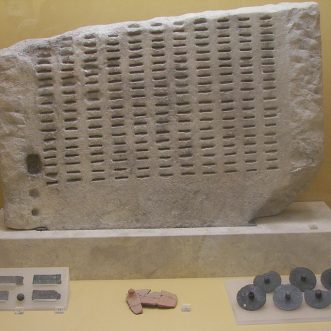
For an Athenian man who didn’t want to be an idiot, the answer was to put yourself forward for public office.  Appointment was by sortition – a lottery.

The Athenians built lottery machines like this kleroterion to ensure selection was random, because a) they believed all men were equally capable of making decisions with others, and b) they valued the diversity of perspective that diversity of occupation, status, and income would bring.

They also knew that the best way to preserve the Athenian Promise of Value, was to ensure maximum active participation in maintaining it.

Of course they left some people out – women and slaves didn’t count as citizens.  But the mechanism was fair and very explicit and could easily have accommodated this kind of social change, given time.

We small businesses (and modern states) can learn from the Athenians, without making their mistakes.   If everyone in our business believes in the same Promise of Value and knows how to Share it, Keep it and Improve it like a ‘Boss’, from their own and others’ perspectives, we can trust each and every one of them to do the right thing for the people we serve.

That doesn’t just lighten the load for us.  It improves the experience for our clients and our teams.  And most importantly of all, it keeps our businesses truly alive, thriving and able to adapt to whatever new perspectives come next.

Discipline makes Daring possible.

Ask me how.

Worth the effort

Worth the effort

What makes all the effort of writing down and sharing your Customer Experience Score worth it?

Simply that you get more of what you really want:

  • Agency – your business has become your ‘me-shaped’ dent in the universe.
  • Mastery – you’ve learned and mastered the skill of designing a business to deliver a unique promise.  You’ve taught others how to use it.
  • Autonomy – you’ve given your business the autonomy it needs to continue without you, so your dent can last much longer than you.
  • Purpose – you’ve designed your entire business around what you are here to do for the people you serve.
  • Community – you’ve created a community of ‘people like us’ – your team, your clients and everyone involved with your business – bonded together by shared values.
    • Status – You’re no longer the only Boss, but everyone knows you are the foundation of your business.

And so does everyone around you.

Discipline makes Daring possible.

Ask me how.

Giant leap

Giant leap

Once your team are running the business alongside you, it’s time for them to own it alongside you too.

Discipline makes Daring and Longevity possible.

Ask me how.

Big step

Big step

Repeat your Baby Step and Next Step until your entire Customer Experience Score has been written down and can be played as well as or better than you by everyone and anyone in your team.

This will take time, but the payoff is huge.

Your team will be happier and more engaged with the business.   Supported by a clear framework for the least that should happen, they can dare to delight more.  It will feel more like their business.

Your clients will notice the difference.

You’ll be able to disappear when you need to and grow the business further.

Discipline makes Daring possible.

Ask me how.

Next step

Next step

The more people who know how to do what up to now only you could do, the better.

So, once you’ve got your first section of Score written down, get the person who helped you to teach everyone else how to play it too.

Then, once everyone is familiar with it, get them to take turns performing it for real.

Collect their suggestions for improvement.   After  week or so, discuss them with your team, and apply only those that enhance your Promise of Value for the people your business serves.

That might mean automating some piece of drudgery that enables the team to spend more time with clients.   It might mean un-automating something to make a client/team experience more human for both of them.

Repeat until you have a section of your Customer Experience Score that truly lives up to your Promise and that anyone can run as well as or better than you.

You don’t have to do this alone.

Once your team are running the business alongside you, it’s time for them to own it alongside you too.

Discipline makes Daring and Longevity possible.

Ask me how.

Baby step

Baby step

What’s the smallest step you could take to get started on your Customer Experience Score?

Try this:

  • Choose a job you shouldn’t be doing.
  • Find someone to help you – ideally the person you wish to delegate the job to.*
  • You tell them what needs to happen to complete the job, they write it down.
  • They have a go at doing it, following their notes.
  • You observe, and where it goes wrong, between you, you modify the instructions to get the outcomes you want.
    • You clarify what really happens  (not what you think happens).
    • They suggest ways to make it easy for them to do.
  • They write up the improved version.
  • Save the latest version where everyone can get at it.

Repeat until you have a section of your Customer Experience Score that can be run reliably by anyone who needs to.

*If you plan to outsource the job to another business, get a friend/fellow business owner to help you do this, then hand over the finished Score as part of your specification for the supplier.

Tips:

  • Assume competence.
  • Start with the (usually positive) 80% case.  You can capture major exceptions later.
  • Think ‘Get Outcome’ – what’s true at the end of the process that wasn’t true before?  So it’s easy to tell when you’ve succeeded (or not).
  • Start at the very beginning and carry on right to the end.  You’re trying to capture a transformation that is meaningful to your client and therefore your business.
  • The quicker you test it, the quicker you can improve it.
  • If it feels like you’re trying to fit too much in, you probably are.
  • It’s a prompt, not a novel.
  • Practice makes perfect.
  • Remember, it’s about the process not the people.

And for the visually minded:


Even a little bit of Discipline makes Daring possible.

Ask me how.