Discipline makes Daring possible.

Why create a Customer Experience Score?

Why create a Customer Experience Score?

Why write down your Customer Experience Score?  I can think of at least 6 reasons:

  • Memory.
    • Without a Customer Experience Score, some of the knowledge of “what we do here” and as importantly, “how we do things round here” and “why we do what we do” gets lost every time one of your ‘good people’ leaves.  This knowledge also gets changed as new people join and bring their previous experience with them.
    • This can be overcome by a founder that spends time and energy ‘policing’ the culture (think Steve Jobs), but one day even the founder will disappear.
    • A Customer Experience Score gives your business a memory of its own, outside the heads of the people in it – including you.
    • That memory needn’t be prescriptive. The most detailed score still leaves room for interpretation, and you can make it more improv if that’s your style, but the main thing is that if the business always remembers the “what”, “how” and “why”, your people don’t need to make it up as they go along.
  • Detachment.
    • As Japanese businesses know well, what I call a Customer Experience Score embodies the ‘thing’ a group of people are working on – whether that’s a play, a car, a building or a service.
    • This allows a certain level of separation between ‘what I am trying to achieve‘ and ‘who I am‘, which makes it much easier for everyone involved to discuss and agree improvements, because it’s ‘the thing’ that’s being judged, not ‘me’.   Free from the fear of personal criticism, your good people can eagerly look for ways to make things better.
  • Confidence.
    • Having a Customer Experience Score to follow while they learn, gives people confidence that they are doing the right thing.
    • Once people are confident that they know what they are doing, they don’t wait to be made accountable – they take responsibility.  With the confidence of a process behind them, your good people can pretty much manage themselves.
  • Emotion.
    • Most modern businesses, large and small, involve interactions of some kind – with other employees, customers, and suppliers.
    • These interactions require emotional labour – listening; empathising, being present to the other person as well as intellectual labour – pattern-matching, imagining potential scenarios, reviewing possible solutions etc..
    • Without a Customer Experience Score these interactions become harder than they need to be, because every interaction is treated as unique, where in fact they fall into common patterns, with unique features.
    • Your Customer Experience Score captures what has to happen in the common patterns, giving your people a framework to work from that doesn’t need much thinking about.
    • A Score frees up intellectual and emotional energy to be spent on the unique and personal aspects of regular interactions, and on the exceptions that either prove the rule, or highlight the start of a new pattern.  With their heads cleared of the routine, your good people can use their hearts to do more than keep your promises – they can confidently exceed them.
  • Automation.
    • The hardest part of automating any process or function is specifying exactly what it is you’re trying to do.  This is so hard that most people skip this step, trusting the software to do this job for them.  The trouble is, off the shelf software is by necessity, targeted at a mass market, while you have your own unique way of making and keeping promises.  This means either conforming to the way everyone else does things, or worse, automating the details, without understanding the process as a whole.  With a Customer Experience Score, you can use automation (even off the shelf) to strengthen your uniqueness, not dilute it.
  • Longevity.
    • Not even I would say that a Customer Experience Score can be designed to deal with every possible scenario, exception or eventuality, and without good people a Score-based business gradually fossilises and becomes irrelevant, or worse, gets completely out of step with its environment.
    • Good people can handle exceptions appropriately when they occur. They can also identify when those exceptions are due to environmental changes that need to be dealt with by adjusting the Score.
    • Good people spark off constraints (such as a process), they ad-lib, improvise, invent workarounds, dream up ridiculous scenarios that open up new opportunities.  With a solid framework to play in, good people bring a business to life – they make it human.  A Customer Experience Score enables people to keep your business alive and human for generations to come.

Discipline makes Daring possible.
Ask me how.

Keeping it simple

Keeping it simple

If you don’t tackle the underlying organizational complexity and bureaucracy that generate the torrent of meetings and email requests, you’re not going to make much progress–no matter how clever your personal “hack” might be. Michele Zanini in response to: “Workers Now Spend Two Full Days a Week on Email and in Meetings“.

No matter how ambitious you are, I bet you don’t want your small business to end up like this.

If you keep the overall structure simple and the purpose clear:

Then empower your team to manage processes rather than other people, you can make sure you never do.

And that means you can grow bigger, without growing slower.

Discipline makes Daring possible.
Ask me how.


Negotiated joining

Negotiated joining

Another really interesting piece from Vaughn Tan today:

Using Negotiated Joining to Construct and Fill Open-ended Roles in Elite Culinary Groups

In a nutshell, instread of recruiting new team members against an extensive checklist of skills, comptencies and attributes, these elite teams (incumbents) select a likely-looking candidate (aspirant) and find out whether and how they can best work together by actually doing it for a provisional period.

During this time, the aspirant is expected to understand the role and the role-components that make it up, and to demonstrate strengths in enough of these roles to make them worth employing.   They may even bring new strengths to the role, requiring a new role-component.

On the other side, the incumbents are expected to understand and test the strengths of the aspirant and recognise when one or more of their own role-components is superseded, or a completely new role-component has been created.

Only when the negotiation is satisfactory to both sides does membership become formal.  In this way both sides negotiate coming together to form a new, reconfigured team.

I think this is a very interesting process that could be applied to more than elite teams, such as a growing small business that already has a Customer Experience Score in place.  Role-components correspond to Activities in the Score, while Roles have responsibility for one or more parts of the Score.  Having the Customer Experience Score in place makes this less risky than it might otherwise be, since everyone knows ‘the least that must happen’.

I’d use it to allow individuals to negotiate how they can best contribute to the delivery of the company’s Promise of Value, not just when they join, but throughout their career with the company, as they grow and develop.

I’d also use it to ensure that everyone knows more or less everything about the Customer Experience Score, giving flexibility and resilience to the organisation while leaving  plenty of room for evolution.

Because, after all, the Discipline is there to make Daring possible.

Learning by doing

Learning by doing

As I mentioned yesterday, almost the biggest challenge for the food innovators in Vaughn Tan’s “The Uncertainty Mindset”, is making sure that any new experience (whether a dish, a meal or an event) is both consistent with their unique ‘ethos’/’house style’/’brand’ AND completely new.

How on earth do you teach someone how to do this?

The answer is a process something like this:

  • An R&D chef is given the job of producing a new dish.  There’s a brief, but no specification of method.
  • The chef prototypes it, then brings it to the team for assessment and feedback.
  • Together the team decide whether it has met the brief, giving constructive and concrete feedback.  “The texture is wrong, our style is more xxx”, “This ingredient overpowers the others, we’re after something more yyy”.  The most important piece of feedback is nearly always “like that zzz dish you made last month.”

These steps are repeated until the dish is judged fit to introduce to the restaurant menu.   It’s at this point that instructions for re-creating it will be set down.

The key things here are:

  • Every chef does this, no matter how experienced they are or how new they are.  Everyone judges everyone’s dishes all the time.  It’s the job.
  • Feedback is concrete, pointing a chef towards the outcome without ever specifying method.
  • It’s a non-hierarchical and safe space.  Nobody is managing anyone else.  They are essentially peers (some more experienced than others) reviewing an output they all want to be proud of.

The result is that learning and reinforcing the unique ‘ethos’/’house style’/’brand’ becomes almost effortless, because it’s simply part of the job.   Chefs learn all the time by doing, presenting and re-presenting the results of their work for the scrutiny of their peers.

These are businesses operating under conditions of extreme uncertainty, but I think there’s something really useful here, that could and should be incorporated into a system for making and keeping promises.

Because in truth, what we really want is a system for making and exceeding promises.

After all, the Discipline is there to make Daring possible.

How would you do it?

Roles

Roles

One of the things that seems to make innovation easier for the companies in “The Uncertainty Mindset”, is what Vaughn Tan describes as ‘modular roles’.

It’s not clear exactly what this means, but I think its something like this: my job title might be ‘chef’, but I can do things that might seem to fall outside that description, and even within it I can specialise.

Team members discover their own and each others preferred roles within a given innovation through practice.  There’s no sense of treading on anyone’s toes or ‘that’s not what I was hired for’.

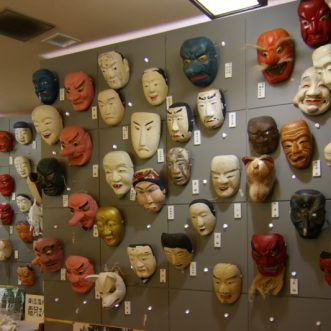
Like acting, any role can be stepped into simply by taking up the mask and putting it on.  There will be stars and understudies but in essence anyone competent to play a role can play it.   And by watching others play, a newcomer can learn enough about a role to take it up as a kind of apprentice too, because everyone is practicing, all the time.

In The Disappearing Boss,  I use a similar idea.   A Role is a part played in a performance by a person.   It’s defined by what the Role does during the performance, and the parts of the customer experience they are responsible for delivering.

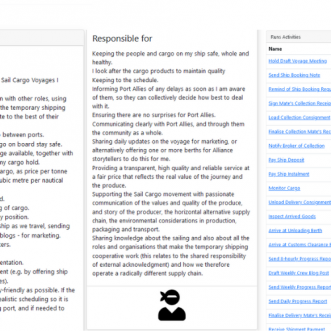
Here’s an example from one of my clients.  Its the definition of the Ship’s Role in a Sail Cargo Voyage Co-op:

The definition of the Ship's Role in a Sail Cargo Voyage Co-op.

It covers what the Ship does,what it is responsible for, and the Activities it runs in order to achieve that.

It covers what the Ship does as part of a Voyage, what it is responsible for, and the Activities it runs in order to achieve that.

What it doesn’t specify is how exactly the person playing the Role does that, nor the skills and comptencies needed.  They are taken for granted, and they may well be different for different Ships.  What matters is that responsibilities are delivered.

As Vaughn Tan has discovered, the great thing about using Roles rather than job descriptions is that they allow great flexibility in resourcing.  One person can play many Roles.  A given Role can be played by many people.  Once defined, a Role can easily be handed off to someone outside the business, and replicated to increase capacity.

At the same time, focusing on the ‘what’ of a Role, rather than the ‘how’, leaves things to certain extent open, allowing every actor to bring their own personality to the performance and enabling them to respond to the unknown with the kind of creativity, flair and inspiration, that keeps your customer experience memorable.  Worth coming back for again and again.

Discipline makes Daring possible.
Ask me how.

Dancing with chaos

Dancing with chaos

I finished “The Uncertainty Mindset” this morning.   Unike many management books, it’s taken me a while to finish because the book is dense with ideas and insights, so I have had to rest between reads.

I thoroughly recommend it, especially for those who wish to disrupt with their business.

In the high-end, ultra-innovative world of fine dining of the book, teams of innovators repeatedly dance with chaos, pushing themselves into some new, unknown situation (moving the restaurant to new country; organising a conference; organising food relief in hurrican-struck islands) inducing a feeling of desperation as they scramble to deliver on a promise that will be at once utterly new and utterly familiar to their clientele.  Each time they dance they learn anew that they will succeed, even if they don’t yet know how.  And they do succeed. Spectacularly.   Then they rest, allowing themselves time to recover before they go again, on an even bigger challenge.

They can do this because they are specifically R&D teams.   The day-to-day of a restaurant can’t run like this.  The teams running the restaurants have a different challenge with it’s own rhythm.

What if you’re not a restaurant chain?  What if you aren’t R&D?  What if you simply want to evolve continuously, not necessarily radically, in response to the world around your business, through the lens of your customers?  What can be learned from this approach?

It’s this aspect that I want to pursue – that dance between order and chaos, between predictbility and uncertainty that makes life so interesting.

So I’ll be reading it again, taking notes, and translating it into my own terms, so I can share it with you.

Discipline makes Daring possible.

The cat’s out of the bag

The cat’s out of the bag

I see City bosses are clamouring for a return to office working again.

I wonder why?

Are they worried about rents on empty offices?   Those are effectively a sunk cost.

Are they worried about their teams’ jobs or wellbeing?  I doubt it.

Are they worried about ‘losing control’?  Are they bullies then?

Is it about status?  What’s the point of being a boss when there’s nobody around to see it?

Or could it be that when frontliners demonstrate that they can achieve better results without supervision, intervention and commutes, it’s the manager’s job that’s redundant?

Hmmm…

It seems to me that for a long time, traditional corporate management has been about pushing risk and accountability downwards to the people who do the work, without giving them the rewards to match.  Now the cat’s out of the bag.

It’s going to be hard to put it back.

Better then to follow through instead, and give people what they really want:

  • Agency – to make their own ‘me-shaped’ dent in the universe.
  • Mastery – to learn and master (even teach) new skills.
  • Autonomy – to be free to choose how they make their dent.
  • Purpose – to do this for something bigger than themselves, that has meaning beyond the sale.
  • Community – to do all this with ‘people like us’.
    • Status – to know (and for others to know) where we stand in our communities.

Supported of course, just not necessarily in the form of management.

Discipline makes Daring possible.
 

What do you think?

Order with feeling

Order with feeling

I didn’t get much reading done this weekend.

Instead I’ve been sorting fabrics.

Over the years I’ve built up an extensive collection of vintage fabrics and shirts that I’ve been intending to use for quilts.  I like the idea of recycling other people’s cast-offs into new and interesting material.

My collection was all over the place, scattered across different parts of the house, all colours jumbled together in various bags too heavy to move.

So my job over the last week or so has been to sort through it, chuck some, earmark some for passing on, and get the rest cut up for flatter storage, organised into smaller labelled bags.

It’s been hard work, but pleasant, evoking some happy memories.  I picked through a bag of scraps – far too small to actually use – remembering the velvet teddy I made for one niece; the bright Provencal backpack I made for another; the tartan dinosaur I made for a colleague’s wedding; the bean bags I made for nephews, and the enormous one I tie-dyed to commission for another colleague.  Then I threw the scraps away.

I’ve never thought of myself as an artist.  I can’t draw or paint.  But give me something concrete to work with and I can create useful things that also look unexpectedly good.  Pottery, jewellery making, woodwork, patchwork – those are more my style.

Also businesses.

Give me a business, that perhaps feels a bit disorganised, a bit scattered, not quite coherent.  Yet nevertheless amazing.   I’ll teach its owners to re-arrange it into an elegant sysem for making and keeping promises that becomes more than the sum of its parts.  Ordered, scalable, yet still full of of feeling, it becomes an heirloom they’ll be even more proud to pass on.

In business as in patchwork, Discipline makes Daring possible.

 

Adjusting the system 3 – refining the Score

Adjusting the system 3 – refining the Score

Once you’ve assessed the potential consequences of what you’re seeing in feedback, and decided what to do about it, you can start acting to adapt your system.

You may find that you need to refine an existing part of your Score.

This could mean simplifying an Activity by removing unnecessary steps.  Or spelling out what has to happen in more detail.  You might remove an Activity, or add a new one, or several.

Whatever the change, there are bound to be knock-on effects.  Perhaps you need to review Props for this part of your Score.  You might need to create a new Role.  You’ll certainly need to let your people learn and practice the new Score before you perform it for real.

This may seem like a lot of unecessary work, especially for minor adjustments.  It will be tempting to just change practices without bothering to change the Score first.

Resist that tempation.

Following through the impact of even minor changes on your Score, before implementing them in real life allows you to try different ideas and scenarios ‘on paper’, when getting it wrong and reversing back to your starting point is easiest and cheapest.

It means you get to see the full impact before you start changing anything.

It means you can share this task with everyone on the team, to get multiple perspectives and arrive at better solutions more quickly.

It also means that your Score always reflects the reality of how your business works, which keeps it useful, and even more importantly, preserves the value of your business until you’re ready to exit.

Discipline makes Daring possible.