Discipline makes Daring possible.

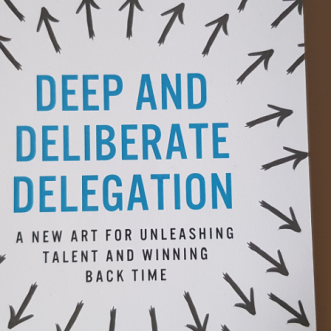
Deep and deliberate delegation

Deep and deliberate delegation

I re-read this book by Dave Stitt over the weekend, and frankly, it made me jealous.

It is just so good.

Clearly and simply written, sharing tools and techniques I’ve never seen before, it delivers a really powerful combination of thought and action, insight and how-to, theory and process.

All of which makes it a much deeper, more thought-provoking read than most business books, yet still one that prompts you to get on and have a go for yourself.

If you are taking stock of how you delegate in your business, with a view to doing it much, much better, I thoroughly recommend this book.

Deep and deliberate.   Pretty good rules to do business by.

Community (and status)

Community (and status)

Humans are tribal.  We know that.

We like to hang around with other people like us.   Who share our beliefs, values and ideally, our sense of purpose.

We can belong to many different, overlapping ‘tribes’ – when I was a student in Manchester, I could take you to more pubs than anyone else I knew, because I belonged to several separate tribes, who each had their own hangouts.

We also like to know where we fit within our tribes, our status.

Status doesn’t necesarily mean being at the top.   We might indeed be a ‘leader’, but we could equally be an ‘elder’, a ‘wise one’ or a ‘poet’.  We might be the ‘one everyone goes to for information or advice’.   We might even be ‘the weirdo’.   Status simply means knowing our position in the tribe, and knowing that everyone else knows it too.

Of course, our tribalism isn’t always a good thing.   And like our other motivations, if we don’t find it at work, we look elsewhere.

So maybe we should offer it at work?

And not just for the team, for customers, suppliers and associates too?

Purpose

Purpose

If there is one thing that human beings like better than making their own individual dent in the universe, it’s being part of something that promises to ma

Mastery

Mastery

Humans love learning to the point of mastery, where we can start to pass that learning on to others.

We can’t help ourselves.  If we don’t get the opportunity in school or at work we make our own opportunities.

Don’t believe me?

I challenge you to pick anybody in your circle who has not mastered something well enough to be able to teach you what they know.

You may not think it a skill worth mastering, but it is mastery nonetheless.

Maybe we’ve got work all wrong?   We’re making people seek mastery outside work instead of helping them to find it in their work.

Why is that?

Agency

Agency

On Saturday, I found a really good definition of ‘Agency’:

“People are ‘conscious, reflecting initiators of acts in a structured, meaningful world.’  They are not simply programmed to follow scripts defined by roles; they instigate actions, often with considerable intelligence, creativity and improvisation.”*

We see this all the time outside work.   People restore whole canals, railways, buildings.  They run clubs for all sorts of activities.  They learn difficult skills as a hobby.  They volunteer to do boring or ridiculous, dangerous things for charities.    Even more so during a crisis, as now.

It seems that people can’t help themselves.  Given the smallest chance, they spontaneously create value, as long as they feel they have a ‘structured, meaningful world’ to do it in.

Of course a workplace can be a ‘structured, meaningful world’, in which people can behave as ‘conscious, reflecting initiators of acts’, but far too often, it isn’t.

Why is that?


*Erik Olin Wright, quoting Goran Therborn.

Go!

Go!

Now go.

Get started.

Move faster than you feel you should.  Faster than you thought you could.

Not because you’ll get there quicker, not even because you’ll get there.

Because it’s the running, the doing, the moving forward, with others, with people like us, that is the real reward.

This is what it means to be human.

Re-focus

Re-focus

The world has changed since the last time you did this.

Before you get going again, take another look.

Knowing what you do now about the resources you have to deliver what you really want; what the people you serve really want and what the people you work with really want, which version of better are you aiming for this time?

Take stock

Take stock

Once you’ve accepted what is, it’s time to take stock of the resources you have available to you.

Obviously, the physical resources – cash; credit; working capital; stock; work in progress, the available working hours of your team.

Also the intangibles – your Promise of Value, your ‘way we do things round here’; your know-how and expertise; the willingness/ability of your team, clients and suppliers to support you through changes.

Less obviously perhaps,  its time to take stock of what matters.   Because that will almost certainly have changed, for you, your clients and your team.   And that may open up whole new futures, and close some you thought you had available.

Possible futures are resources too.   It’s worth taking stock of them before you decide which ones to explore.

Let it be

Let it be

Over the weekend, as well as reading, I listened to wise words from Scott Perry, of Creative on Purpose:

“Acceptance of what is opens the door to what is possible.”

It’s difficult to avoid grieving over what you’ve lost, which includes the future you thought you were going to have.

It is lost.    There is nothing we can do about that.

But other futures are open to you.   Different futures.   Better futures.  Because you can make them so.   At least, you can do your best to make them so.

The first step in a process of recovery is to accept what is, now.

The Basics

The Basics

Yesterday, I read “Simply Better. winning and keeping customers by delivering what matters most.” by Patrick Barwise and Sean Meehan.

Here are a couple of interesting quotes from the book:

  • “Most customers, irrespective of how you have organised them into segments with slightly different needs, expect the basics.   Alas, it seems they are disappointed remarkably often.”
  • “From a customer perspective, product categories matter more than individual brands.”

“The basics” are those things that a customer expects to get from anyone in the category, and which in practice they don’t always get from everyone, or maybe not even anyone in the category.

The encouraging message of this book is that you can systematically grow your customer base by systematically delivering on the basics for your category.   Doing “what it says on the tin” may not be glamorous, but it is a winning strategy.  And to be successful at it, you need to know exactly what you’re promising, and build your business around delivering on that promise.

The even more encouraging message of this book is that once you’ve got that sorted, you can safely expand “the basics” and change the game for your category.

Discipline makes Daring possible.