Discipline makes Daring possible.

Investment

Investment

We’ve got used to thinking of investment as a purely financial thing, undertaken by shareholders in a company.   A risk taken in the hope that the return will be worth it.

We’ve also got used to the idea that capital investors are the most important investors, and that returns to them should be kept high and constant, because otherwise they’ll take their capital elsewhere.

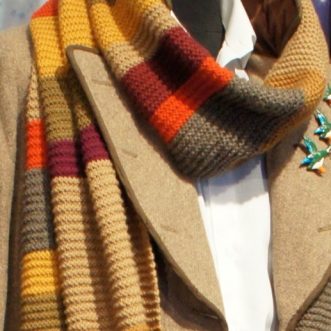
‘Investment’ carries another meaning though – to put on clothes, especially the ceremonial clothes of office.   In other words to publicly adopt the roles and responsibilities associated with that office.

Looked at this way, there are certainly other investors in a business.  The founders, workers, suppliers, and customers who take a risk with their time, energy and belief, in the hope that the return will be worth it.   These (along with some personal capital investors to be sure), are the people who adopt the roles and responsibilities associated with it.   Who clothe themselves in its values, purpose and ways of doing things.   Who may even wear its uniform, badge, or logo publicly and with pride.

Money isn’t the only thing necessary for the long-term success of a venture.   It certainly isn’t sufficient.

What if we focused our dividends accordingly?

If you read one book during lockdown

If you read one book during lockdown

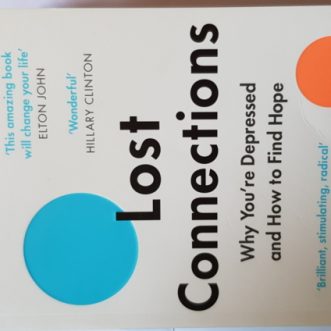
Another read-in-one-go-over-the-weekend book, I recommend.  “Lost Connections”, by Johann Hari.

Appropriate for Mental Health Awareness Week and beyond.

This is a book about what happens to human animals when they don’t get what they need from life:

  • Agency – to make my own unique dent in the universe
  • Mastery – to be continually learning and developing my talents
  • Autonomy – to choose how I make my dent
  • Purpose – to do all the above for something larger than myself
  • Community – in the company of like-minded people
  • Status – and to find my place in that community

It’s also about ways to put it right.

Luckily, for small business owners, putting it right is not that hard.

We can simply make sure everything we do in our businesses contributes at least something towards these things for the people we work with, the people we work for, and ultimately for ourselves.

It starts by reading this book.

And then maybe this one.

Subject, Consumer or Citizen?

Subject, Consumer or Citizen?

Subjects are defined by their relationship with the people who are ‘over’ them.  The word ‘subject’ literally means ‘thrown under’.

Much of what we call history is about groups of ‘superiors’ fighting for control of subjects.   For the subjects, it didn’t matter who you were ‘thrown under’, your life was much the same – nasty, brutish and short.

Consumers, on the other hand, are defined by a repetitive act that embodies their relationship with producers.   Producers make, consumers ‘use up’.   Consumers can come into being once subjects are able to get beyond the basics of subsistence and think about choice.  Consumers make mass production possible.

Citizens are defined by the fact that they share their space with many other people, and by the fact that doing so requires shared values, constant negotiation and active participation to be effective.   Even more so now, when we’re no longer tied to a specific location, but are like Diogenes, ‘a citizen of the world’, whether we like it or not.

It seems to me that being a subject or consumer is perhaps an easier role to play, but rather passive and ulitmately unsatisfying, when you consider that we only have one life.

Citizenship on the other hand, is hard work, but work that is fulfilling both in the short run (because through it we can grow), and in the long run (because done well we make it easier for people in the future to grow).

I know which I’d rather be, and I’m clearly not alone.   It seems we are all heading that way, if we’re allowed to.

This model works at many levels, from a single family to the entire world.

We could make a start with all the companies we’re in.


Many thanks to Anwen Cooper for pointing this out to me:

https://medium.com/new-citizenship-project/subject-consumer-or-citizen-three-post-covid-futures-8c3cc469a984

Reading the signals

Reading the signals

Quite a while ago, I lost a lot of weight.   I was happy with where I was, so I stopped trying.   I ignored the signals (tightening waistbands, reverting to my old clothes), and refused to even look at the ones that would have told me the brutal truth (the scales, mirrors).

Now I’m back to where I started, doing it all again, with 5 stone to lose instead of only 1.

Don’t judge me.

What signals are you ignoring in your business?  Which are you wilfully blind to?  Which are you not even seeing?

From Recovery to Evolution

From Recovery to Evolution

A little while ago, I mused on what might make a good recovery process:

I’ve been thinking about this again, and with a simple addition, this becomes something much more sustainable – a process for evolution as well as recovery:

Maybe we’re always recovering?

Being prepared is much better than trying to predict the future.

Being prepared is much better than trying to predict the future.

Yesterday, I caught a repeat of “The Spark” on BBC Radio 4.   A conversation with Margaret Heffernan on preparedness.

There was far too much in this 30-minute programme to summarise here.   I recommend a listen, but here are some of Margaret’s brilliant thoughts on preparing for various eventualities rather than trying to predict which will happen:

  • “Preparedness is a better mindset when you know you are dealing with things that are generally certain, but specificially amibiguous.”   For example, we know epidemics occur, but we don’t know when, where, or exactly what.   We can’t predict, but we can be better prepared by asking questions like this: “If X (or Y or Z or J) happens, what will we wish we had had?”
  • Too much focus on efficiency (as quickly as possible, as cheaply as possible, as high a utilisation as possible), is the enemy of preparedness. Cutting out the margins for error, leaves no margin for resilience when you need it.
  • It’s a good idea to separate what’s predicitable from what isn’t, and deal with the two things as separate processes.   Human beings are inherently unpredictable, they can’t and won’t be bureaucratised.  Don’t try.   For truly predictable things use technology.   For the unpredictable stuff (such as dealing with human beings), use human beings, they are much better at using their judgement.
  • Surround yourself with people who are different from yourself.  who don’t see things the way you do.  Who will help you ask this question regularly: “If you were wrong, what would you see?”

And if you want to take preparedness even further, I recommend “Antifragile: things that gain from disorder”, by Nassim Nicholas Taleb.

Learning to see things differently

Learning to see things differently

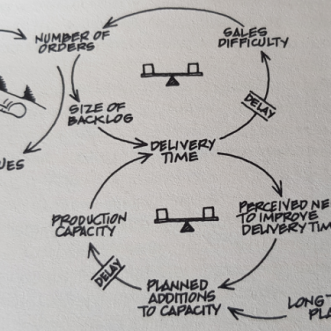
My introduction to systems thinking was “The Fifth Discipline  The art and practice of the learning organization”, by Peter Senge.

That was a long time ago, and you’ve probably never heard of some of the companies used as examples (People Express?), but if you want to learn to see the systems that exist in and around your business or organisation, and more importantly, how they in interact in ways currently invisible,  this is a brilliant introduction.

Forgive the old-fashioned-ness of it, and have a go at spotting and sketching the systems that make a difference to your business.

You’ll soon learn to see things differently.

Long reads for a long weekend

Long reads for a long weekend

As human beings we are complex sytems, inhabiting complex systems.

Some of these are natural – weather, plate tectonics, ecosystems, the galaxy; some we’ve made up ourselves.  And of course, through the social systems we invent, we impact some of the natural ones.

The more we’ve understood our bodies – the physical system we inhabit – the better we’ve been able to cure, contain or prevent individual suffering and maximise the potential for individual flourishing.   The more we’ve understood the natural systems we operate in, the better we’ve been able to exploit or enhance them to our benefit.

As businesses we operate within social systems, and if we want to maximise the potential for it’s individual flourishing, it pays to understand those systems better.

They’re both a long read, but with a bank holiday weekend ahead, Capital in the 21st Century and its sequel Capital and Ideology are a great place to start to understand the social system that’s had the biggest impact on everything in our world for the last 250 years.

If reading is not your thing, Capital is available as a documentary film too.

Remember, all models are wrong, so it’s worth exploring as many as you can.   Some of them may prove useful.

What is simplicity?

What is simplicity?

I found this book in a pound shop.   I read it in a day, and liked it so much I went back and bought up the rest to give to as many friends and clients as I could.

It’s a fascinating read, even to a Mac-heathen like me, and in common with my other recommendations this week, it combines an engaging story with actually useful guidelines.

But at the heart of it is this:

“Simplicity is a core set of values that pervade everything you do.”

Simplicity is much harder to do than complexity.    Especially if you decide to be the only one responsible for it.

What is Marketing?

What is Marketing?

One benefit of this pause we’re in is more time to think about our businesses than usual.

Which makes books like the one I recommended yesterday particularly good reads, if reading is your thing.

Today’s book is “This is Marketing” by Seth Godin.   I recommend it because unlike any other marketing book I’ve come across, it makes you think hard about what marketing is really for.

We usually start our marketing thinking from the wrong side of the relationship:  How much do I need to sell?  Who can I sell it to?  How can I get to that is quickly and easily as possible?

This book challenges you to think from the other side:  Who do you want to serve?   What do they want?  What do they really want?  Can you offer that?   How can you do that best for them?  How does the word spread when you get it right?

The result is a business that may be very hard to get started, but which in the long run creates more, better, more appropriate value.

More, better, more appropriate value is just what we all need going forwards.

This is the book to help you create it.