Labour
“Nothing should be made by man’s labour which is not worth making; or which must be made by labour degrading … Read More “Labour”
Apparently, feeling connected to other people is beneficial to humans.
Perhaps it comes from the fact that at a quantum level everything is entangled. Connection and interdependence is the natural state of things.
Connection makes us healthier and happier. It also makes us powerful.
Doesn’t that feel good?
Lifestyle businesses get a bad rap. As if they are not serious. As if they are not real businesses.
In a ‘lifestyle’ business, people make things, or offer their services, for money, that they then use to buy other things which support and enhance their lifestyle – including keeping the business going.
In a ‘proper’ (i.e. capitalist) business, people put money into ventures that will make them more money, that they then use to put into either the same venture or others, that will make them more money. Sometimes the venture is making things that enhance lifestyles, but it doesn’t really matter what it is (smoking, sugary food, addictive medicines) as long as it turns money into more money. Capitalist business is how we’ve got to the mess we’re in.
But it’s lifestyle businesses that get a bad rap.
When in fact they are the original (and best) business type.
They don’t even have to be small. A lifestyle business can support hundreds of people, maybe even thousands.
The point is that they are about life, not money.
Let’s have more lifestyle businesses, I say.
And let’s make them even easier to run for their owners, so they can get bigger and last longer without turning capitalist.
The reason why voter ID is such a bad idea, is that any physical object capable of serving as a ‘unique identifier’ can by definition be forged. If the technology exists to create it, the technology exists to forge it.
The same is true of a physical product or service. Almost anything about it that you can consider as ‘unique’ can be copied, reverse-engineered or reproduced by someone else.
And will be if you are successful.
The processes around your product are harder to copy, but not impossible. Otherwise franchises wouldn’t exist.
But the values, emotional labour and personality you put into making and keeping the promises around your product or service are uncopiable. Especially if you allow everyone in your team to bring their own self to bear too.
Consistency, not uniformity, is what you’re after.
That’s what makes scaling safe.
It may not feel like it, but regulation is simply another form of feedback for your business. It just happens to be the kind of feedback you are not allowed to ignore.
Think of it as feedback from your industry. Lessons learned by others that can save you grief. Of course not all of it is designed to help your business, sometimes it’s the result of bigger players flexing their muscle in the market, to make it harder for businesses like yours. Even that is useful feedback – telling you where the bigger players feel vulnerable. Use it to your advantage.
Since you can’t ignore regulatory feedback, it pays to have a really clear Promise, and plenty of the other kinds of feedback coming in regularly, so that you can make sure the requirements of regulation can’t unduly distort your unique way of making and keeping your Promise to the people you serve.
That means that as far as possible, compliance, like admin, needs to be a side effect of doing what you’re here to do, not the other way around.
Of course you need to be compliant, but the regulator shouldn’t come first.
They’re not your customer.
“The ultimate, hidden truth of the world is that it is something that we make and could just as easily make differently.” David Graeber.
Somewhere back in the 15th century, probably unintentionally, we remade our world, creating a system we now call capitalism.
This system is so good at reproducing itself it now includes everyone and everything on Earth – and even beyond. Whether they like it or not.
We’ve trapped ourselves inside a system that is good for some, very bad for others and terrible for our planet.
It wasn’t always this way. It doesn’t have to stay this way. We can change the system.
But how? Especially when the people at the top are those that benefit most?
Our small businesses are worlds we make and can easily remake.
Why not start there? Build a tiny version of the kind of world you’d like to see: democratic, participatory, responsibly autonomous, humane, non-extractive. Liberating.
Bottom up, inside out.
Until one day, we are the new system.
You don’t have to lose your business to be able to leave it.
You just have to take yourself out of the day-to-day.
To do this, make everyone a boss. Get the music that’s in your head written down so that other people can play it. Give your people the responsibility and the autonomy to deliver your business’s unique customer experience consistently, in their own style.
The sooner you do this, the sooner you get to choose how much time you want to spend in your business, the sooner you free the business to grow and the sooner you’ll free your people to grow too.
Best of all, you get to keep everything that makes your business uniquely yours.
In the end, you’ll have built a community, not just a business. A community centred around the promises you make and keep for the people you serve. A community that becomes your legacy.
The irony is that all this makes it an even more attractive buy.
But of course by then you won’t want to sell.
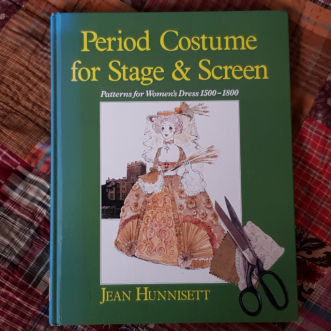
Jean Hunnisett was a costume designer. Someone whose job it is not just to recreate ‘the look’ of a particular period, but to recreate it in a way that is comfortable and practical for the actor to perform in.
People have changed over the centuries, becoming fuller and taller. Clothes have become lighter and less constricting. Women are no longer used to re-configuring their bodies to suit the current trend by wearing corsets from childhood. So a costume designer’s job is never to simply reproduce historical examples, it is to re-interpret, re-measure and re-size those historical examples to produce the desired effect on screen without crippling the actor.
That’s hard work. And Jean Hunnisett did it. Once it was done, she put it out there for the world to share in her costumes and her books. For people like me and Vivienne Westwood to find.
No matter how unique our genius, how brilliant our vision, we achieve nothing alone. We build on the free gifts of human nature left by those who came before and those who work around us now.
That by no means diminishes our achievements.
But it seems only fair to acknowledge the gifts that enable us.
What do you really want?
I’m willing to bet that it’s something like this:
You can build a successful business by delivering this for your clients through what you give them and the way you do it.
You can build a sustainable business by delivering this for your people through the way that you enable them to deliver to clients on your behalf.
Do both, and you’ve sorted yourself out too.
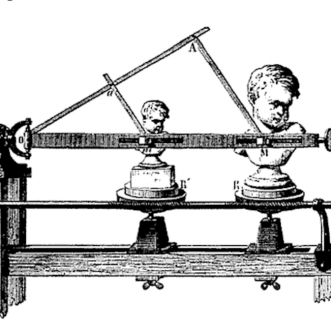
The Mechanical Turk was hailed as a miracle, a step forward in progress, the bleeding edge of innovation. But at it’s heart was a big, fat exploitative lie.
The same is true of many of our current everyday miracles – free delivery, just-in-time manufacturing, ultra-cheap food, computers that fit in our hand.
As yet we have not discovered a way to get something from nothing. Which means that always, someone, somewhere has to do the actual work to make that everyday ‘miracle’ happen. Wearing out their own car at 50p a parcel. Sewing designer clothes in a sweatshop somewhere. Getting paid to vet Facebook posts in a refugee camp – one at a time. Destroying unusable PPS in a prison, or down a poisonous mine extracting the cobalt for your phone.
Just because they’re hidden away in the bowels of the machine doesn’t mean they’re not there.
They shouldn’t be. We don’t need these everyday miracles.
We can work much better ones.
Merry Christmas.
See you in the New Year.