Discipline makes Daring possible.

It’s always been there

It’s always been there

When you’re composing your Customer Experience Score, it’s important to remember that your customer experience music has always been there.

If it wasn’t your business wouldn’t be doing as well as it is.   You have clients who love what you do for them.  You have employees and suppliers who love working with you.   The music is there and it appeals to others.  You’re an expert at playing it.

When we become experts, we turn things we used to have to think about into habits we unconsciously perform.   Some of those habits are excellent.   Some are not so good.   They’re simply the habit we got into that made things ‘good enough’ at the time.

Some habits are downright bad, but we keep using them because to do otherwise takes conscious effort, and when you’re busy looking after clients and teams, that’s hard to do.

Your first job as ‘composer’ of your Customer Experience Score is to make the music as good as it can possibly be.   To surface all your habits, and consciously choose to keep the excellent ones, improve the ‘good-enough’ ones and ditch the bad ones.

It’s an opportunity to deliberately assess whether you could do even more for your clients, or do what you do 10 times or a 100 times better.   To make sure that your music truly reflects your Promise of Value, and to re-shape it so that it does.

This is not straightforward.  Dredging stuff up from your subconscious is hard work.  So it helps to have a framework to build on, and a critical friend to encourage you, push you, suggest solutions and hold you to account.

That’s where I come in.

Discipline makes Daring possible.

Ask me how.

The changes and processes you recommended are coming together nicely. But it all takes so much time!   Slowly but surely I’m disappearing as a boss though :).

Two tools in one

Two tools in one

A musical score is a multi-use tool.   For the composer, its a tool for thinking, for designing.   The score gives concrete shape to the music that’s playing in their head. And once concrete, it can be more easily modified and improved, until it fully reflects their intentions.

From then on, the score also becomes a different kind of tool.  A tool for communicating that vision to the players who will be responsible for delivering it.   A tool that tells them what the performance must convery, without telling them how to do it.    Because as experienced artists, they know that already.

A score can switch between these two uses as many times as it needs to.

A Customer Experience Score works the same way.   It’s a design tool for the business owner, a communications tool for their team.    And like a musical score it can switch between these uses whenever it needs to.

Perhaps even after its composer has disappeared, if the players feel strongly enough about the original vision.

The perfect employee

The perfect employee

“Creative action, one might say, is at any level encompassed within a larger system of actions in which it becomes socially meaningful – that is in which it takes on social value.

All creative action is to some degree revolutionary; but to be revolutionary to any significant degree, it must change that larger structure within which it is embedded.

At which point one can no longer imagine one is simply working on objects, but must recognise that one is also working on people.” David Graeber

In other words, the ‘perfect employee’ is made by how you choose to employ them.

Nodes

Nodes

Yesterday I learned two things from the same street in Soho.

The first was that when you try and force yourself into the box that society/the system has made for you, you may very well die.

The second was that when you design your own box, then connect it with those of other like-hearted people, you become a node, enabling yourself and everyone around you to be so much more than society/the system expects.

It might just be me, but it feels like the nodes are winning, in spite of everything the system/society is throwing at them.

Feeling the water

Feeling the water

If you’re worried about the economy, and what might happen to your business this year, I’m going to recommend this book again:

The Joy of Tax, by Richard Murphy. My copy, photographed by me.


and this free pdf by the same author:

Downloadable from here.

You can’t take the best actions, if you don’t know how the system really works.  Take a moment to feel the water you’re swimming in.

Discipline makes Daring possible

Contribution

Contribution

As a musical instrument, the triangle is often regarded as a bit of a joke.  A bit ridiculous.  Not to be taken seriously.

Yet a composer includes it in their orchestration for a reason – because it’s unique sound contributes to the experience they wish to convey.  Without it the composer’s promise couldn’t be kept.

When times are hard, it’s tempting to strip back on our offer.  To cut down on the details of our customer experience.

Just remember, it’s your promise you’re really stripping back.  Eventually it will show.

Use your natural ingenuity to find a better way to keep it instead.

What you don’t know can hurt you

What you don’t know can hurt you

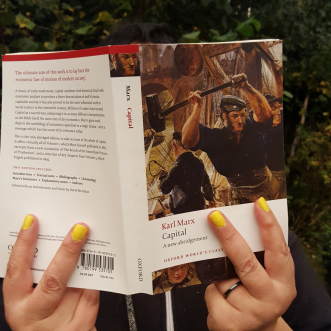
Even if you’re sure you’ll disagree, it’s worth reading Marx’s ‘Capital‘.  Especially if you’re a small business owner.

As an explanation of how ‘the system’ works, its far more enlightening than anything I was taught at London Business School.

I’m also pretty sure that most of the people who attend the World Economic Forum at Davos have read it, and use that knowledge to their advantage.

Knowing Marx won’t hurt you, The least that will happen is that you have another lens to see things through.

Discipline makes Daring possible.

PS Even better read in conjunction with Professor David Harvey’s ‘Companion to Marx’s Capital‘, or with his open lecture series at The People’s Forum in New York City.


Factors of production

Factors of production

From our perspective as a user, the search engine, the AI generator, the social network, the online shop are simply tools.  Tools we use to do the things we need to do for work or pleasure.

From the perspective of the tool owners – Alphabet, OpenAi, Meta, Microsoft, Amazon – they are not just tools, they are a factor of production.  As we are.  We are the factor that creates value.

Why then do we give our labour for free?

Because the factory is hidden from us, of course.   That way we can’t withdraw our labour.

Machines

Machines

Prompt: “short, scrawny figure; hunched shoulders; weak, sagging jawline; thin, greasy hair; unkempt, unruly style; dull, lifeless eyes; lack of intelligence, confidence; wrinkled, sallow skin; excessive stubble; crooked, hooked nose; thin, pursed lips; flabby, untoned body; undefined, flabby muscles; exudes weakness, insecurity, unattractiveness; epitome of masculine ugliness; timid, self-doubting; air of nervousness, insecurity; truly a sight to avoid; unimpressive” via Midjourney v4, prompt generated by chatGPT after requesting description of the opposite of a perfect man“. Cameron Butler

“If the necessary reasonable work be of a mechanical kind, I must be helped to it by a machine, not to cheapen my labour, but so that as little time as possible may be spent on it.  It is the allowing machines to be our masters and not our servants that so injures the beauty of life nowadays.”  William Morris

Labour

Labour

“Nothing should be made by man’s labour which is not worth making; or which must be made by labour degrading … Read More “Labour”