Discipline makes Daring possible.

Less, but better

Less, but better

“You cannot understand good design if you do not understand people; design is made for people.” Dieter Rams ‘Design by Vitsoe’, 1976

Good Design:

  1. is innovative – The possibilities for progression are not, by any means, exhausted. Technological development is always offering new opportunities for original designs. But imaginative design always develops in tandem with improving technology, and can never be an end in itself.
  2. makes a product useful – A product is bought to be used. It has to satisfy not only functional, but also psychological and aesthetic criteria. Good design emphasizes the usefulness of a product whilst disregarding anything that could detract from it.
  3. is aesthetic – The aesthetic quality of a product is integral to its usefulness because products are used every day and have an effect on people and their well-being. Only well-executed objects can be beautiful.
  4. makes a product understandable – It clarifies the product’s structure. Better still, it can make the product clearly express its function by making use of the user’s intuition. At best, it is self-explanatory.
  5. is unobtrusive – Products fulfilling a purpose are like tools. They are neither decorative objects nor works of art. Their design should therefore be both neutral and restrained, to leave room for the user’s self-expression.
  6. is honest – It does not make a product appear more innovative, powerful or valuable than it really is. It does not attempt to manipulate the consumer with promises that cannot be kept.
  7. is long-lasting – It avoids being fashionable and therefore never appears antiquated. Unlike fashionable design, it lasts many years – even in today’s throwaway society.
  8. is thorough down to the last detail – Nothing must be arbitrary or left to chance. Care and accuracy in the design process show respect towards the consumer.
  9. is environmentally friendly – Design makes an important contribution to the preservation of the environment. It conserves resources and minimizes physical and visual pollution throughout the lifecycle of the product.
  10. is as little design as possible – Less, but better – because it concentrates on the essential aspects, and the products are not burdened with non-essentials. Back to purity, back to simplicity.

Imagine if we designed organisations and processes this way too?

“keep the human in view”

“keep the human in view”

In today’s ‘Thought for the Day’ on Radio 4, Tina Beatty told us of an insight by Hilary Cottam, which is that many big ‘social welfare’ projects fail ‘not because of a lack of funding, but because of a lack of attentiveness to what people really need.’  For women without easy access to water, a well in their village is a far better – and far cheaper – solution than building a dam.

As Tina said, this seems so obvious, why is it being viewed as radical?

I think it’s because ‘failure’ depends on which side of the funding you are on.  Take a look at the diagram in this piece by Richard Murphy to see the kind of thing that often happens.

What actually makes Hilary Cottam radical is that she’s suggesting that the ostensible purpose of these projects should also be the real one.

All too often, we mistake what we want for what the people we claim to serve want.

Once you know this, what you do for the people you serve can get simpler.


A short cut

A short cut

Today is ‘A’ level results day.   I hope that everyone gets the results they want.

But if you don’t, I hope that you remember that the results you wanted were only a short-cut to wherever you want to go.

That destination isn’t closed off to you, it’s just that you might have to take a more roundabout route to get there.

And we all know that travel broadens the mind.

The beauty parade

The beauty parade

The problem with forcing yourself to conform to a particular ideal of ‘beauty’, as an individual or a business, is that over time and space, what constitutes that ideal changes.  Plus of course it is an ideal, never actually seen in nature.

Of course this is the point.  No one can possibly keep up, but they will spend time, money and energy trying.  Time, money and energy that could be spent on things that are more dangerous for the status quo.

Yet, as humans, we find beauty in the things we love.  Whatever the beloved looks like, becomes by definition, beautiful.

That means there’s no need to define yourself by another’s standard.   Live up to your own.

The right people will see your beauty.

Unsung Innovators

Unsung Innovators

We’re fond of the oddball genius, the outsider who sees possibilities that nobody else could, the creative destroyer that starts with a clean sheet, cross-fertilising industries or disciplines to generate a great leap forward.

But there is another breed of innovator, just as valid.  One who combines deep knowledge and understanding of what’s gone before with an openness to novel solutions that enhance that past rather than destroying it.   Driven by a straightforward desire to make things better.

Unicorns and racehorses.   We need both.

Better tools

Better tools

One of my favourite Seth Godin aphorisms is this one:

“Make things better by making better things.”

Making things better is what humans do.  And we mostly do it by creating new, better tools – tools for making and tools for doing; tools for organising and tools for co-ordinating; tools for learning and tools for thinking; tools for connecting and tools for feeling.

For me, great tools extend human capabilities without undermining the humanity behind them or the context around them.   They make us both more human and more part of the world we live in.

Our very best tool is our ability to re-imagine what ‘better’ means.

Counting

Counting

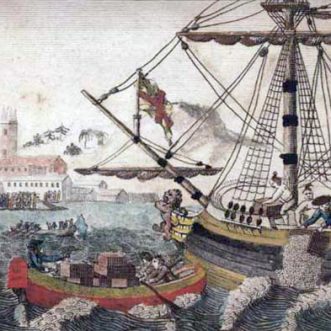
“No taxation without representation!”

We’re all familar with the demand that triggered the American war of independence.

Colonists felt it was deeply unfair that they should have no say on how they were governed from afar, but still had to pay duties on luxury goods received via that far-off government.

Nowadays there are those who would like to flip this idea around, claiming that those who pay ‘no tax’ should not be represented in government.

This is based on misinformation of course, ‘no tax’ in this case means ‘no income tax’.   People who are not eligible to pay income tax still pay national insurance, VAT, fuel duty, tobacco and alcohol duties, car tax, insurance tax, and these taxes often represent a significant proportion of their income.

What those suggesting “No representation without taxation” are really saying is “You don’t count.”

Tax is far too important to merely avoid.   Time to think differently about it, before it’s too late.


Lenses

Lenses

We all see the world through our own particular lenses of values, experience, beliefs.   We wear those lenses closely, as if they are part of us.

We form them through conversation, reading, watching – by temporarily seeing through other people’s lenses.

It’s important to be aware of this.  It’s also important to actively seek out different lenses through which to view the world.

Otherwise, its easy for those lenses to become blinkers.

Do no harm

Do no harm

One of the books I’m reading at the moment is “Jainism and Ethical Finance”, by Atul K. Shah and Aidan Rankin.

The first vow taken as a Jain is ahiṃsā  – non-violence or the desire to do no harm.

The interesting thing about this is that it extends beyond humans to animals, insects, microbes and even plants.   Strict Jains are vegetarians who do not eat roots, because this destroys a plant’s ability to reproduce itself.

That is a very thought-through concept of impact, that we could all learn from.

Especially as it doesn’t prevent Jains becoming highly successful business owners.