Discipline makes Daring possible.

Why do I need process if I have good people? Responsibility

Why do I need process if I have good people? Responsibility

Why do I need process if I have good people?

Having a process to follow while they learn, gives people confidence that they are doing the right thing.

Once people are confident that they know what they are doing, they don’t wait to be made accountable – they take responsibility.

With the confidence of a process behind them, your good people can pretty much manage themselves.


Browsers welcome

Browsers welcome

I’m old enough (just) to remember when you weren’t really supposed to go into a shop unless you were serious about buying.

You couldn’t just see what they had.   As soon as you were through the door an assistant pounced on you.

Soon, retailers realised that letting people browse increased sales.   Times had changed.  People had spare cash.  They were no longer buying to fill a need, but to fill a mood.

Today, of course, browsing is always welcome.

Only now, online retailers do the equivalent of chasing you down the street with stuff you browsed – “Hey, you looked at this and didn’t buy it!  Why don’t you buy it?  Go on, you know you want to really!”.

Desperation is not a good look.   It’s not healthy either – especially if it works.

The best protection is permeable

The best protection is permeable

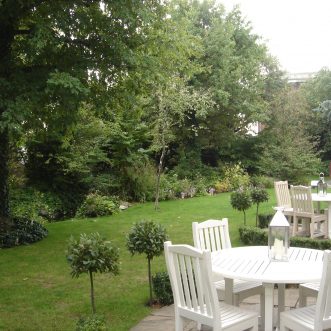
As every Chelsea gardener knows, the best way to protect your garden from wind is not a solid wall or fence, but a permeable barrier like a hedge.

This filters the wind, slowing it down, letting in fresh air to circulate among your precious plants and shrubs without damaging them.

A solid barrier on the other hand lets air crash over it like a wave – and then falls at the first gale.

Not freedom or order, but freedom and order.

Not freedom or order, but freedom and order.

This is the second post inspired by an extract from ‘Leadership and The New Science’ by Margaret Wheatley, entitled “Change, Stability, and Renewal: The Paradoxes of Self-Organising Systems

To recap: if a business has a strong frame of reference in place – its Promise of Value and its ‘way we do things round here’ – then it can be confident that any changes that occur will be consistent with that frame of reference.

This means that not only a business can afford to be open to small variations (what Holacracy calls ‘tensions’), it needs to be – especially to small, persistent variations that are driven by the people it serves – its customers.

This in turn means that it makes sense to give people full autonomy to respond to variation, because you know they will do so in line with the Promise of Value at the core of the business, so no harm will be done, and because what starts as a small variation may well turn into a new opportunity, a new product or service, a new way of doing things, that makes the business stronger and more stable over time.

Most of us like things to stay the same, we seek order and predictability.   We fear that loosening control will lead to too much fluctuation and eventually chaos, so we tend to keep systems rigid and control centralised.

The paradox is that the opposite is what we need to maintain the identity and stability of our business over the long term.

Not freedom or order, but freedom and order.

Discipline makes daring possible.


Autopoiesis. How self-organising systems evolve.

Autopoiesis. How self-organising systems evolve.

Last weekend I spent a day going through my old London Business School notes before throwing them out to make room.   Its 21 years since I did my Sloan Fellowship, so this stuff is bound to be out of date.

Still, I skim-read quite a bit of it – lecture notes, my coursework, case studies – along the way, and I was struck by how much of it still resonated, especially an extract from ‘Leadership and The New Science’ by Margaret Wheatley, entitled “Change, Stability, and Renewal: The Paradoxes of Self-Organising Systems

According to Ms Wheatley, that’s not at all surprising.   One of the characteristics of a self-organising system (e.g. a human being) is that “as it changes, it does so by referring to itself [autopoietically]; whatever future form it takes will be consistent with its already established identity”,  “when the environment demands a new response, there is a reference point for change.”

For a business that reference point is it’s Promise of Value.   The more clearly and explicitly that is spelt out, and built into the way a business works, the more resilient that business will be – not because it won’t change, but because changes will always be adopted in a way that is consistent with that Promise.

As long as the system is self-organising, that is.    More on that tomorrow.


Processes, procedures, workflows

Processes, procedures, workflows

The terms ‘workflow’, ‘procedure”, ‘process’ are often used interchangeably.   I think it’s useful to distinguish between them, because they are doing different things.

A workflow does what it says – it describes how responsibility for an activity flows around your organisation as if it was a physical thing moving between departments – a purchase order is raised, goes to X to be reviewed, then to Y to be authorised, then to department Z to be actioned.

A procedure describes the steps needed to complete a specific activity, e.g. Raise Purchase Order, in the same way as a recipe describes how to prepare a specific dish e.g. a Lemon Drizzle Cake.   Like a recipe, it assumes you know how to do the steps – whisking an egg-white, or completing a purchase order form.

Processes are like the storylines of a film or novel.   As in a film, or novel, each character has their own storyline, and is changed by it.   And like a film or a novel, its best to start from the top and work down – to the point where you can define individual scenes or procedures.     Unlike a film or novel, an organisation has many individuals playing the same roles, both over time and in parallel, so needs to leave some room for improvisation.

Its relatively straightforward to capture a procedure, or even a workflow, its much harder to capture process.   But that’s where the real value is for an organisation, because to live the story, everyone needs to understand the story.

Systems and processes

Systems and processes

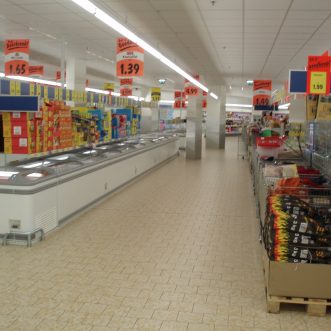
Having a staff member sat idle at an empty checkout lane feels wasteful.

So the company policy is to train staff to do everything in the store, so when its quiet, they can be re-stocking, tidying up or whatever else needs to be done. When it gets busy, people jump back onto their checkouts to quickly get the queue down.

Not a bad policy, provided you have enough people.

But having a staff member sat idle at an empty checkout lane, or casting about for something to do still feels wasteful. So its tempting to the store manager to cut the total number of people. “We have a self-checkout people can use, so unless its really busy, we don’t need any other checkout open, and I can handle that – I can make more profit with a smaller team.”

Now you’ve introduced a bottleneck for customers, a bottleneck some of them are going to dislike so much they will stop shopping with you, despite all the changing stock you put in to encourage return visits, browsing and impluse buys.

Your shop gets less busy, so you cut down further on staffing levels. The queues at the self-checkout get longer, the queue at the manned checkout even longer.

Suddenly you’re hardly ever busy, and company management are wondering whether your store is viable.

3 points:

  1. Checking out is merely one step in the customers’ cyclical process of shopping. Before optimising any step, consider its impact on the process as a whole.

  2. A store is a system designed to enable that process for the people you serve locally. All systems need slack if they are to work efficiently.

  3. A store is part of a larger company system designed to make and keep a particular promise to a particular set of people. Before optimising anything, consider whether it will reinforce that promise or undermine it.

It is of course perfectly OK to put some people off shopping with you – so long as you do it on purpose, and only to the right people.
User-centric

User-centric

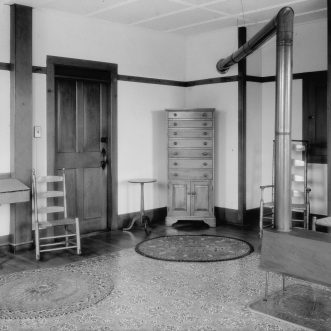
The Shakers knew that people wouldn’t be able to resist chair-tilting, so they invented a mechanism that would make it safe for the chair and for the person.

They also made their chairs beautiful.

That’s what I call user-centric design.

Distance

Distance

At home, if I burn my hand on the handle of the grill pan on my cooker (because I’ve forgotten that when the oven is on, the grill also gets hot), I don’t have to report that to my boss, who’ll report it to her boss, along with all the other mishaps of the kitchen. I don’t have to wait for a decision from them on how best to avoid that next time.

Of course not. I’m a grown-up. I say to myself “stupid woman, of course that would be hot!”, and remind myself to use an oven-glove next time. And I do. I don’t need a notice on my grill pan handle saying “Caution – may get hot”.

If I keep burning my hands, then I need to find out why. Are my oven gloves getting lost? Am I rushing things too much? Should I buy different oven gloves that are easier to use? Should I invest in a different cooking arrangement?

Of course this is fine for me, I don’t share my kitchen with other cooks. But I think the principle is the same.

Given the responsibility and the means, the people in the kitchen are probably best placed to solve most kitchen problems.

Reporting

Reporting

Nobody likes reporting. It gets in the way of doing the job.

Because it feels like an extra task, it gets pushed back to the last minute, and possibly even made up. Worse, it can be very tempting to request more information in a report, because ‘they’re reporting anyway’.

On the other hand, feedback is essential if a business is to thrive and evolve.

So how best to get feedback you can rely on?

Firstly, keep it simple. What is the least you need to know whether are not things are going well?

Secondly, make collecting that information a side-effect of doing the job. The trick here is to find a step in your process that creates its own trail. A step that either gives you the data you need or can act as a proxy for it. If that’s not possible, sample instead of monitoring continuously.

Of course, reporting as we know it only happens because the person doing the job is not the person making decisions about how best to do the job.

That’s where the real problem lies, and the solution to that is responsible autonomy.