Discipline makes Daring possible.

Are there too many managers?

Are there too many managers?

That was the question asked on ‘The Agenda with Steve Paikin’ the other day.

Of course it’s the wrong question.

One real question is “How do you build an organisation that takes individual competences and creates an organisational capability”.   In other words, how do you co-ordinate the activities of different people into a consistent,  repeatable business activity?

Another is “How do we create organisations that are as capable of as the people inside them?”.  In other words, how do you make sure that individual capabilities are not stifled/wasted in the process?

If you want your business to achieve its purpose effectively and efficiently, you have to find a way of managing that addresses both of these questions.

Managers are a solution, but they aren’t the only one.  And they may not be the best.

Resilience

Resilience

When I finally worked out what was going wrong with my website last week I was appalled.

It was a miracle I hadn’t felt the consequences much sooner.  Only the fact that the internet is literally a world-wide web, full of redundancy and alternative routes had kept everything working for so long.

That’s because it’s an ecosystem, and in an ecosystem variation and redundancy is actually what keeps it stable over time.

A machine, in contrast, would have simply stopped long ago.

If something wasn’t quite right in your business, would you want it to carry on working, or would you prefer it to stop immediately?

If you want to make sure it carries on, you might want to build in some redundancy, and some tolerance for variation.

Sleep

Sleep

I’ve finally found a way to lose weight effortlessly – get more sleep.

Sadly for me, this isn’t an answer.  I get a good 8 hours a night.   And even that may not be natural.   In the past, getting those eight hours took longer.  People took two sleeps, with a gap between, where they might read, chat, sew, make love or even get up and do stuff.

Industry made that impossible for most people.  For the past 500 years or so we’ve gradually compressed the opportunity for sleep into a smaller and smaller timeframe. Which is of course counter-productive.  Well-slept people are mare productive, and less dangerous to themselves and others.

For all the emphasis on LEAN and reducing all forms of waste, Muri – wasted effort due to overburdening or stressing people, equipment or systems, is the one we consistently ignore.

One of the best ways to reduce it, is to increase the efficiency of our time at work.   Automate drudgery, make sure people know what they are supposed to be doing and why, give them autonomy over how and where they do it.

The reward for the business is increased profit.  A side-effect is more time for everyone – including you.

Early learning

Early learning

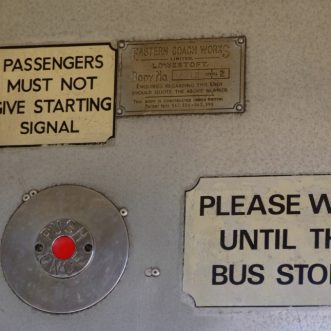
In the olden days, there was only one button you could use to request the bus driver to stop, and in the outskirts of Newcastle, where I grew up, only one person could press it – the bus conductor.

No exceptions.

There were other rules too.   There was a special school bus, which only allowed children on board.   And where there was a school bus, children weren’t allowed on the normal (rush-hour) buses.

No exceptions.

Until my first day at primary school.

My mum wanted to take me on my first day.   It was a fair way to go, so she thought we’d get the bus.

But I wasn’t allowed on the ordinary bus.  She wasn’t allowed on the school bus.

No exceptions.

My mum argued:

It’s her first day, I want to take her myself.

No exceptions.

“It’s just for the first day”

No exceptions.

“Surely you’ve had this happen before?”

No exceptions

It wasn’t just stubbornness on her part.  She realised that it wasn’t just her, it was every mum that missed out.*

She staged a 1-mum sit in until she got her way.

In theory, having separate buses during rush-hour was a great idea.   But the people who designed it hadn’t thought of the human aspect – that most mums would want to accompany their child to their first day at school.  If they had thought of it, it could have been easily accommodated, with an extra bus on the first day of a new school year, and exceptions allowed in between.

Instead they made the whole experience stressful for everyone.

I don’t know if my mum changed anything permanently, but at least she tried.

We were late for school, but I learned something useful that morning.

If you think something is wrong, don’t just put up with it, do something.


*I should mention that my mum had form. At her school, she’d successfully negotiated a permanent change of uniform for 16 – 18 year old girls – away from St Trinan-style gymslips to a more comfortable and becoming blouse and skirt ensemble.

Our best selves

Our best selves

Being ‘all of yourself, to everyone, all of the time‘ is what we might call being our ‘best selves’, our ‘whole selves’.

If you want your people to bring that ‘whole self’ to work, you have to make sure the work feeds it properly:

  • logical and creative,
  • thinking and feeling,
  • independent and communal,
  • autonomous and collaborative,
  • leading and following,
  • familiar and innovative,
  • left brain and right brain,
  • etcetera,
  • etcetera,

If you only use half the person, you’ll only get half the job.

In other words, the work needs to empower them to be fully human.

The investment pays off.   Handsomely.

Chains

Chains

Here’s Peter Drucker talking about management chains, way back in 1954:

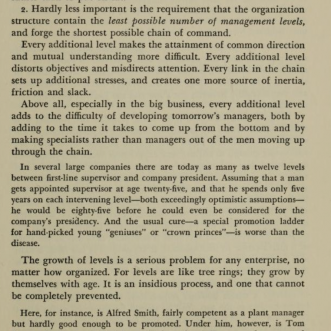
“Every additional level makes the attainment of common direction and mutual understanding more difficult.  Every additional level distorts objectives and misdirects attention.  Every link in the chain sets up additional stresses and creates one more source of inertia, friction and slack.    Above all, especially in the big business, every additional level adds to the difficulty of developing tomorrow’s managers, both by adding to the time it takes to come up from the bottom and by making specialists rather than managers out of the men moving up the chain.”

There’s a good chance that these observations reflect your reasons for setting up on your own – so you could focus on the customer rather than your boss(es), and so you could have complete autonomy over how you serve those customers.

But as you grow your own business from just you to more than a few, how do you stop yourself replicating the structures you found so constricting?

Simple.

Make everyone a manager – not of other people, but of the process every business runs – making and keeping promises to the people it serves:

disappearing boss course card


When everyone’s a boss, there’s no need for chains of any kind.

Thanks to Michele Zanini for the prompt.

Bullshit Jobs

Bullshit Jobs

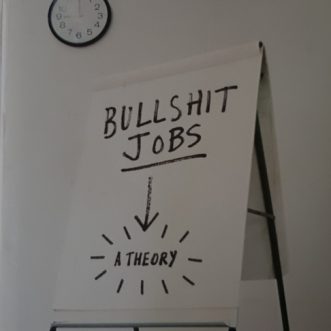
This week, I’ve mostly been re-reading this book by David Graeber, published what seems like a lifetime ago in 2018.

In 2015, YouGov published a poll, showing that when asked whether their job “makes a meaningful contribution to the world?” 37% of respondents said ‘no’, and 13% of people said they didn’t know.  That’s a terrible waste of human potential.

Until recently many of those 37% or 13% will have been furloughed, while many of the other 50% weren’t – their jobs (care workers, nurses, shop workers, bus-drivers etc) were simply too ‘key’ to allow that, or they were self-employed.

I wonder whether furlough gave some of the 37% time to re-think what they wanted from work?   Is that what’s behind ‘The Great Resignation”?

What seems to be fairly clear from my re-reading of this book, is where most of those ‘bullshit jobs’ are.   They’re in corporates, or privatised government agencies.

Where they aren’t is in small businesses.

One more reason why I believe bigger small businesses are the future.

Bollards

Bollards


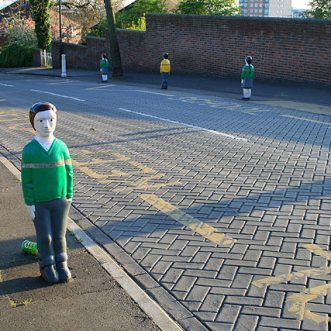
There are quite a few traffic bollards near where I live.   They are there because in the past, drivers persisted in using the narrow pavements inappropriately, endangering other road users, and damaging the fabric of the public realm.

For at least one set, the need has disappeared.  Lorries delivering to the school across the road used to go up onto the pavement in order to reverse through the gate.  The school has since moved and widened their gate, making this manoeuvre unnecessary.   The bollards remain, narrowing the pavement even further.

Bollards, like rules, are a last resort.  A physical or legal barrier erected to block behaviours that have proved impossible to prevent by other means.

The trouble with this is that most bollards don’t tell you why they were erected.  They seem arbitrary, so they leave behaviour untouched.

But if you design them with a bit of imagination, they can both block undesirable behaviour in the moment, and change it for the future.

In other words, rules, like bollards, are part of a process, not an event in themselves, and if you treat them that way, you’ll make them more effective.

Saying it better than I can

Saying it better than I can

This post from Seth is so good, I have to give it to you in full:

Customer service is free

Most large organizations would disagree.

They hire cheap labor to answer the phone. They install recordings to mollify people who are on hold for hours. They measure the cost of the call center and put loopholes in the warranty.

When you see customer service as a cost center, all of these steps make sense. Any money spent lowering costs seems to raise profits.

But customer service is actually a profit center, for four reasons:

First, because the customer who calls you or shows up at the adjustments window is fully enrolled. Unlike just about every other moment you’ve had with them, in this moment, they are paying attention, leaning into the situation and on high alert. Everything you do here, unlike just about every other marketing interaction you have, will go on your permanent record.

Second, because your competitors have foolishly decided to treat this interaction as a cost, the chances that you can dramatically overdeliver are pretty good. You can’t make a car that’s ten times better, but you can easily produce customer service for your car customers that’s ten times better than what most manufacturers deliver.

And third, because in our industrialized economy, people love to tell stories about service. And so the word spreads (or doesn’t) based on what you’re about to do.

Finally, it’s been demonstrated again and again that the most valuable customers are the loyal ones. While your promotional team is out there making noise to get you new customers, you’d be much better off turning your existing customers into repeat customers and ambassadors.

And so, the money you spend on customer service isn’t simply free. It actually repays you many times over.”

Customer service is an opportunity to play a different game, an infinite game of connection.

The irony is that when it’s genuine, it leads to more profit, not less.


PS it’s not so different when governments spend money on people at the bottom of the pile instead of the top.   They get more back than they spend.  And their people flourish.

Reconciliation

Reconciliation

You run a business with a partner.  One of you hates not knowing what’s going to happen, the other loves that.   One favours planning, the other seeing what happens.  This is a source of much tension.

How could you reconcile these opposites to get the best of both worlds?

Simple.

Give yourself a safety net.  A floor below which things cannot go.  Or as Mr Nassim Taleb would have it, protect yourself against the downside.

Design repeatable processes that ensure ‘the least that should happen’.  The planner will be much more comfortable with possibility when you’ve ruled out the worst.  You can both be open to the upside.

When you find it, move the net up, and repeat.

This doesn’t only work for partners, it can help everyone who works with you to reconcile their individual appetites for risk.