Discipline makes Daring possible.

Renewable energy

Renewable energy

By convention, everyone inside a business tracks the boss.   Orders come down from on high, performance data is sent back up the line to the top.  Orders are adjusted and sent back down again.   New performance data is sent back up the line.   And so on.

Who does the boss track?   In a public company, it’s often the share price.   The opinion of the financial markets, of potential traders in those shares – not investors, they rarely hold shares long enough to be truly investors.

What if everyone in the business tracked the people they serve instead?

They’d be powered by a completely renewable energy that’s also sustainable and efficient.

Customer experience, service delivery

Customer experience, service delivery

Like many large organisations, the NHS has a Director of Customer Experience.

As if Customer Experience is somehow separate from Service Delivery.  As if they aren’t two sides of the same coin.

Now, I might be wrong, but this feels like a bit of a bolt-on.  Like the customer might actually the last person to be thought of in the whole mechanism.

In any business, what the customer experiences is your Service Delivery.   Design that intentionally around what will truly serve and delight your customer.   Then make sure it happens consistently and you can’t go far wrong.

That way you won’t need an expensive Director to convince people you are doing it.

The Law of Attraction

The Law of Attraction

I’ve never seen Anthropologie, the retail chain, advertise.  They don’t waste their time, money or energy putting themselves in front of people who aren’t interested in what they have to offer.

Instead they have identified very clearly who it is they want to attract into their stores, then created stores that are magnetic to that kind of person.   You either walk past an Anthropologie store, or you walk in.  And if you walk in, it’s very likely that you’ll buy something.

It goes even deeper though.   Anthropologie’s promise is to send their clients out of the store looking and feeling fabulous.  And they are prepared to forego short-term sales to achieve this.

When I was at business school we were told the story of one store that sacked their ‘best’ salesperson.   The salesperson was great at selling, but at the expense of sending the customer home with clothing that didn’t make them look and feel great.

For the people Anthropologie serves, Anthropologie’s aim is become part of who they are.  Nothing less will do.  They wait patiently for the right people to find them, then keep their promise to them religiously.  The result is a growing community of enthusiasts.

That’s not magic, that’s dedication.

A productivity problem

A productivity problem

This week, my husband took his father on a 90-mile round trip to see a consultant, only to be told “We don’t do that here.”

Why?

For the same reason a jury of 12 people can hang around for days waiting for a case, only to file into a courtroom and be told “We can’t try this case now.”

Because the process has been designed around the wrong role.

No wonder we have a productivity problem.

The Status Quo

The Status Quo

We like to stick with the status quo, believing that if we do nothing, nothing will change.

But in a complex evolving system things are always changing.  All we can do is try and shape those changes.  To make possible new status quos that are better than the one we have now – and now – and now.

This is an almost impossible task.  But not to be given up.

Because if we don’t choose the shape of the next possible status quo, someone else will do it for us.

Or against us.

“What comes to pass does so not so much because a few people want it to happen, as because the mass of citizens abdicate their responsibility and let things be.” ~ Antonio Gramsci

Measuring doughnuts

Measuring doughnuts

In an earlier post, I asked why it’s deemed important to report on the FTSE 100 index at every news on the radio, and what relevance that index has for most ordinary people.

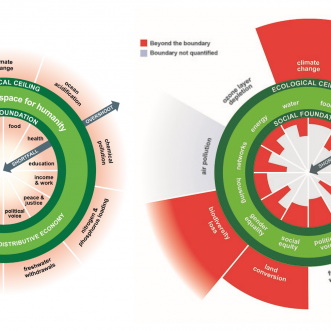
There are alternative things to measure, that matter more to most people, and I think Kate Raworth’s doughnut pretty much captures them all.

What if instead of the FTSE, we had a daily snapshot of our impact as a nation on overshooting the ecological ceiling, or undershooting the social foundation?   What if we could see every day how well we are doing at keeping within “the safe and just space for humanity”.

Like the FTSE and other indices, this snapshot would be made up of data from millions of enterprises large and small across the country, and that means that each enterprise would need to measure it’s own impact too.

That’s completely doable, if we set our mind to it, with the help and support of our accountants.

Why wait?  Let’s start now.

Hitting eyeballs

Hitting eyeballs

In 2011, the city of Sao Paulo banned billboards and logos from it’s streets and buildings.

Despite protest from advertisers, the move made hardly any difference to the economy of the city.  People still bought stuff.  The only people who lost out were the people selling advertising space.

Which raises three interesting questions.

  1. Is reaching ‘eyeballs’ the same as reaching people?
  2. If ‘eyeballs’ are out of the question, how would you get the people you wish to serve to realise you exist?
  3. Why is selling advertising still a thing?

Extending the franchise

Extending the franchise

Enfranchisement: verb (used with object), en·fran·chised, en·fran·chis·ing.

  • to grant a franchise to; admit to citizenship, especially to the right of voting.
  • to endow (a city, constituency, etc.) with municipal or parliamentary rights.
  • to set free; liberate, as from slavery.

Franchising creates a business within a business, where the management of a branch of the original business is outsourced to a third party, who pays for the privilege.

Franchising works because it balances autonomy with responsibility.  If I buy a franchise, I own that business, I get to keep most of the profit, I manage my branch as I see fit.   At the same time I have a responsibility to the parent business and my fellow-franchisees to maintain and even enhance the brand.

For this reason, good franchisors recognise that they need to communicate ‘how their business works’ to franchisees.  Not just technical stuff, such as how to put together a pizza or prescribe a pair of glasses, but the customer experience stuff too.   Sometimes, if my potential franchisees are unlikely to be business owners already, even how to monitor business performance.   Then they let the franchisee get on with it.

A good franchise takes a lot of effort to set up, but once set up it is relatively straightforward and quick to replicate and expand.  Done properly, franchising is a brilliant way to grow a business without killing yourself in the process.

It’s possible to give yourself a head start.

Enfranchise the people inside your business first.

Repetition

Repetition

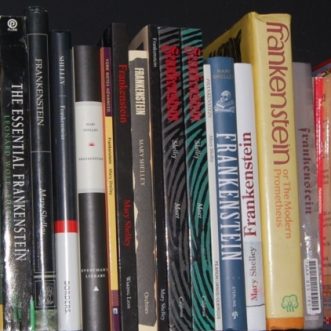
I own a few thousand books, all of which I have read multiple times.

Why do I do this?

Because every time I read a book, I’ve changed since the last time I read it, so my interpretation of it changes.  I see different things in it, notice different character traits, or different ways of using words than I did before.

I also own several editions of the same works.

Why do I do this?

Partly for practical reasons.  Some editions fit more easily into a pocket than others.   But mainly because the experience of the physical book is different in each case.  Some have fine, almost transparent pages of thin, crisp paper.  Others are thick, rough-textured.   Some even have edges cut by the book’s first reader.   Typefaces vary.  The smell and heft of each edition is different.

You may think I’m weird (I know I am), but I bet you’ve re-read a book, or re-watched a film, or watched a remake of a favourite.  You will have heard different versions of the same song, and sometimes preferred a cover to the original.  I bet you’ve eaten the same dish at different restaurants, or at the same restaurant at different times.  Not because you want it to be identical, but because ‘the same but different’ is interesting.

Repetition is comforting, reassuring.  Repetition with variation is comforting, reassuring and enriching.

Something customer experience designers could learn from.