Discipline makes Daring possible.

Why this? Why you? Why now?

Why this? Why you? Why now?

Bernadette Jiwa has a real gift for encapsulating the essence of a problem in few words.    I’ve had these 3 questions from a hypothetical customer running round my head for a couple of weeks now, as I work out how to apply them to what I doing.

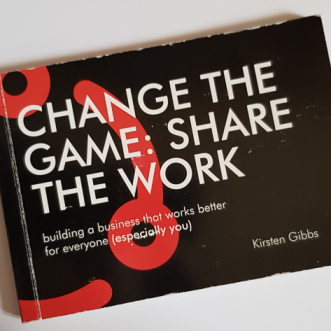
My new book is out soon, so I thought I’d give answering them a go:

Why this?

Because all the small business owners I’ve met want 3 things:

  • to do a great job for their customers or clients.
  • to do right by the people who work for them and with them.
  • to build a better life for themselves, their families and their communities.

They need to make profit to do that effectively.  This book gives ideas for how to approach the first two in a systematically different way, to get more of the third.

Why you?

Because I’ve used this approach to help businesses achieve all 3 of their goals, and I want to teach more business owners how to do it for themselves.

Why now?

Because if we want a better world for everyone (if we want a world we can live in at all), we have to find a better way of doing business.  This won’t come from the top, so we small business owners must make it happen from the bottom up.

That was an interesting exercise.  What would you answer?

Beware the black box.

Beware the black box.

The great thing about a musical score is that it tells you what to play, not how.   It tells you which notes, in which order and at what speed.  It can also give you hints about the mood you’ll be trying to create.

What it doesn’t tell you is how to play those notes.   It assumes you know.   Neither does the score dictate what instrument is used.   As long as you produce the right notes, in the right order and at the right speed to produce the required mood, you can play them on anything – from a crumhorn, to an electric guitar, to a computer – and the listener will probably recognise the music.

This is what gives a musical score longevity.  It can be picked up centuries after it was originally written, played with completely different instruments by completely different people, yet sound broadly the same as when it was first performed.

Imagine what would have happened if Mozart had simply taught his musicians their parts by rote, tightly coupling the ‘what must happen’ with the ‘how we make it happen at the moment’.

He would have created a black box, that could make music only for as long as the specific players he taught could remember it, or the instruments they used were available.  A black box limited by the number of people Mozart could physically teach; that would be impossible to interrogate, update or re-interpret; that would quickly become obsolete.

If you seek longevity or scale for your enterprise, keep ‘what must happen’ separate from ‘how we make it happen at the moment’.  Given the ‘what’, future generations will be able to work out ‘how’ for themselves.

Playing with change

Playing with change

Aversion to new kinds of food is an instinct that kicks in for humans at around 2 years old.  It’s a safety mechanism, evolved to protect the species.   Just when they start toddling about, beyond the immediate reach of adults, children become extremely wary of whatever goes into their mouth.

As all parents know, this causes huge problems, when you’re just trying to get them all fed properly.  This wariness can fossilise into a refusal to try anything new, leading to a choice between becoming what my mum used to call ‘A Marks and Spencer cafeteria’, or turning mealtimes into battles.

A non-stressful way to handle this wariness, is to give it its due attention, and give children time to overcome it themselves.   Instead of putting new foods in front of them and expecting them to try them immediately, you introduce new foods as part of play.

Playing with carrots, broccoli, blueberries, with no expectation of having to eat them seems to release a child’s natural curiosity, and from painting with beetroot, it’s a small step to tasting it.   Before you know it, your children are happy to try new things, mealtimes are enjoyable again, and you’re cooking the same meal for everyone.

Once you understand why children get fussy about what they eat and take it seriously, the right approach becomes obvious.

As I was watching this on TV, I wondered whether a similar approach might work with adults and work.  Perhaps, if we can find ways of letting people play with changes, with no obligation to make them, we might unleash their natural curiosity and creativity and so not only end up with  happier people, but better changes too.

Sanity

Sanity

Listening to Start the Week on Monday, I heard Grayson Perry give a brilliant definition of sanity:

“Sanity is being all of yourself, to everyone, all of the time.  Not schizophrenic or chameleon-like.”

Authenticity follows on from this: “Authenticity means bringing all of yourself to bear on a topic” – in other words, bringing your whole self to the work.

So, if it feels like your job might be driving you insane, you could be right.

More than skin deep

More than skin deep

Professor Richard Murphy has sparked controversy (again) this morning with his AccountingWEB article: Do you recognise your own accounts?

In it he suggests that companies of all sizes consider their published accounts as part of their marketing, and own them in the same way they would any other part of their marketing collateral.

I agree.  Your promise isn’t just superficial fluff, it’s the essence of who you are and the change you seek to make in the world.   It should be reflected in everything you do, even the parts many people don’t see.

How you do one thing is how you do everything.  Dissonance undermines trust.

Self-service

Self-service

My friend Mary Jane Copps (aka The Phone Lady) sent out a brilliant tip for delighting prospects today.    It got me thinking again about self-service.

When supermarkets first arrived, housewives were delighted.  No more queueing at counters to be served, you could just pick and choose whatever you wanted from the shelves of one shop and check out.   They could work to their own timetable.  They were empowered.

The same is true of many online services.   I can renew my passport, book train journeys, order print, buy tyres, whenever I want to.  I’m no longer tied to someone else’s schedule – in some cases not even for physical delivery.  I’m empowered in ways that I never dreamt of as a child.

There is however, one place where self-service really doesn’t work well, and that’s when things go wrong – when I make a mistake, or something doesn’t arrive on time, or I’m not sure what to type.

Cycling through frequently asked questions that aren’t my question, or being directed to a forum that shows hundreds of others with the same (un-addressed) problem is disempowering, and disenchanting.    I want to follow my own schedule – I need help now.    Forcing me to spend the first 60 seconds of a call to the helpline listening to  instructions to visit the website is disrespectful.

Of course self-service reduces costs for the provider.   If you make it obvious that’s the only reason for it, you’ll disgust your customer.

On the other hand, if you make sure it enables them to follow their own schedule in every scenario, you’ll delight them.

An antidote to the news

An antidote to the news

It would be easy to get depressed if all I saw was the news.   It would be easy to feel helpless against the natural and human forces that seem to be sending the world to hell in a handcart.

Fortunately I get out quite a bit and meet other ordinary people like me.   People who are trying to make the best living they can in the best way they can.   And what I see is a different take on what ‘best’ means, what ‘wealth’, ‘prosperity’, ‘growth’ might mean, and a willingness to act on that, each person rippling out from the centre of their own small circle.

Those ripples will meet, join up and create a larger change – probably before anyone in the news has really noticed.

Bring your whole self to work

Bring your whole self to work

Conventional economic theory views human beings as rational seekers of pleasure and avoiders of pain – ‘homo economicus’.  We must be forced to work by the threat of starvation, while at the same time we must be persuaded to gratify every passing whim in order to boost consumption and profits.

Asking people to “Bring your whole self to work” is an acknowledgment that this view simply isn’t true.

But sometimes I do wish that people would respond to this request as ‘homo economicus’:

“Pay me for my whole self then.”


Take a closer look at Bentham’s ‘Springs of Action’ here.

Practical optimism

Practical optimism

Last Monday was ‘blue’.  This week is supposed to be the gloomiest week of the year (for those of is in the northern hemisphere at least).    All that’s left of Christmas and New Year are the debts and broken resolutions.   Easter and Spring Bank holidays are a long way off (even though the Easter eggs have been in the shops since Boxing Day).

I don’t buy it.

For me, the days are getting longer.   Snow can’t lie for long if we get it now.  Spring is on its way.  People and businesses are up and about again, getting stuck in with new plans for making the world a better place.

But here’s a practical idea for next year:

Take one of the too many get-togethers that happen in the run-up to Christmas and move it to the beginning of 2021.  The best works Christmas party I ever went to took place in February.

Celebrate each other outside the prescribed calendar of feelings.