Discipline makes Daring possible.

Maintenance

Maintenance

Maintenance.  None of us want to do it.  Most of us don’t even want to know it’s being done.  We hide it.  We put it off, and off, and off again, even though we know that ‘a stitch in time, saves nine’.

Why is that I wonder?   Animals and birds seem to do maintenance instinctively.   Birds pop food in one end of their nestlings, then tug poop out of the other.   Nests and dens are rebuilt or cleared out regularly.  How have we humans lost this?

Maintenance of all kinds is what keeps our systems and ecosystems going, but we don’t value it.  We don’t even want to see that it’s being done.   We hide it in basements and cupboards, offsite, even offshore.   And we certainly don’t value the people who do it, we turn them into quasi-servants, invisible, ‘low-skill’, and therefore deserving only low wages.

Until something breaks.  Then we love them, applaud them, can’t thank them enough.  5 minutes later, we’re ignoring them again.

Maintenance isn’t sexy, but it is essential.  It’s high time we got better at it.

As a start, perhaps we should all do more of it ourselves?

I’m off to clean the oven.

Reminders

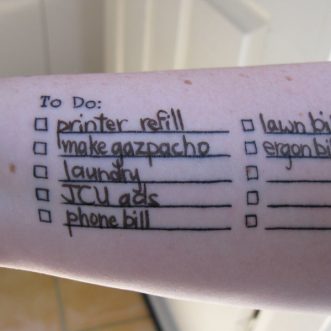
Reminders

We like to remind ourselves of what we have ‘to do’.   But we all too easily forget the why behind them.   It’s easy to get derailed by happenstance and other people’s agendas.    This isn’t helped by systems that focus on tasks rather than outcomes.

True productivity (adding value) is driven by focusing on the why.   What if you built a system that constantly reminds people of that?

Given the why, they can probably work out the best thing to do next.

One percent

One percent

The very best question I know for improving your process for making and keeping promises is this one:

“How can we make this 1% better today?”

1% seems like a pathetic target for improvement until you realise it compounds.

Compounding works in any direction of course, so it helps to frame the question in the direction you want without tying down the ‘how’.   This takes some thinking about, but is well the effort.

Hiut Denim (who gave me the idea) has this one, for example:

“How can we reduce the environmental impact of our jeans today?”

Tiny, daily, incremental improvement are easy to start, easy to keep going as a habit, and add up sooner than you think to a ‘better’ that’s far bigger than you could ever have dreamt of.

What would your question be?

Making maps

Making maps

“There are known knowns; there are things we know we know.  We also know there are known unknowns; that is to say we know there are some things we do not know.  But there are also unknown unknowns—the ones we don’t know we don’t know. .. it is the latter category that tend to be the difficult ones.”  Donald Rumsfeld

Part of any consultant’s job is to formalise the known knowns and the known unknowns.   To map out the worldview a business owner is working within so that they can share it with their teams, giving them routes to follow.

In doing that, we achieve something even more important – we surface the unknown unknowns – the areas of the map that have up to now been blank, or worse, have become the abode of monsters signalling ‘Don’t go there‘.  And by turning the ‘unknown unknown’ into a ‘known unknown’, we break through to new territories for the business to explore and expand into.

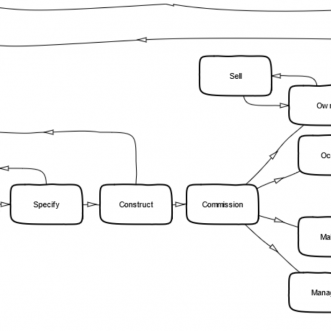
For me, the brilliant thing is that all it takes to achieve all this is questions.  So this week I’m going to share some of the best mapmaker questions I know, organised around my map of a business:

I hope you’ll join me on the journey.

It would take too long

It would take too long

We’ve been brainwashed into thinking that changes have to be big, hairy, audacious, and fast.   Sometimes that is what’s needed.   But most often it’s not.  Long-term change takes a different kind of energy.   A crash diet is disruptive and hard to stick to, and if you’re not careful leads to the loss of more muscle than fat.  Much better to lose half a kilo a week for a year, changing your eating habits along the way, so you live better for longer.

On average, a business has around 50 business processes that make up its Customer Experience Score, depending on how many different services are on offer.  It’s tempting to make that a big deal, to throw everything up in the air while change is going on.   To disrupt the status quo before you have anything to put in its place.  A ‘big bang’ is dramatic, but as we all know, it rarely leads to real change.

It would be possible to re-engineer a business in 6 months, but I’ve always found it better to go for a steady ‘one-process-a-week’ approach.

I usually start with the simple, uncontested, but often forgotten process of opening and closing for business each day.   It’s a good warm-up to get everyone used to working together, an introduction to the notation, and a gentle way to get thinking about how much what happens every day can contribute to the process of making and keeping promises to clients:

When does the day really start?  When does it really end?  Who opens up?  Who closes up?  When are the phones tested?  When is the internet tested?  What happens if they fail?  Where do the kitchen provisions come from?  How do we make sure we don’t run out before a client meeting?   How do you set the scene for visitors?  How are they welcomed?

Each week, my job is to ask the stupid questions, get people thinking about the things they take for granted, hold the processes to account against the business’s Promise of Value.  In essence to get the business delighting its clients on purpose, systematically, repeatedly.

Once we’ve started there’s a rhythm to it.  Review last week’s captured process (always wrong the first time round), then start the next most important process.  We move forwards steadily, with the simple aim of making the business work the way you really want it to.  The way you would want it to work if you were a client.

Like dieting, the benefits accrue right from the beginning.  The change in lifestyle is gradual and relatively painless, relatively easy to stick to.   Until suddenly, by the end of a year, you realise you’ve made a radical change.   You’re a new business, more confident, more energetic, more fun to be around and able to look forward to the expected lifetime of a Galapagos tortoise, rather than a hare.  And looking back, it didn’t seem to take long at all.

Making deep, lasting change is a marathon, not a sprint.   And even marathons go more quickly than you think.
I don’t know how

I don’t know how

Of course you don’t know how to capture your Customer Experience Score.   You’ve never done it before.

There are many things you’ve never done before, but if you decided you wanted to learn one of them, you would know how to go about it wouldn’t you?

You might get yourself set up with whatever kit you need and have a go.   That’s hard to sustain, because even before trying to acquire whatever skill you’re trying to master, you have to know what you don’t know.    Years ago, I thought I’d learn to play the melodeon.   I bought the wrong sort, which made it more difficult to play the tunes I wanted to learn, which in turn made it even harder to get my fingers in the right places.   I didn’t last long.

Or, you could find someone who does know, check out their track record of doing it, and ask them to teach you.   There’s nothing quite like learning by doing, accompanied by someone showing you how, explaining why it’s done this way and holding you accountable for doing it.   That’s how I learned to speak Spanish and to do Pilates, skills that have stuck with me ever since.   It’s by far the quickest way to really learn.

Of course, once you’ve acquired your new skill, the best way to carry on developing and improving it is to pass it on, and teach the others.

Despotism

Despotism

You might feel that writing down the Customer Experience Score for the business you founded is a bit, well, dictatorial, despotic even.

But I can tell you, having a score I can consult myself, whenever I need to is more liberating than whatever is currently locked inside your head, expressed only as “I can’t exactly explain it to you, but I know it when I see it, and right now I see you’re getting it wrong.”

Especially when you add that the first, prescriptive draft is just the beginning.  Once defined and shareable, the Customer Experience Score belongs to the business, not you.   It becomes open to critique, discussion, improvement by everyone.

A long time ago, we worked with a shop owner.   He was adamant about the way customers should be treated when they came into his shop, lavishing attention on them to make them feel welcome and supported.   Until we demonstrated that by treating one customer this way, he was actually being extremely rude and unwelcoming to whoever came in next.

Whatever it looks like, your Customer Experience Score is much better for your business outside your head.

Systems

Systems

Of course I had to share this from Seth.   A bonus post to make up for missing yesterday’s:

https://seths.blog/2020/09/when-can-we-talk-about-your-system/


The givens

The givens

Axioms are the foundations of ‘grammars’.  They are the givens, things we don’t have to question, that we can take for granted, that are (at least to us) self-evident.  Otherwise it would be nigh-on impossible to get anything done.  Imagine a whole orchestra having to agree what ‘C’ means before they start playing, or having to define exactly what you mean by a ‘metre’ on every page of a set of building drawings.

For a business it’s different.   Remember,  “When you make a business, you get to make a little universe where you control all the laws.  This is your utopia”(Derek Sivers).

That means you define your own business axioms – how many times it’s acceptable to let the phone ring before you answer it, who is most important, the boss or the customer, how much it’s legitimate to care about the environment in relation to how your busines makes money.

If the grammar of your business can be written down as what I call a Customer Experience Score, the axioms that govern what that score looks, sounds and feels like are what I call your Promise of Value.

Both are unique to your business.   Together, explicit or otherwise, they are the reason your best clients buy from you, stay loyal to you, and tell their friends about you.  Both are worth writing down.

Interference

Interference

Last Friday, the materials for our new roof were delivered.  Tiles, ridge tiles, clips, battens, everything the roofers would need to start the job the following day.

Except, I spotted, the membrane that goes between joists and tiles.   Without that the job couldn’t even start.   To be honest, we’re relaxed about the schedule, but I knew our building company prides itself on being ahead, rather than behind, and our choice of tiles had taken time to source, so they were only just ‘on track’.

I could see the delivery driver had a pallet-load of it on his truck, so I asked the question, just in case.   It wasn’t on his delivery sheet, so he called the office.  They didn’t have it in the order either.

“Well I’ve got a pallet load here, so I’ll take a roll off and we can sort out the order with our client back in the office.  That saves me coming back later if it is missing.”

When I told our project manager, she said that’s why they always use that building supply company, because they focus first on foremost on taking care of their clients and end-users, rather than sticking rigidly to procedure.

I’d interfered in the process wrongly, as it happened.    The membrane wasn’t missing.   When the roofers turned up next day, they brought a big roll of it with them, and put it back in their van once they saw it wasn’t needed.

Obviously what was really missing was a clear understanding of who’s responsible for what, apart from inside the project manager’s head.  Does it always work this way?  Or does that depend on the roofer?   If everyone (including the client?) knows it’s always the supplier’s job to supply everything, this sort of mix-up wouldn’t happen.

What could remedy that?   A Customer Experience Score.

Not a procedures manual to consult every five minutes and follow slavishly.  Rather, a high-level picture of ‘what happens when’ that can be quickly and easily learnt by each new person or business that comes on board.  Something that says “This is how we do things, so if you join us, you need to understand this too”.  That way everyone is empowered to make sure things happen as they should, even if they don’t actually work for you.

In this case the mix-up happened the right way round.   The roofers finished at 10pm on Sunday, having worked their socks off for two days.   Our build is back on schedule, and I’m happy to recommend our building company to anyone.

But I’m also going to suggest a little composition.