October 21, 2020
Related
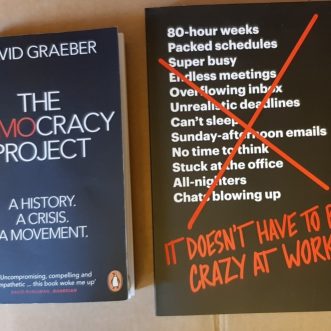
This was last weekend’s reading.
Strangely enough, they are related. I recommend reading them together.
This was last weekend’s reading.
Strangely enough, they are related. I recommend reading them together.
The very best question I know for improving your process for making and keeping promises is this one:
“How can we make this 1% better today?”
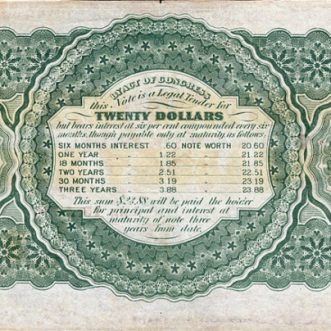
1% seems like a pathetic target for improvement until you realise it compounds.
Compounding works in any direction of course, so it helps to frame the question in the direction you want without tying down the ‘how’. This takes some thinking about, but is well the effort.
Hiut Denim (who gave me the idea) has this one, for example:
“How can we reduce the environmental impact of our jeans today?”
Tiny, daily, incremental improvement are easy to start, easy to keep going as a habit, and add up sooner than you think to a ‘better’ that’s far bigger than you could ever have dreamt of.
What would your question be?

It turns out that yesterday’s AWOL veg box wasn’t down to a new driver, but to a problem with the navigation software.
The driver did a great job of sorting things out. He bought a new phone, double-checked his route and corrected the mistakes. He took responsibility and did what needed to be done to really keep us happy.
Meanwhile head office was offering refunds.
Technology is brilliant, but you need a systematic way of identifying when it’s broken, as quickly as possible. Analogue visual indicators work well for this e.g.the address label on the box, a line marked on a bottle that used every day.
You also need a fall-back manual process for when the software breaks. That way, things may take a little longer, but nobody is taken by surprise, and nobody is let down. And you don’t have to compensate unnecessarily.
Do you check your phones are working every morning? Do you have backup phones? Do you keep an up-to-date back-up (maybe even hard copy) of your contacts? Do you have a process for learning from mistakes and accidents?
I’d be surprised if you do.
Performing a piece of music isn’t simply a matter of reproducing a score (not even with a computer).
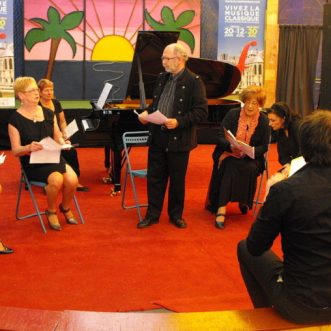
An orchestra rehearsing a piece will first read the score together; question it; interrogate what’s behind the notes to understand the composer’s intention and find better ways of expressing it. They’ll use their technical expertise to try different approaches – trying to bridge the gap between the person who wrote it and the people who will be hearing it. They’ll try out different interpretations, then agree on the interpretation to be performed.
Practising the chosen interpretation gets everyone in sync, but they will only really know if it worked through performance.
Performance is the source of useful feedback. Everything else is conjecture. The last night is unlikely to sound exactly like the first. The interpretation and it’s delivery will have been tweaked, to take account of the actual audience. The audience shows their appreciation in enthusiastic applause, repeat visits and recommendations to friends.
All creative endeavours – plays, films, dance, businesses – where people take a more or less abstract representation of proposed reality and make it real, go through a similar process.
It starts by learning the ‘rules’, proceeds through interrogation, questioning, trial and error into interpretation and performance. Every performance feeds back into future interpretations.
2 things to bear in mind if you’re looking to generate profitable, repeat performances through your business, that expand your audience:

Making sure the right props are in the right place at the right time is an important job in theatre or film (check out The Goes Wrong Show for what happens when it’s not done well).
It’s an important job in business too, although it’s rarely considered as such. More often than not it turns into everybody’s job, which makes it nobody’s job, which makes it something that doesn’t happen consistently.
The answer is to think through the process your business runs (how you Share your Promise, and How you Keep your Promise) from beginning to end. As you do, you’ll identify where each business prop is used or referred to. Once you know this you can start to automate the ‘Stage Manager’ role.
Most importantly, you’ll see where it is easiest to create each prop, because that’s where the information it embodies is naturally and easily gathered.
As far as possible, you want this to happen as a side-effect of doing what people want to do anyway. This is why cloud accounting is such a brilliant thing. Clients do what they do – raise invoices, pay bills, log expenses, manage bank accounts. The side effect of all this is that all the props needed to produce a VAT return or monthly management reports are ready and waiting for the accountant to work with.
Where this isn’t possible, sharing the text of the play (your process) makes the downstream impact visible.
Salespeople, for example, are notoriously rubbish at logging client details, even though they are the people who naturally have all the information to hand. That’s because they don’t feel the impact on what comes after them. From a business perspective a sale isn’t complete until the customer has received what they paid for and is happy with it.
That means that, like the bricklayer’s labourer, part of what every salesperson produces is the productivity of the people down the line.
Your business is like a play. Each role in your business contributes to the productivity of the whole play. Recognise that in the way you reward people, and you’ve created an incentive for improvement.

Standardisation is useful. Standard shoe and clothing sizes enabled manufacture at scale, which in turn meant that more people could afford decent clothes and shoes than ever before. Standard sizes are worked out by taking averages of the actual population.
Standardised clothing works for two reasons. First because sizes are based on at most two or three dimensions. This means that any given individual is more likely to fall within an average range for a given size. There will be exceptions (I can never find gloves to fit), but they will be rare. The other reason is that clothes are soft, they have give. People can easily adjust the standard to suit themselves. You can belt a baggy shirt, or wear extra socks inside too-big shoes. A slightly too-tight dress will stretch a little. You can at least be comfortable, if not always elegant.
Averaging over multiple dimensions, especially for something rigid, like a building, an office, or a cockpit is far less successful – even dangerous. Nobody fits this kind of average, so everyone becomes uncomfortable and inefficient.
The same goes for business processes. No two businesses do things in quite the same way – not even when they are doing the same job. So forcing your way of doing things into a generic off-the-shelf pattern squeezes out diffentiation, turning you into a commodity. It also makes the people running the process both uncomfortable and inefficient.
Those are the last things you or your customers want.
The alternative isn’t to tailor everything from scratch every time.
If you’ve been in business for a few years, you will have your own set of patterns for ‘the way we do things round here’.
Identify them, create templates from them. Then use them to build processes that are fully adjustable by the people who will actually use them.
Adjustable gives far better results than the average.

As you probably know, I have a bit of a book habit.
I read this one on Saturday, and for now all I’m going to say is that I recommend it.
I hope to share more later, but I’m asking permission first.
Have a great day!

I’m a firm believer in automating drudgery – boring, repetitive unsatisfying work, often physically hard, and often involving tasks that we humans really aren’t that good at.
So I welcome software that automates sending emails, or makes it easier to book people onto a job, or does my bank reconciliation for me.
But every time we automate, we insert a veil beween us and the people we serve, making it easier to forget why we are doing the work – to help another human being flourish. As layers build, it becomes all too easy to slip into thinking about people as mere statistics, rather than the flesh and blood individuals they are.
The way to counteract this is to consciously use the energy and attention released by automation to make a deeper connection with the person on the other side.
For the people who spend their lives behind whole walls of automation and disconnection, this will feel ‘wasteful’. It isn’t.
It’s an investment that will pay off handsomely, for both sides.

Did you know, the word ‘Serendipity’ was coined by Horace Walpole in 1754?
The ‘Serendip’ part refers to an old name for Sri Lanka and a Persian fairy tale about 3 princes who were “always making discoveries, by accidents and sagacity, of things which they were not in quest of”.
Lots of breakthroughs have been serendipitous – penicillin, graphene, Post-it notes, Nutella (apparently). If you go back far enough most of what we eat and drink must have been discovered serendipitously – cheese, tea, kimchi, alcohol, even cooking food at all.
Serendipity doesn’t just happen though. And of course someone has created an algorithm for it.
Serendipity is fundamentally about noticing. Mindfully observing the world and what happens in it, without a specific purpose, but open to the possibility of discovery.
Three things are key to making serendipity work:
None of these things are inherently expensive to do. They probably also make life more interesting.
Why not find a way to plan them into how you improve your process, daily, weekly or monthly?
You never know what might turn up.

It’s hot. Too hot for me. My office is on the south side of the house, so it gets plenty of sun. And of course I’m at home, where I don’t have air conditioning.
It’s difficult to think, difficult to get down to anything, difficult to come up with ideas.
I can’t do anything to make the room cooler.
Luckily, I have at least 4 other options:
Sometimes, acknowledging what you can’t change, makes you see what you can.