Your second draft may well be wrong. Mine frequently are.
Your third draft may not be quite right. That often happens to me.
But you can’t find any of that out unless you have a first, second, or third draft to work with. It’s very hard to follow a process that’s in your head. Much easier when you see it spelt out as a map in front of you. That’s true for you and for your colleagues.
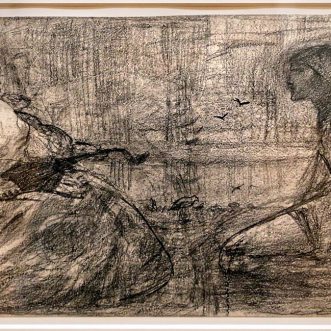
This is how great artists work. They sketch, tentatively and hairily at first. to get the idea out of their head into a form they can work on.
I’d even go as far to say feel free to start at Step 3, with the story and just get something down. Then review it in the light of Steps 1 to 5 to refine what you have in your own head before you present it to others.
When it comes to capturing how things should work for your business, the most important step is to get it out of your head, and into a form that you and others can reason about, re-design and improve.
It will never be perfect, but it will be visible. Therefore capable of being made better
Like a great artist, keep practicing, keep sketching.
In time, your sketches will look more like finished works. But they’ll always be valuable.
Our modern world is built on treating people like strangers. That means we can concentrate on things, on the transactions through which we acquire things, ignoring the human being(s) behind them.
That makes life very convenient, but it also makes it unsatisfying.
It also makes it dangerous. It’s easier to attack a stranger than a friend. And when you’re used to ‘unseeing’ people, even those you’ve lived among for decades can easily become strangers.
I’ve had a lot of work on this last couple of weeks. A fair chunk of it as a customer.
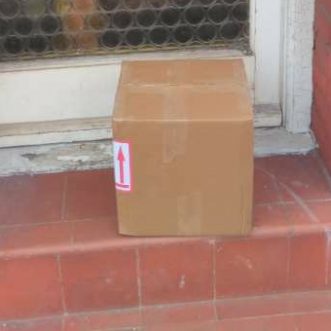
My bank is asking me to re-give them some information they have had for at least 11 years; my pension manager has asked me to give them information about dependents – but won’t use that information to update anything they already have, so now I have call them to check that myself; I’ve had to chase to get a replacement pair of boots delivered and I’ve had to walk my own ‘last mile’ to pick up a parcel that got to my doorstep, but not beyond.
Don’t get me wrong, I have no problem with do-it-yourself – where that makes my life easier.
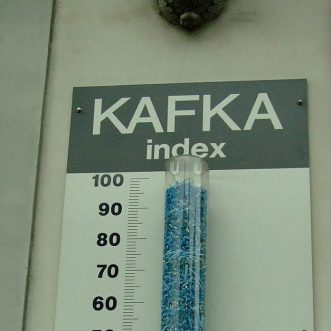
We humans want agency. We want to do things for ourselves. What we don’t want is to get tangled up in the inefficient bureaucracy and busy-work that is clearly going in inside these major organisations. Bureaucracy that’s happening because they’ve forgotten who they really serve. The customer.
Do your own job guys, that’s what I pay you for.
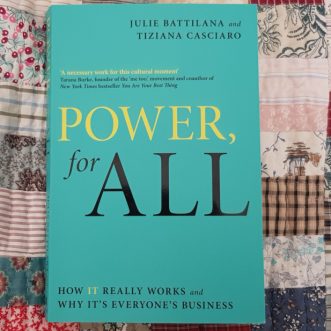
PS If you want to know more about bureaucracy in modern times, read this book. Watch the author’s summary here.
But for some reason its purpose fails and the parcel never makes it past my front door.
Even though I was on the other side of it waiting for delivery.
There was no knock. Only the faint rustle of a blank ‘no delivery’ card pushed through the letterbox. By the time I got there the van, and my parcel, had gone.
Later that evening my husband and I walked the mile and a half to the collection point to pick it up, because it was too heavy for me to carry on my own. That was, in part, why I’d had it delivered.
This seems to be a growing feature of our modern lives. Every low-paid, precarious service job is surveilled and tracked to within an inch of its life, and at the same time compressed into an ever shorter timeframe, until the point becomes to satisfy the tracking system – even if that means dissatisfying the customer.
This misses the point, big time. The purpose of process is to support human beings to be better humans. To remove the need to remember the things we’re good at forgetting, so we can concentrate on doing the things we’re good at doing – like focussing on the customer as another human being. But of course, that can only happen by acknowledging that the delivery person is a human being too, not a poor substitute for a robot, who you don’t know, don’t care about, don’t think is worth decent pay, and who therefore won’t be in the job long, so can’t be trusted to do the job properly.
So in the race to the bottom, what we end up with is process as a means to consistently and efficiently deliver bad service.
Whenever I put our plastic rubbish out for recycling, knowing that it won’t get recycled, but at best burned. I remember this.
In 1998 I visited a factory that recycled rubbish from the street bins of Barcelona into cardboard for packaging. They didn’t sort a thing. They took everything – paper, cartons cans, banana peels, everything.
They extracted the easy metals, then boiled the rest up, extracted the aluminium (which they sold to the concrete factory across the way) and turned it the result into perfectly printable, usable card for packaging.
Why am I telling you this?
Because sometimes we have had answers, but they’ve been sidelined or ‘forgotten’ by the system.
Maybe part of our job as responsible businesses and humans is to help people ‘unforget’ that other ways are possible. Or to imagine new ways that might be possible. And to help us act together, to change the system.
To which end, I’ve got a little involved in a thing called The Carbon Almanac.
“Because when it comes to the climate, we don’t need more marketing or anxiety. We need established facts and a plan for collective action.”
It’s easy to conflate ‘enrolment’ and ‘onboarding’ and think they are the same thing. They’re not.
Enrolment means to ‘sign up’, to ‘commit’, to ‘buy into’. It’s what you want your prospect to do at the end of Share Promise. You want them to say ‘Hell yes, I’m in!‘, and start their journey with you.
Onboarding means to ‘acclimatise’, to ‘socialise’, to get to know ‘how things work around here’. It happens at the start of Keep Promise – if it happens at all, that is. Because if you’ve built your business around the client, it should already feel like home to them.