January 17, 2019
Marketing
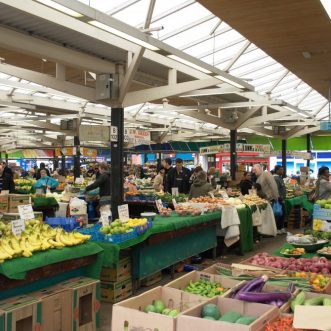
‘Marketing’ used to mean shopping – going out to the market and buying what you couldn’t produce yourself.
That’s still quite a useful way of looking at it if you have something to sell.
‘Marketing’ used to mean shopping – going out to the market and buying what you couldn’t produce yourself.
That’s still quite a useful way of looking at it if you have something to sell.
![“People will always need [insert ancient profession here]”](https://disciplinemakesdaringpossible.com/wp-content/uploads/2019/01/Balance_sheet_Mesopotamia_Louvre_AO6036-331x331.jpg)
Being in an industry that’s driven by compliance seems like a safe option.
But when the compliance part can be automated, outsourced or down-skilled (and it will be the compliance part that goes first), you have to offer more if you want to stay in profitable business.
There will be many incumbents who decide to step out when this happens.
That’s a great opportunity for those who want to step up.
“A critical characteristic of a profession is the need to cultivate and exercise professional discretion – that is, the ability to make case by case judgements that cannot be determined by an absolute rule or instruction” [*]
So, how do you get professionals to do things the right way?
Not by expecting them to work like fast-food operatives, or a production line.
First, work with them to build a shared vision of what ‘the right way’ means for your clients – what I call your Promise of Value.
Then create a supporting framework of high-level, end to end business processes that operates at the right level of abstraction – delivering guidance rather than absolute rule. Something like a professional musician’s score, that tells them what to play, but not how.
The two things together make a powerful combination that encourages consistency, yet leaves plenty of room for judgement on the exceptions, plus plenty of scope to evolve the system in the light of experience.
In other words, you’ll free your people up to be professional.

I wrote a blog for you on Friday, but it didn’t go out to you.
I’ve looked into it, and I’m hoping this one makes it.
Thank you for reading them.

Despite my frequent rants about self-checkouts, there is one good reason to have them.
If you only have one or two things, you don’t want to wait behind an enormous weekly shop. A self-checkout or basket-only lane is a good solution here.
Similarly, its a good idea to split the bakery queue into ‘sandwiches’ and ‘bread’, so bread buyers aren’t waiting behind the office lunch order.
Sorting a big queue into separate, differently handled sub-queues reduces queueing overall, and makes handling the different types of order easier, because you’re not switching between them all the time.
Better for everyone then.
Forcing everyone into the self-checkout queue defeats the object though.

Whatever you’re promising your prospects, it isn’t just about the technicals of what you do, it’s also about how you do it, and that needs to be carried through into every experience

It is easy to assume that more choice is always better.
But:
More options means more work for your prospects, and more chances for them to get it wrong.
More options means more work for you, and more chances to get it wrong.
So it’s worth stepping back and asking: “What do my clients really want?”.
It may be that you can package options up to suit different categories of client. Or that you offer a standard product or service with a few optional extras. Or that you offer a single ‘take it or leave it’ choice.
Whatever you do, making it easier for your prospects to choose, makes it easier for them to choose you (or not) and that makes it easier, and more profitable, for you to give them what they really want.

As Nassim Taleb says in his excellent book ‘Antifragile’, ‘stressors are information’.
That means that rather than just get stressed by them, you can use them to direct improvement.
For example, when ‘exceptions’ start to become common, it’s a sign that something in your system needs to change in line with the environment.
A good place to start is by asking “How could I pre-empt this situation?”.

It sometimes seems to me that the world is divided into two ways of dealing with uncertainty.
You can expect the worst, and try to protect yourself from that possibility by tightly specifying and controlling everything down to the last detail.
Or you can expect the best, and leave everything to chance.
Neither response is optimal. The first closes off opportunities to do better than expected. The second leads to drift.
A more constructive approach is to set direction, leaving latitude for serendipity, obliquity and creativity, measuring effects as you go.
That way, whatever your natural bias, the worst that happens is that things get better.
You’ve put your heart and soul into building a remarkable business that does things differently.
Now you’re ready to scale.
But the last thing you want is to sell out to the same-old, same-old, corporate route to growth.
What if there were a new and different way to think about organising and growing your business, that takes the best bits of being small – your customer-focus, your agility, your meaningfulness – and scales the business around these properties, instead of suppressing them in favour of a traditional corporate approach?
What if you could structure your entire business around your own unique way of making and keeping your promise to customers?
What if your business had no management hierarchy, no silos, no ‘overhead’, only people enabled and empowered to share and keep your promise to your customer and to continuously improve how that works?
What if everyone in your business had roles that describe how they contribute to the customer experience, not where they fit into the hierarchy or the machine?
What if people were supported by technology to be more human, not straitjacketed into being less?
What if your business didn’t need you, because it is a living system, that not only works without you, but evolves without you to find new ways of delivering the promise it embodies?
It’s all possible.
You built a remarkable business, you can grow it remarkably too.
If you dare.