This is where I was when I should have been writing yesterday’s blog. Picking up my shopping. Olive oil, almonds and honey from Portugal, chocolate from Trinidad via Cornwall, Coffee and sugar from Colombia, sea salt from Brittany.
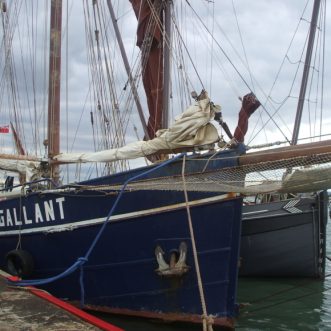
There was plenty more on offer – olives, tapenades, lupini beans, pinto beans and more. All more or less direct from small producers, transported under sail.
I even got to meet 50% of the supply chain: Gareth from Raybel Charters through whom I ordered, and Guillaume who captains the ship.
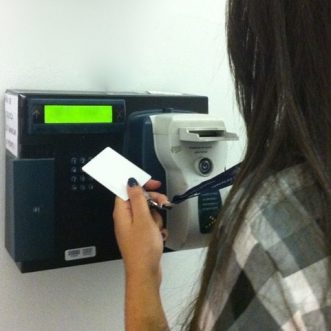
That’s my kind of self-checkout.
PS If you’re in Faversham or Whitstable over the next couple of days, look out for the Thames barge Dawn the ‘van’ for onward local deliveries
You start your own business to take back control. To be at nobody’s beck and call. To do what you think is right by your clients.
Once you get good at that, you outsource key functions, take people on to help you deliver, and suddenly, you’ve lost it. The control has gone. You’re at the beck and call of clients, or team members, or suppliers, and it seems impossible to get people to do things the way you would.
A natural reaction is to tighten your hands on the reins, supervise more, intervene more, even to redo the work.
Micromanagement doesn’t work. You only end up working harder, being a nag, and training your people to give up trying.
Instead, give control away as soon as you can.
Not by abdicating, not even by handing it over to superstar colleagues, but by installing your DNA into the way the business works, so that it works the way you want it to when you’re not in the room.
Strangely, creating this kind of control is liberating:
For your people, because they know the outcomes they are aiming for, and what needs to happen to achieve them, plus they have the freedom to do that with flair and personality.
For you, because you can relax your vigilance, and concentrate on growing and evolving your business.
For your business, because its no longer dependent on the individuals who happen to be there at any one time.
We call this writing your Score. Because once you’ve written it, the music you and your orchestra are creating now can last forever, no matter who plays it, or how.
If you want to take back control, start by giving it all away.
Back in the 70’s there was a TV series called ‘The Troubleshooter’.
Each week, captain of industry Sir John Harvey-Jones would visit an ailing British manufacturing company, and advise them on how to turn around their fortunes.
One of his insights really stuck in my mind. It goes something like this:
“These people working for you, have a rich life outside work, where they build complex systems, run clubs, manage budgets, research everything there is to know about their particular interest, invent things. You make them leave all of that at the door. What a waste!”
Whenever I tell people about Matt Black Systems, a manufacturing company with no managers, no administrators, and almost no overheads, the reply I most often get is “I couldn’t do that, not with the people I’ve got.”
It’s not the people that are the problem, it’s our model of what a business is. 50 years on from ‘The Troubshooter’, we’re using AI and automation to track and reward attendance, not contribution.
As many have discovered during lockdown, being in the office where you can be seen, isn’t necessary for getting results.
But for a long time, in a corporate environment, sitting at your desk was a proxy for working, with predictable effects. Some people stayed late, to look like they were working hard. Some used being present to cover for getting very little done.
At one place I worked, this was really easy to do, because everyone worked in their own Dilbert-style cubicle. Nobody could see whether you were working or sleeping – especially through the fog of cigarette smoke that hovered constantly over every cubicle.
The cubicles hid more than a hangover snooze. This was also the place where if you left your cubicle for half an hour, someone cannibalised your computer for spares while you were gone. So you couldn’t get anything done even if you wanted to.
But the worst case of presenteeism I came across was as part of a youth employment scheme back in the early 80s. It was interesting work. A small team of us researched and wrote papers for schools to use as additional resources for lessons. We wrote about local history, local firms and local places of interest.
We had a boss, but we were left pretty much to our own devices, which suited us fine, because the boss did nothing. Literally nothing. He sat in a different office, at his desk, staring into space and smoking. All day.
At the time we thought this was scandalous, but looking back I think it was actually marvellous. We managed ourselves. We worked in our own shared room. We chose our own projects, did our own research, collaborated with each other to produce, illustrate, print and in at least one case publish our papers. We believed in what we were doing, we had fun, and we produced good work. What’s more, we learned how to do it again. We didn’t need to be watched over.
The only downside was for the organisation that employed us all – they could have saved themselves some overhead, and employed a couple more researchers instead.
We have managers, because we don’t believe people will work unless they’re made to, then surveilled to make sure they are.
But is that really true? We know it doesn’t work for some people, and for the rest it isn’t needed.
There is a better way. And I think it looks like this:
Backed up by a clear Promise, and an empowering Score.
I’ve only ever met one person who wanted to be a manager. Most other people want to be technicians (because that’s what they were in the company they left), and some are genuinely entrepreneurs.
So why do we have managers?
According to the e-myth, managers sit between an entrepreneur with a vision and the bunch of technicians who make the thing the business sells. Managers organise technicians to deliver the vision.
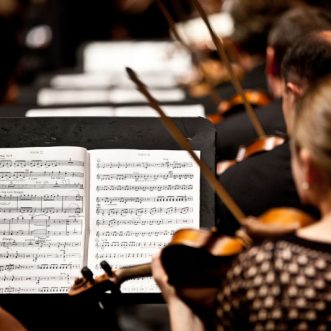
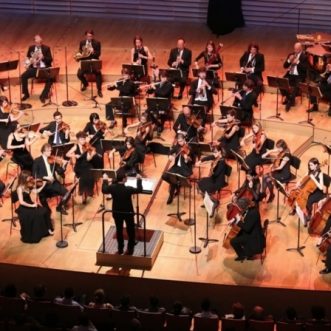
It doesn’t have to be like this. Take an orchestra. An orchestra is a bunch of technicians, delivering the vision of someone who’s usually dead. The nearest thing to a manager is the conductor, and that’s stretching it a bit. The conductor doesn’t organise, they interpret, co-ordinate, keep the tempo up.
So what makes an orchestra possible?
The score. The talent, skill and ability of the players. Lots of practice.
If you want more impact just add more players. If you want to play at more venues, assemble more orchestras. The score tells everyone what they need to know. No interface needed, no managers required.
All the extra spend goes in front of the camera, where the audience will experience it. Less overhead, more profit. In other words, scale as opposed to growth.
Since scale is what everyone looks for, modelling a business to be more like an orchestra might make a lot of technicians and entrepreneurs very happy.
It’s a worrying and challenging read, exploring and explaining just how naturally easy it is for we humans not to see what’s in right in front of our eyes.
The reasons are varied, from feelings of affinity or love, wanting to fit in or please people in authority, too rigid systems, distance and disconnection, the bystander effect, a narrow focus on money or sheer cognitive overload and exhaustion. Sometimes, in the worst scenarios, such as Grenfell Tower or Texas City, several reasons combine and exacerbate each other.
The answer is to make ourselves see better. Systematically, intentionally, but never mechanically.
We do that by encouraging diversity of thinking and argument, by thanking whistleblowers, complainers and critics instead of sidelining them.
We do it by constantly reminding ourselves of what we are in business to do – to make and keep promises to human beings, our customers, and by eliminating the hierarchies, silos and long chains of command that get in the way of that.
We do it by creating transparent ways of working that keep our promise visible and support people to hold each other accountable as human beings for seeing what’s really there, and acting on it.
And of course the irony is that if we do these things well, we will create more value and do better financially. Because its not only bad things we make ourselves wilfully blind to, its also opportunities.
We’ve all suffered from it. Corporate amnesia. You call a company you’ve done business with for years, and give them your name, address, and inside leg measurement 3 of 4 times before you get to the point of the call.
A more insidious form of corporate amnesia forces a team member to recall the process before they perform a task, instead of having the system remember it for them.
This kind of amnesia results in variation over time and between team members. Sometimes the variations will be improvements, but most often they are an ever-worsening copy of a long-forgotten original, void of life or meaning. Any improvements are forgotten, because the organisation has no way to capture them or remember them.
This isn’t just amnesia, its also akrasia – doing one thing when you should be doing another.
Because if you’re too busy remembering what’s supposed to happen, you aren’t making it happen.