Discipline makes Daring possible.

Disorder

Disorder

I’m fascinated by the tension between process and freedom, between order and chaos, between prescription and exploration.   So naturally I couldn’t resist buying these books to find out how people working in a completely different discipline approach the same issue.

In the first book I’m reading, ‘The Uses of Disorder’, the author describes the difficult transition people have to make through adolescence – that stage where we have the ability to fully exercise our powers as human beings, but without any life-experience to guide us.  We have to find our own identity, but identity is forged though experience – messy, uncomfortable and maybe even distressing.   This prospect makes some people frame an identity for themselves in advance, as a way of avoiding experience.

Most of us ‘grow out’ of this stage as we are unavoidably exposed to otherness, but some people continue to close themselves off to anything that might undermine it.  The author’s point is that this doesn’t just happen on an individual level, but also at the level of a group or community, which is where this starts to get interesting.

For these authors, a city is a framework that can be enabling or disabling.   And what makes it enabling is a certain amount of disorder, because disorder enables people to encounter the different, the new and the alternative.  In other words, disorder helps us to grow aand thrive as human beings by opening up possibilities.  So if you want to city (or any community) to enable people to thrive, you want it to be somewhat disorderly.   Not so disorderly that people get no chance to absorb change, but disorderly enough to allow people to find their own change.

Similarly if you want your business to help the people in and around it (including clients) to thrive, you want it to be a bit disorderly – not so disorderly that people don’t know what to do, but disorderly enough that people can find and create their own change.  You want controlled disorder.

The good news is, I think, that you can design it in.  Which is why I use the idea of a Customer Experience Score, rather than a process.   With your Customer Experience Score as the floor, you can safely leave room for exploration and interpretation.

Discipline makes Daring possible.

Just in case you were wondering

Just in case you were wondering

I did a little bit of research this morning, using data from the Office for National Statistics.

By my calculation there are around 82,595 what I might call ‘ordinary’ private sector businesses (employing 1 – 19 people) who have commercial electricity contracts expiring by December this year.

Anecdotally (from radio phone-ins and Twitter), companies like these are being asked to sign new contracts for electricity at around 10 times their current rate.

That is simply unsustainable for most.  Many will be forced to close, costing up to 314,790 people their jobs and removing up to £60,255,000,000 in turnover from the economy.

If I include businesses employing up to 49 people, we’re looking at losing up to 280,279 businesses, 524,974 jobs and £121,344,002,000.

I’m all for bosses disappearing.  Not their businesses though.   I’d like to see them flourish.

Which is why we need to cherish our ordinary businesses.

Ordinary

Ordinary

Over recent months we’ve seen some extraordinary behaviour from big institutions.   Employers knowingly break the law.   Airlines and holiday companies sell flights they know they can’t deliver.   Energy retailers bill small business customers amounts they know are impossible to pay.   Policemen murder women.  Or shoot first and ask questions later.  A holiday park is prepared to evict its guests to observe a bank holiday.  Politicians no longer pretend to tell the truth or even talk sense.   Journalists publish easily verifiable lies to create false outrage.

Thankfully, ordinary people are not like this.  Ordinary people rush to help when someone collapses in the street, or asks for help on Twitter.  Ordinary people go out of their way to keep a promise they’ve made.   Ordinary business owners agonise over having to lose people.  Ordinary business owners pay their suppliers on time and almost always over-deliver for their customers.

That’s because ordinary people operate in what you could call the ‘natural economy’.   We know the world doesn’t run on money, but on the promises we make to each other.  We know that even money is really just a promise.

Let’s celebrate and cherish the ordinary.  That’s where a better future lies.

Who do you help your client to become?

Who do you help your client to become?

Most of the time we don’t buy to meet a simple need.   We buy to get a job done.    We don’t buy a drill, or even a hole in the wall, we buy ‘putting a picture up’, ‘fixing that broken chair’.

Even then, this isn’t what we really buy.   There’s a bigger job behind the immediate job to be done, the job of becoming a better version of ourselves, in a way that others will notice.

That means that at the heart of every Promise of Value is an unspoken promise.  A promise of transformation, that goes something like this:

“Working with us will enable you to become who you want to be, in a way that is congruent with your values, beliefs and style, so you can join the tribe that feels like home for you, with the status you seek.”

It’s clear from this that it is not just what you do that matters, but how you do it.   And if you are to be congruent with your client’s values, beliefs and style, they must in turn be congruent with at least some of yours.

It’s well worth identifying what the minimum level of congruence must be, in order to make working together satisfying for both you and your clients.   What values must your clients espouse with you?  What behaviours must they share?  What must they believe that you also believe?

Once you know this, you know what kind of people you are a good option for.  Therefore what language you need to use to speak to them so they feel seen.

Now you just need to know where to find them.

Every enterprise makes a Promise

Every enterprise makes a Promise

Every enterprise, even the smallest or shortest-lived, makes a Promise.   It can be summed up simply as “what we do for the people we serve.

Unfortunately it’s rarely spelt out as clearly as it could be.  If you run your own business you know it’s there, because you have clients who love you, and recommend you to all their friends.

But I bet you find it difficult to articulate clearly.   And I bet your team find articulating it even harder.

It’s very hard to live something that you can’t articulate.   So if you’re feeling a bit frustrated by your team’s inability to deliver on your enterprise’s Promise as well you would like, here’s something you can do to help:

Get your whole team together and ask this simple question:

What’s brilliant about this business?”

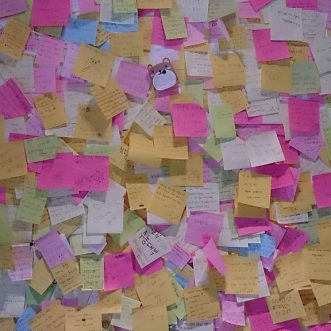
Get everyone to spend 10 minutes answering this question on a generous pile of sticky notes, then, one by one, starting with the newest or shyest, get each person to share what they’ve written and why they wrote it.

As they do this, listen out for gems.

When asked ‘what’s brilliant?‘, people often start with clichés like ‘quality’ or ‘service’.

If you encourage them to explain why they’ve written that, they often voice values, behaviours and specific examples that are far more reflective of the value you bring to clients.

Capture these on new sticky notes as you go, and share them with your own at the end of the session.

It’s an afternoon’s work, but you’ll be glad you did it, because by answering this question with your team, you’ll not only articulate your own values and preferred behaviours, you’ll also identify values and behaviours you share with at least some of your clients.    You’ll know exactly who they are.   They’ll be the clients you most enjoy working with, and who most appreciate what you do for them.

What’s more, you’ll have energised your team.  You’ll have discovered nuances of your Promise of Value that you didn’t know about before.   You’ll have started to articulate more clearly what makes your enterprise unique.

And perhaps most importantly, you’ll have reassured yourself that you’re all on the same side.

If the shoe doesn’t fit

If the shoe doesn’t fit

Cinderella’s sisters would do anything to get their feet into the glass slipper.  They cut off their toes, and when that didn’t work, they tried trimming off a bit of their heels.   All they did was create a bloody mess.  The slipper wasn’t designed for them.

In business, it’s sometimes desirable to present your ideas in a format people are more comfortable with.   That’s always something worth exploring.  If you want to change minds, it’s helpful to start with the familiar as a way to introduce something new.

Be careful though.

If you find yourself mangling the idea to make it fit, this shoe is not for you.

Find (or make) a new one.

Starting a conspiracy

Starting a conspiracy

Now that the weather is turning autumnal, I’ve decided I need to work on getting a little bit fitter.

So every other morning I get up early, walk a couple of miles to one of my local parks, and use their outdoor gym equipment.  Well actually, just the rowing machine thing, because I’m trying to get some upper body movement in.

Then I walk back again.

This morning was my second visit.   The chap who was there the first time saw me coming and said “you after that machine there?”, and when I nodded, got his towel out and carefully wiped the seat for me, to get the dew off.

That wasn’t just a kind gesture, it was a ‘welcome to the club’, a little bit of encouragement, a nudge to start a habit.   Because now I have to continue, so I don’t let him down as well as myself.

Who knew you could start a conspiracy so easily?

An opportunity

An opportunity

Yesterday brought home to me just how ageist our banks have become.

My husband helps to run a small non-profit organisation.  Just over a year ago, they were told their account wasn’t active enough and would be closed.

13 months later they are still trying to open a replacement.

Doing anything face-to-face is out of the question – the banks simply won’t countenance that.  Everything has to be done as a combination of phone calls with a bank contact and online.

First of all, the bank contacts are obviously overloaded.  It took months to speak to anyone, and months for them to get back with a decision.

But the online part is the pits.

Because the non-profit does things properly, several signatories are involved.   And as with many small, local non-profits, all of them are over 60, some well over 60 – because that’s how they have the time to devote to these causes.

They don’t all have mobile phones, and if they do, they don’t carry them around all the time.  So a simple thing like 2-factor identification becomes a real difficulty.

Then, when they get things wrong, the error messages coming back are unhelpful, for example being told you have entered the wrong email address via an an email sent to that address (!!).  So they get worried about getting things wrong, and do what seems sensible.  They write things down, take things slowly.

But their fingers aren’t as fast as they used to be, so they get logged out of screens before they’ve had time to type things in.

And so they get frustrated, and have to spend more time getting together to try and sort things out.

These are intelligent, kind, generous people who are just trying to help their community.   All they are looking for is somewhere safe to keep the money people have trusted them with; somewhere that will give them an audit trail for the few transactions they need to carry out.

Tough.   Because banks have clearly decided that people don’t matter.  And what could have taken a day to set up in-branch has taken 13 months – so far.

There’s a massive opportunity here for someone prepared to offer a no-frills, human service.  Perhaps not for long, since the baby-boomer bump will be over in a decade or so, but for long enough to do decent business.

I wonder if anyone will take it.

Metaphors

Metaphors

A metaphor is a shortcut to understanding.

Faster than a speeding bullet, an idea moves fully-formed and sharp as nails, from my head to yours.

The problem is that if a metaphor doesn’t capture some deep truth, it’s actually pernicious.  Dust thrown into the eyes.   A quick and easy way to lie.

The elephant in the room is that everything that matters is far too complex to be captured in a single metaphor.  We live in systems, not storybooks.

So maybe it’s time to see our metaphors for what they are – millstones round our necks, stopping us from making progress.

Let’s abandon them, and find better ways to imagine how the world goes round.