Discipline makes Daring possible.

What makes me angry

What makes me angry

On the whole, I’m a pretty laid-back person.

But you know what really makes me angry?

Seeing amazing micro businesses die when their owner disappears.  Whether that’s because they’ve sold up, gone off to do something else, or simply wound down and died.

All that innovation, all that care, all that value, wiped out.  Wasted.

Unnecessarily.

It makes me really angry.  And I’m on a mission to do something about it.

Because all it takes to avoid that waste is a decision to ‘disappear’ from your business earlier, on purpose, replacing yourself with a flexible, supportive framework that enables others to be ‘a boss’ instead of you.

The irony is that by doing this in plenty of time, you’ll start to enjoy running your business again.   You might even want to grow it.  But you won’t have to be there.

Help me on my mission.

If you know an amazing micro-business that deserves to last longer than it’s owner, tell me about them, put them in touch.

We need these amazing businesses to be around for longer.

They’re what makes our commercial life worth living.

Hard work

Hard work

It takes a lot of work to maintain a garden like this.

And the only way to renew or change it is to uproot everything and start again.

Much better to build a garden that can evolve with little tending.  Even at the cost of some untidiness.

That’s where the delightful surprises come from.

Disorder

Disorder

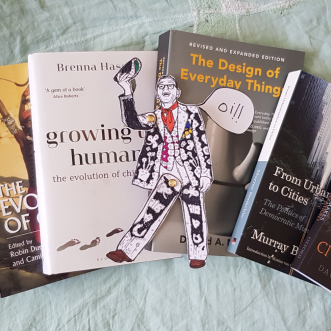
I’m fascinated by the tension between process and freedom, between order and chaos, between prescription and exploration.   So naturally I couldn’t resist buying these books to find out how people working in a completely different discipline approach the same issue.

In the first book I’m reading, ‘The Uses of Disorder’, the author describes the difficult transition people have to make through adolescence – that stage where we have the ability to fully exercise our powers as human beings, but without any life-experience to guide us.  We have to find our own identity, but identity is forged though experience – messy, uncomfortable and maybe even distressing.   This prospect makes some people frame an identity for themselves in advance, as a way of avoiding experience.

Most of us ‘grow out’ of this stage as we are unavoidably exposed to otherness, but some people continue to close themselves off to anything that might undermine it.  The author’s point is that this doesn’t just happen on an individual level, but also at the level of a group or community, which is where this starts to get interesting.

For these authors, a city is a framework that can be enabling or disabling.   And what makes it enabling is a certain amount of disorder, because disorder enables people to encounter the different, the new and the alternative.  In other words, disorder helps us to grow aand thrive as human beings by opening up possibilities.  So if you want to city (or any community) to enable people to thrive, you want it to be somewhat disorderly.   Not so disorderly that people get no chance to absorb change, but disorderly enough to allow people to find their own change.

Similarly if you want your business to help the people in and around it (including clients) to thrive, you want it to be a bit disorderly – not so disorderly that people don’t know what to do, but disorderly enough that people can find and create their own change.  You want controlled disorder.

The good news is, I think, that you can design it in.  Which is why I use the idea of a Customer Experience Score, rather than a process.   With your Customer Experience Score as the floor, you can safely leave room for exploration and interpretation.

Discipline makes Daring possible.

Just in case you were wondering

Just in case you were wondering

I did a little bit of research this morning, using data from the Office for National Statistics.

By my calculation there are around 82,595 what I might call ‘ordinary’ private sector businesses (employing 1 – 19 people) who have commercial electricity contracts expiring by December this year.

Anecdotally (from radio phone-ins and Twitter), companies like these are being asked to sign new contracts for electricity at around 10 times their current rate.

That is simply unsustainable for most.  Many will be forced to close, costing up to 314,790 people their jobs and removing up to £60,255,000,000 in turnover from the economy.

If I include businesses employing up to 49 people, we’re looking at losing up to 280,279 businesses, 524,974 jobs and £121,344,002,000.

I’m all for bosses disappearing.  Not their businesses though.   I’d like to see them flourish.

Which is why we need to cherish our ordinary businesses.

If the shoe doesn’t fit

If the shoe doesn’t fit

Cinderella’s sisters would do anything to get their feet into the glass slipper.  They cut off their toes, and when that didn’t work, they tried trimming off a bit of their heels.   All they did was create a bloody mess.  The slipper wasn’t designed for them.

In business, it’s sometimes desirable to present your ideas in a format people are more comfortable with.   That’s always something worth exploring.  If you want to change minds, it’s helpful to start with the familiar as a way to introduce something new.

Be careful though.

If you find yourself mangling the idea to make it fit, this shoe is not for you.

Find (or make) a new one.

Metaphors

Metaphors

A metaphor is a shortcut to understanding.

Faster than a speeding bullet, an idea moves fully-formed and sharp as nails, from my head to yours.

The problem is that if a metaphor doesn’t capture some deep truth, it’s actually pernicious.  Dust thrown into the eyes.   A quick and easy way to lie.

The elephant in the room is that everything that matters is far too complex to be captured in a single metaphor.  We live in systems, not storybooks.

So maybe it’s time to see our metaphors for what they are – millstones round our necks, stopping us from making progress.

Let’s abandon them, and find better ways to imagine how the world goes round.

The revenge of Muri – a reprise

The revenge of Muri – a reprise

When times look good, or you think nobody will notice, it’s tempting to overload systems, processes and people.
A little cut here, a small increase in workload there.    A freeze on recruitment, a delay of re-equipping or upgrading.    It has no visible effect on the bottom line.    You get away with it.
So it becomes tempting to do it again.    To ‘keep it lean’, ‘cut no slack’, ask people to ‘lean in’, commit 100% 110%, 120%, 150%.
And again.
And again.
Then, when you’ve cut everything to the bone and built your entire system on just in time, lowest cost, no slack, it doesn’t take much to bring the whole thing crashing down.
It’s not rocket science.   We are part of a system.   Overloading any part of it is not sensible behaviour.  Overloading all of it at once is madness.

Freeloaders will try, of course, because it means they can extract a higher immediate return.   Blind to the fact that they will not be able to enjoy it.
It’s up to the rest of us to prevent them.   For their sakes as well as ours.

Confusions

Confusions

Stick insects confuse their predators on purpose.   They pretend to be a twig.  A predator already has a mental model of what a twig is and how it works, which doesn’t include being edible.  So it leaves the insect ‘twig’ alone.

We humans confuse people all the time.  Sometimes on purpose, most often by accident.   We assume that our mental model of the thing we’re building will be obvious to everyone who buys it, uses it or operates it.   Yet that is rarely the case.

Take a small business.  For a shareholder or investor it’s a machine for generating returns.   For founders it’s a way to make a dent in the universe or their route to a coveted lifestyle.  For their accountant it’s a set of connected accounts.  For an operations manager it’s a set of loosely related functions, one of which they probably consider to be the most important.  For some employees it’s a means to enjoy life outside work.  For others it’s a lifeline, and for others still a vocation.   For a customer it’s a solution to a problem.

Conflicting mental models pull people in different directions and make the thing you’re building confusing, less effective and ultimately unusable.

The answer?

  • Use a model that is simple, easy to communicate and effective in delivering what everyone wants.
  • Design the thing you’re building around that model, so that the way it works clearly reflects the concept behind it.
  • Share your model in your marketing materials, shareholder reports, filed accounts, operations manual, help guides and status reports, so that it becomes a joy to interact with, whatever your role.

If you’re a small business owner, you might like to use mine:

It works well, if you want to create a business that can last or that can grow.

Or both, if that’s what you want.

Conservation

Conservation

When there’s a heatwave on, the best thing for me to do is to sit still and read.  Or colour in.

The reason I have such a big library is that I can’t help following threads from one book to another. Sometimes I keep on picking up new threads, often I go back on myself and revisit old favourites.

Eventually they all get darned in together, to make something new and familiar, well-worn and stronger, decorated by repairs.

Like a Pearly King’s suit, or my lovely old linen sheet, too fine and lovely to throw away, so kept just for heatwaves.

Keep it simple, stupid

Keep it simple, stupid

I’m facing a really interesting challenge at the moment.

Over many years I’ve developed a methodology, notation and software for capturing a Customer Experience Score in a way that suits people rather than machines.  My notation is very simple.  There aren’t many rules, and even those are only casually enforced.

This is because it’s all about making it easy for ordinary mortals.   Whether that’s a business owner wanting to capture their desired customer experience or one of their colleagues wanting to learn what’s needed to deliver that experience.   My aim is to make the software easy to learn and easy to use, and above all flexible so that the people using it can start scrappy, and build up to whatever level of detail works for them.

My challenge now is that some of those humans want to generate something more formal from their Score, something that needs clear rules to produce an output.

It’s interesting because it’s showing me how fuzzy (and sometimes inconsistent) my logic is.  This is fine for humans, because humans are perfectly capable of interpreting fuzziness, and in any case I want to leave plenty of room for interpretation.  It’s not so fine for software.

One approach would be to make the tool more rigorous, more constrained, more precise.  In other words, to make it more machine-like.   But that would mean adding levels of detail that would soon become excruciating for any ordinary mortal.

No, my work is all about liberating humans to be human, so I have to find another way, and I think it’s this:   If humans are good with fuzziness and nuance, and machines are not, let the machine ignore all that and concentrate on the essentials.

For stupid machines, the answer might just be to keep it simple.