What’s the difference between a good stew and a great stew?
Time.
Sometimes, leaving things alone for several hours is the best thing you can do. And as of course you know, the very best stews are tasted the day after you cooked them.
Time is an ingredient we frequently forget to add, and not just to our cooking. If you’ve got something knotty you’re working hard on or thinking really deeply about, a long bank holiday weekend is an excellent opportunity to add time.
Over the next 3 days, let whatever it is do its thing. Let it braise, brew, tenderise, meld. By Tuesday you’ll find yourself with something really tasty.
When you create your own business, the ‘truth’ of why it exists, what it does, who it’s for and how it should work is only in your head.
If you want to grow beyond the impact you can make on your own, you have to find a way to communicate and transfer that truth to the heads of your collaborators.
At that point, we tend to replace our truth with facts. Facts are controlling, dry, objective, soulless. We try to flesh the truth out as much as possible by adding too many facts, hiding the very thing we need to reveal.
No wonder people resist, preferring to follow their own idea of the truth – however different that may be from yours. What’s really needed is a way to position your truth in the space between the people who work together to deliver it. That way everyone can access it, everyone can question it, everyone can improve it.
Your truth is your Promise of Value. The space between the people who work together to deliver it is your business.
Make a map of that space that describes how you make and keep your Promise to the people the business serves. Keep the facts minimal – just enough to indicate concrete action; allow the truth to shine through.
Leave room for interpretation, dissent and discussion. Then make sure there’s a process for reaching consensus around a new, better truth. That’s how your business will grow and evolve.
Breathing is something that comes naturally to us. That doesn’t necessarily mean we do it well.
Nature is lazy, it does enough to get by, to survive. Any more than that is over-engineering and wasteful. So as we grow up, we learn to breathe badly. Not noticeably, but badly enough to create problems for ourselves in later life. Because we assume that since it ‘comes naturally’, we must be good at it. And because we assume that, we assume that the problems are ‘natural’ too.
‘Breath‘ by James Nestor will open your eyes to just how much we’re missing out by taking breathing for granted. Fortunately, it will also open your eyes to how breathing actually works and how it can be improved, through discipline, to create astonishing possibilities.
‘Breath‘isn’t just a fascinating read, it’s a reminder that understanding how something really works, and using that understanding to improve daily practice, pays dividends.
The problem with a hierarchical management structure, is that it’s expensive – adding layers of overhead and transaction costs that have to be carried by the revenue-generating part of the business. Even worse, it encourages everyone working within it to focus on the wrong thing – their immediate boss. And that makes work miserable for many, especially those at the bottom of the pyramid.
Alternatives to hierarchy, such as holacracy, co-operation and teal address this by delegating much of the management and decision-making to the people at the coal-face – no longer the bottom, but the cutting edge, where the business meets its customers.
This doesn’t reduce overhead that much because in effect, as Dr Julian Birkenshaw of London Business School observes, these structures “replace a vertical bureaucracy with a horizontal one”. Considerable interaction costs remain as people collaborate and generate consent to create emergent actions. But at least the focus is where it matters, on the customer, client or stakeholder.
It seems to me that what’s really needed is both structure and emergence. A structure that takes the thinking out of doing the right thing most of the time, but allows for emergence at the edges to respond to exceptions and to evolve. The main thing is that both the core structure and the processes for emergence are focused on the same thing – the customer, client or stakeholder.
By now, you know all about my core structure:
Even hierachy works better around this. Replace that with holacracy, co-operation, teal or responsible autonomy, and your business will fly.
When economists talk about productivity, they mean profit per employee.
The trouble is that profit is blind. Companies can (and do) generate profit in many ways, not all of which create actual value, many of which destroy value. For example, if I plant a tree in my garden, I create value, but no profit. If I pay you to plant it, profit arises from the same value created. If I pay you to cut it down again, more profit is created, but the original value is destroyed. If you use it to make a piece of furniture, new value is created.
The problem with capitalism is that it depends on the perpetual growth of profit. That means that once the easy sources of profit (feeding, clothing, housing people) have been used up, new sources have to be found.
Often these seem trivial – meal kits for busy families for example – but others are more troubling. Weapons of all kinds; drugs that manage the symptoms of chronic illness, but don’t cure; collagen extracted from executed political prisoners; palm oil from trees grown where rainforest once was. In fact, looked at carefully, almost all our ‘profit’ has come from destroying value somewhere else.
Profit is a very poor proxy for value. We need to find a better measure. Urgently.
One of the things that put good housing within reach of ordinary people was the pattern book.
Instead of designing and building each house from scratch, an architect could design a basic pattern with variations that any local builder could construct. The first owners could even personalise their home by choosing features from a list – a parquet floor here, a bay window there, a different bedroom layout.
The result was our typical suburbs, from Hampstead Garden Village through to Metroland and beyond. Houses that are enough like each other to give a pleasing sense of uniformity and rhythm, but different enough in their details to be lively.
You are the architect of your business. What if, instead of building each customer experience from scratch, you created a pattern book that your team can start from, and clients can adjust to suit their tastes?
Last year, at the start of the pandemic, eight staff at the Anchor House Care Home moved in.
They spent 56 nights on makeshift beds, isolated from their own families, to protect their residents.
The result? Nobody in the home even caught Covid-19.
Anchor House is a small care home, in a lovely old house in Doncaster. The only one owned by it’s parent company Authentic Care Services Ltd. According to the CQC it ‘requires improvement’.
Hmmm.
Perhaps the CQC isn’t designed to measure what really matters.
In the pre-industrial age, the only way to grow your business was through apprenticeships. Teaching aspiring masters everything you knew one-to-one, or one-to-few.
Once they had mastered their craft those apprentices went off and repeated the process in their own workshops. A few might stay with you if you could get enough work to employ them.
The downside for customers was that everyone tended to make the same, tried and tested stuff for the same local customers. If you wanted to make your mark by producing something different, it was impossible to grow fast enough to keep up with demand.
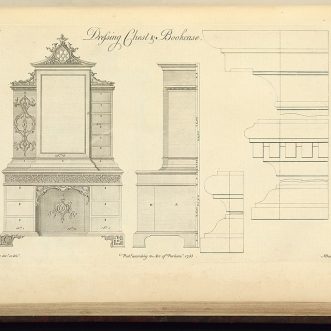
Thomas Chippendale knew what his gentleman customers in London wanted. He knew that there were similar markets in towns and cities across the country. He couldn’t serve those markets himself, but he could enable other cabinetmakers to do so – with a pattern book that could be sold to both cabinetmakers and gentlemen.
The pattern book specifies the end product – what it should look like, dimensions, some key details. Chippendale knew that of course any master cabinetmaker would know how to construct the pieces. He didn’t need to tell them that.
The result is that each piece produced from the pattern book reflects the skills of the cabinetmaker who used the pattern as inspiration, tailored to the sensibilities of their local gentlemen customer.
‘Chippendale’, but not by Chippendale. A halfway house between handcrafted and factory-made.