Discipline makes Daring possible.

Every enterprise makes a Promise

Every enterprise makes a Promise

Every enterprise, even the smallest or shortest-lived, makes a Promise.   It can be summed up simply as “what we do for the people we serve.

Unfortunately it’s rarely spelt out as clearly as it could be.  If you run your own business you know it’s there, because you have clients who love you, and recommend you to all their friends.

But I bet you find it difficult to articulate clearly.   And I bet your team find articulating it even harder.

It’s very hard to live something that you can’t articulate.   So if you’re feeling a bit frustrated by your team’s inability to deliver on your enterprise’s Promise as well you would like, here’s something you can do to help:

Get your whole team together and ask this simple question:

What’s brilliant about this business?”

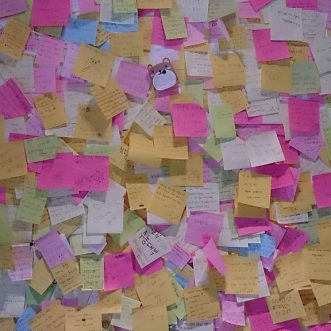
Get everyone to spend 10 minutes answering this question on a generous pile of sticky notes, then, one by one, starting with the newest or shyest, get each person to share what they’ve written and why they wrote it.

As they do this, listen out for gems.

When asked ‘what’s brilliant?‘, people often start with clichés like ‘quality’ or ‘service’.

If you encourage them to explain why they’ve written that, they often voice values, behaviours and specific examples that are far more reflective of the value you bring to clients.

Capture these on new sticky notes as you go, and share them with your own at the end of the session.

It’s an afternoon’s work, but you’ll be glad you did it, because by answering this question with your team, you’ll not only articulate your own values and preferred behaviours, you’ll also identify values and behaviours you share with at least some of your clients.    You’ll know exactly who they are.   They’ll be the clients you most enjoy working with, and who most appreciate what you do for them.

What’s more, you’ll have energised your team.  You’ll have discovered nuances of your Promise of Value that you didn’t know about before.   You’ll have started to articulate more clearly what makes your enterprise unique.

And perhaps most importantly, you’ll have reassured yourself that you’re all on the same side.

If the shoe doesn’t fit

If the shoe doesn’t fit

Cinderella’s sisters would do anything to get their feet into the glass slipper.  They cut off their toes, and when that didn’t work, they tried trimming off a bit of their heels.   All they did was create a bloody mess.  The slipper wasn’t designed for them.

In business, it’s sometimes desirable to present your ideas in a format people are more comfortable with.   That’s always something worth exploring.  If you want to change minds, it’s helpful to start with the familiar as a way to introduce something new.

Be careful though.

If you find yourself mangling the idea to make it fit, this shoe is not for you.

Find (or make) a new one.

Starting a conspiracy

Starting a conspiracy

Now that the weather is turning autumnal, I’ve decided I need to work on getting a little bit fitter.

So every other morning I get up early, walk a couple of miles to one of my local parks, and use their outdoor gym equipment.  Well actually, just the rowing machine thing, because I’m trying to get some upper body movement in.

Then I walk back again.

This morning was my second visit.   The chap who was there the first time saw me coming and said “you after that machine there?”, and when I nodded, got his towel out and carefully wiped the seat for me, to get the dew off.

That wasn’t just a kind gesture, it was a ‘welcome to the club’, a little bit of encouragement, a nudge to start a habit.   Because now I have to continue, so I don’t let him down as well as myself.

Who knew you could start a conspiracy so easily?

An opportunity

An opportunity

Yesterday brought home to me just how ageist our banks have become.

My husband helps to run a small non-profit organisation.  Just over a year ago, they were told their account wasn’t active enough and would be closed.

13 months later they are still trying to open a replacement.

Doing anything face-to-face is out of the question – the banks simply won’t countenance that.  Everything has to be done as a combination of phone calls with a bank contact and online.

First of all, the bank contacts are obviously overloaded.  It took months to speak to anyone, and months for them to get back with a decision.

But the online part is the pits.

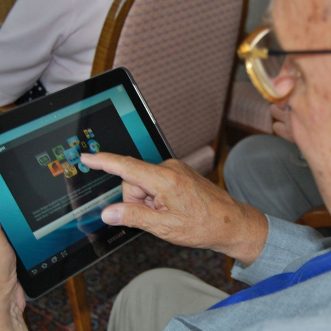
Because the non-profit does things properly, several signatories are involved.   And as with many small, local non-profits, all of them are over 60, some well over 60 – because that’s how they have the time to devote to these causes.

They don’t all have mobile phones, and if they do, they don’t carry them around all the time.  So a simple thing like 2-factor identification becomes a real difficulty.

Then, when they get things wrong, the error messages coming back are unhelpful, for example being told you have entered the wrong email address via an an email sent to that address (!!).  So they get worried about getting things wrong, and do what seems sensible.  They write things down, take things slowly.

But their fingers aren’t as fast as they used to be, so they get logged out of screens before they’ve had time to type things in.

And so they get frustrated, and have to spend more time getting together to try and sort things out.

These are intelligent, kind, generous people who are just trying to help their community.   All they are looking for is somewhere safe to keep the money people have trusted them with; somewhere that will give them an audit trail for the few transactions they need to carry out.

Tough.   Because banks have clearly decided that people don’t matter.  And what could have taken a day to set up in-branch has taken 13 months – so far.

There’s a massive opportunity here for someone prepared to offer a no-frills, human service.  Perhaps not for long, since the baby-boomer bump will be over in a decade or so, but for long enough to do decent business.

I wonder if anyone will take it.

Metaphors

Metaphors

A metaphor is a shortcut to understanding.

Faster than a speeding bullet, an idea moves fully-formed and sharp as nails, from my head to yours.

The problem is that if a metaphor doesn’t capture some deep truth, it’s actually pernicious.  Dust thrown into the eyes.   A quick and easy way to lie.

The elephant in the room is that everything that matters is far too complex to be captured in a single metaphor.  We live in systems, not storybooks.

So maybe it’s time to see our metaphors for what they are – millstones round our necks, stopping us from making progress.

Let’s abandon them, and find better ways to imagine how the world goes round.

Planning

Planning

Here’s a question for next time you feel you need to plan for a big event or outcome:

“What’s the minimum you need to do to enable your people to make it happen?”

The answer might surprise you.

It will almost certainly be less than you thought.

And leave much more room for your people to shine.

An offer

An offer

If you know someone who’s ready to start disappearing from their business, please share.

I’m running a Define Promise workshop series starting on October 5th.

It’s an 8-week course with weekly homework and live tutorials, as part of a cohort of 6 maximum.

Just time to get your Promise of Value nailed before everything shuts down for Christmas, ready to pick up with Package Promise in January.

Check it out here:

Prefer a one-to-one experience?

Let’s talk.

Thank you!

Kirsten

Re-creation

Re-creation

Back in 1960 Albert B. Lord published a book called “The Singer of Tales“.

In it he shows that in a culture without writing, epic poems and stories are not shared by memorising them word for word, line for line.   Each and every performance – even from the same speaker,  is a reconstruction, a re-creation.

A storyteller is able to do this because they work within an enabling framework, in the form of some key constraints. For example:

  • The storyline is well-known by everyone, so things have to happen in the order they are meant to happen.
  • The heroes and heroines are well-known to everyone, they are recognised by certain key characteristics, summed up in familiar phrases.  These phrases must appear, attached to the right people in the story (or perhaps mis-attached for comic effect) for it to be ‘true’.
  • A poem must follow a particular rhyme and rhythm or metre.   This severely limits the number of words it is possible to use, and therefore the number of words the reciter has to hold in memory.
  • The storyteller operates inside a culture, which has certain expectations about how the world works.  These must be reflected in the recitation if it is to be successful.

The point is that even though each recitation effectively starts from scratch and is actually different from every other, it is perceived by both the speaker and their audience as being a word-perfect, faithful repetition of the last time they heard it.    Every telling is perceived as identical to all other tellings, because against all the criteria that matter, it is.

Once we have writing, everything changes.  Writing is of course a way of putting knowledge ‘in the world’, rather than ‘in the head’.  But there are drawbacks.  Multiple versions of an epic poem get written down, but from now on they are read, not re-created.  All too often a single version becomes canonical – the one against which all others are judged.   We gain in practicality, but lose sponteneity, creativity, surprise.

It seems to me though that it is possible to have the best of both worlds:

  • The bones of a storyline are written down so everything happens in the right order;
  • Key roles are written down so they can be identified and clearly signalled;
  • Stock phrases and formulas are given to act as starters for ten until practice has enabled a person to generate their own;
  • Cultural boundaries are clearly stated – “the least that should happen is…”, “Remember this part of our Promise of Value here”.

That’s what makes a good Customer Experience Score.   Enough constraints to ensure the experience is perceived as consistent, plenty of room for a given person to make that experience personal.  Written down so everyone can learn it, practice it and improve it. On purpose.

In your head, in the world

In your head, in the world

The reason you can wander around a new town centre without getting run over is that you don’t have to remember or even really know, how a town centre works.  The information you need to navigate and interact with it successfully is built into its design.

Pavements tell you where you can walk.  Kerbs tell you where the pavement ends.  Different paving tells you which parts are pedestrianised.  Black and white stripes tell you where you can cross the parts reserved for motor vehicles. Shopfronts and market stalls tell you where you can buy things. Litter bins tell you where to put rubbish.

Much of the knowledge of what a town centre is and how to use it is ‘in the world’, which means it doesn’t have to be in your head.  Once you’ve encountered one town centre, you have a mental model – an enabling framework – that you can apply to the next, without having to remember every detail.

Knowledge ‘in the world’ enables us to use our experience to deal with the new and unexpected safely.   When our town centre introduced ‘shared space’ – space that pedestrians and motor vehicles are meant to share nicely – they helpfully made it from patterned paving so walkers didn’t mistake it for a pedestrianised area, in black and white so that cars knew to expect pedestrians.  They also added low-level signage to tell everyone this was something new.

It’s worked brilliantly.

Knowledge ‘in the world’ saves us brain space and effort.

So why do we business owners insist on trapping all the knowledge of how our business should work inside our heads?